
Why venues use external entertainment: a 2026 guide
Discover why venues use external entertainment to boost revenue, enhance guest experiences, and streamline operations in our 2026 guide.
TL;DR:
- External entertainment boosts venue revenue through longer guest stays and increased spending on music nights. It also reduces operational risks by managing licensing, contracts, and cancellations with professional providers. Audience fit is more important than cost, making consistent, tailored programming the key to success.
External entertainment is defined as any live or managed performance, act, or entertainment service brought into a venue by a third-party provider rather than employed directly by the venue. Venue managers across the UK are increasingly turning to this model because it delivers measurable gains in guest spend, dwell time, and repeat visits, while transferring the operational burden of recruitment, compliance, and contracts to specialist providers. Understanding why venues use external entertainment is no longer a peripheral question. For any venue competing on experience, it is a core business decision.
Why venues use external entertainment to drive revenue
The financial case for external entertainment is well established. Live music nights increase bar revenue by 15–25% and extend customer dwell time by 20–40 minutes compared to standard or DJ-only nights. That additional time at the bar translates directly into higher spend per head, making entertainment one of the few venue investments with a clear and measurable return.
The benefits of external entertainment extend beyond live music alone. Quiz nights, tribute acts, and themed performance evenings each attract distinct audience segments. 76% of pub-goers attend venues specifically for events such as quiz nights or live performances, with 45% citing socialising as a key motivator. Weekly or fortnightly events create predictable routines, which convert occasional visitors into regulars.
The impact of entertainment on events also shows up in midweek trading. A skilled DJ reads the room and adjusts music tempo to influence how long guests stay and how much they spend. DJs generate a 10–18% spend uplift over static playlists, making them particularly effective on quieter midweek nights when atmosphere is harder to sustain without a live presence.
Key revenue benefits of booking external performers include:
- Higher average spend per head on food and drink during entertainment events
- Longer guest dwell times, particularly during live music sets
- Increased footfall driven by event-specific marketing and social sharing
- New audience segments attracted by specialist acts such as tribute bands or comedy nights
- Repeat visits from guests who build entertainment nights into their social routines
The cumulative effect is significant. Venues that treat entertainment as a revenue tool, rather than a cost, consistently outperform those that rely on ambient music alone.
What are the operational advantages of using external entertainment providers?
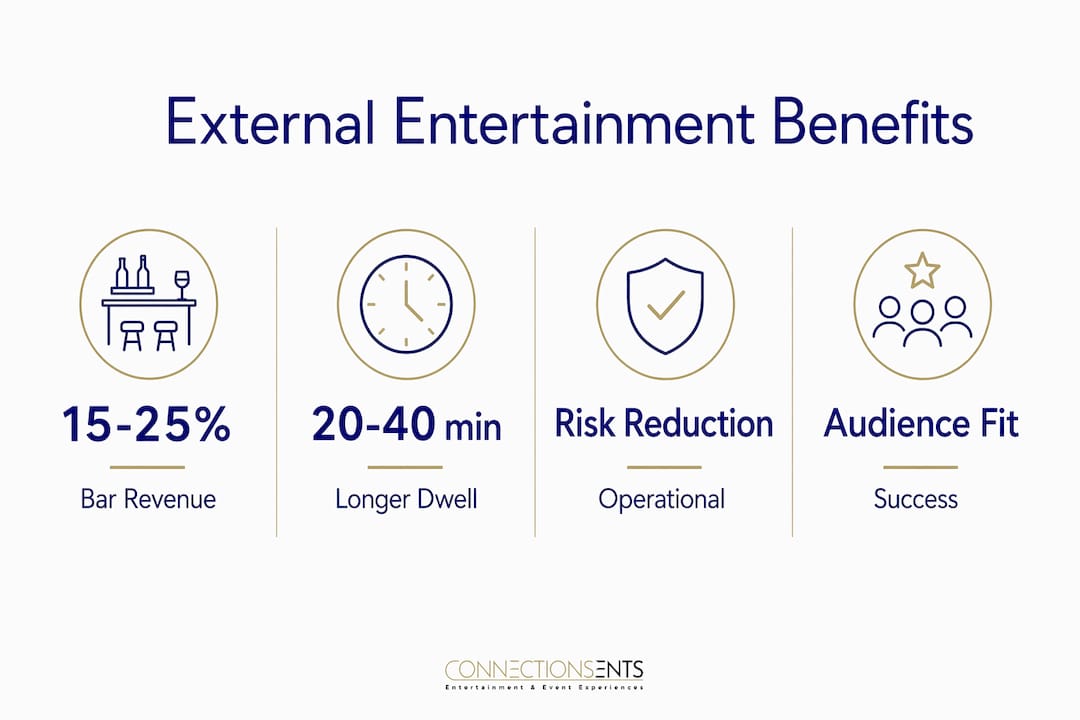
Outsourcing entertainment does more than fill a stage. It transfers a substantial layer of operational risk away from your venue. Entertainment agencies handle recruitment, vetting, contracts, payroll, and training, absorbing the administrative burden that would otherwise fall on your management team. That frees your staff to focus on service quality and guest experience rather than paperwork.

The compliance dimension is particularly important. Music licensing is a legal requirement for both live and recorded music in UK venues, and the consequences of getting it wrong are serious. Improper music licensing can lead to fines of between £500 and £5,000. Professional entertainment partners manage PPL and PRS licensing compliance as part of their service, reducing your exposure to regulatory risk.
Direct hiring creates a different set of problems. When you employ entertainers internally, your venue carries all HR and compliance responsibilities. Outsourcing entertainment reduces venue liability related to right-to-work checks, tax and pension administration, and last-minute cancellations. An agency absorbs those responsibilities, and a reputable provider will have contingency arrangements in place if a performer cancels at short notice.
The advantages of working with an external provider include:
- Vetted performers with confirmed right-to-work status and professional references
- Contracts that protect the venue in the event of cancellation or underperformance
- Health and safety assessments completed before acts arrive on site
- Licensing support that keeps your venue compliant with PPL and PRS requirements
- Ongoing training and quality assurance managed by the provider, not your team
Pro Tip: Ask any entertainment provider for written confirmation of their vetting process and cancellation policy before signing a contract. A professional agency will provide both without hesitation.
Understanding your venue’s licensing obligations before booking any external act is the single most effective way to avoid compliance problems later.
Does audience fit matter more than budget when hiring entertainers?
Audience fit is the single most important factor in entertainment success, and it consistently outranks budget as a predictor of outcome. Experts advise prioritising the right fit of entertainer to audience over the largest available budget. A well-matched emerging artist frequently outperforms a high-cost generic act when properly vetted for professionalism and crowd engagement.
The mistake most venue managers make is selecting acts based on price or prestige rather than demographic alignment. A tribute act that resonates with a 40-plus crowd will generate far more loyalty and repeat visits than a technically accomplished act that leaves the audience cold. Audience alignment drives loyalty and repeat visits more reliably than high production value or cost.
A practical approach to programming looks like this:
- Define your core audience demographic. Age range, musical preferences, and social motivations should shape every entertainment decision you make.
- Vet acts through live footage, not polished demos. Promotional videos are edited to impress. A short clip from a real gig tells you far more about how an act connects with a live crowd.
- Schedule formats to match trading patterns. Live bands work well on Friday and Saturday evenings when guests arrive expecting an event. A skilled DJ suits midweek nights where the goal is atmosphere rather than spectacle.
- Build a consistent calendar rather than reacting to quiet nights. A calendarised entertainment programme integrates with your staffing rota, kitchen output, and marketing schedule, producing better results than last-minute bookings.
- Review performance after each event. Track spend per head, footfall, and social media engagement to identify which acts and formats deliver the strongest return.
Pro Tip: Live music premieres and debut performances often generate strong social buzz before the event even takes place. Acts with an active following bring their own audience with them, which builds pre-event momentum and reduces your marketing spend.
Matching entertainment to your audience is a discipline, not a one-off decision. Venues that treat it as such build reputations that attract guests before a single poster goes up.
Practical considerations for implementing external entertainment
Getting the physical environment right is as important as booking the right act. Live music requires proper venue layout, sightlines, and sound treatment to deliver a good experience. Poor acoustics or a cramped performance area can undermine even a strong act, reducing the revenue uplift you would otherwise expect. DJs are more flexible in smaller or awkwardly shaped spaces, making them a practical choice for venues still developing their entertainment infrastructure.
Sound and lighting are the two technical factors that most directly affect guest experience. A PA system sized correctly for your room, combined with basic stage lighting, transforms the atmosphere of an entertainment night. Audio visual hire is a practical option for venues that do not want to invest in permanent equipment before testing the entertainment model.
| Consideration | What to address |
|---|---|
| Stage and performance space | Minimum clear floor area, power access, and load-in route for equipment |
| Sound system | PA output matched to room size; acoustic treatment to manage reverberation |
| Lighting | Minimum stage wash lighting; dimmable house lights for atmosphere control |
| Staff briefing | Front-of-house team trained on entertainment night procedures and crowd management |
| Cancellation protocol | Written contingency plan agreed with your entertainment provider before the first booking |
Staff preparation is often overlooked. Entertainment nights change the rhythm of service. Your team needs to know how to manage a busier, louder environment, how to handle the stage area, and what to do if an act arrives late or equipment fails. Brief your team before every entertainment event, not just the first one.
Building a reliable roster of external acts takes time. Venues that source entertainment externally save weeks in recruitment and reduce risk by working with vetted, trained professionals from the outset. Start with two or three proven formats, measure the results, and expand your programme as confidence and audience familiarity grow. The role of venue layout in supporting live acts deserves attention early in the planning process, before you commit to a booking schedule.
Key takeaways
External entertainment is the most reliable way for venues to increase guest spend, extend dwell time, and build a loyal repeat audience without taking on the full burden of entertainment management internally.
| Point | Details |
|---|---|
| Revenue impact is measurable | Live music increases bar revenue by 15–25% and extends dwell time by 20–40 minutes. |
| Compliance risk transfers to the provider | Agencies manage PPL and PRS licensing, right-to-work checks, and cancellation cover on your behalf. |
| Audience fit outranks budget | A well-matched act drives more loyalty and repeat visits than a high-cost generic performer. |
| Programming must be consistent | A calendarised entertainment schedule integrates with staffing and F&B to produce reliable results. |
| Physical environment determines success | Sound, lighting, and layout must support the act format before any booking is confirmed. |
Darren’s view: entertainment is a venue’s identity, not a line item
I have worked with enough venues to know that the ones who treat entertainment as an afterthought are the ones who struggle most with quiet nights and low repeat trade. The venues that get it right do not think of entertainment as something they add when things are slow. They build it into the identity of the place from the start.
The most common mistake I see is venues booking an act because it was cheap and available, rather than because it fits the crowd. A tribute act that the manager likes personally but that leaves the regulars unmoved is a wasted evening and a wasted budget. The act does not have to be expensive. It has to be right.
The operational side is where I see the most unnecessary stress. Venue managers who try to handle entertainment recruitment, contracts, and compliance themselves quickly discover how much time it consumes. Working with a professional provider removes that burden entirely. You get vetted acts, proper contracts, and someone else handling the cancellation call at 4pm on a Friday.
My honest view is that partnering with an entertainment company is not a luxury for larger venues. It is a practical decision that pays for itself in reduced admin, reduced risk, and better outcomes for your guests. The venues I have seen thrive are the ones that commit to a consistent programme, measure what works, and build their reputation on the quality of their entertainment nights.
— Darren
How Connections Entertainment supports venues across the UK
Connections Entertainment works with venue managers and event planners across Norfolk, East Anglia, and beyond to build entertainment programmes that fit the venue, the audience, and the budget. The service covers everything from act sourcing and vetting to contracts, compliance, and performance management, so your team can focus on delivering a great guest experience rather than managing logistics.
Whether you are looking to introduce regular live entertainment for your events, build a seasonal calendar of themed nights, or find the right act for a one-off occasion, Connections Entertainment has a catalogue of professional performers ready to book. Browse the full range of available entertainers and find acts matched to your venue type and audience.
FAQ
What is external entertainment for venues?
External entertainment refers to live or managed acts and performers sourced from a third-party provider rather than employed directly by the venue. This includes DJs, live bands, tribute acts, quiz hosts, and specialist performers.
How does external entertainment increase venue revenue?
Live music nights increase bar revenue by 15–25% and extend customer dwell time by 20–40 minutes. Longer stays and higher footfall driven by event programming translate directly into increased food and drink spend.
What compliance risks does an entertainment agency manage?
A professional entertainment agency handles PPL and PRS music licensing, right-to-work checks, contracts, and cancellation cover. This removes significant legal and administrative liability from the venue.
Should venues prioritise budget or audience fit when booking performers?
Audience fit produces better outcomes than budget size. A well-matched act drives loyalty and repeat visits more reliably than a high-cost performer who does not connect with the venue’s core demographic.
How often should a venue programme external entertainment?
Consistent, calendarised programming produces the best results. Weekly or fortnightly events build guest routines, improve off-peak trading, and integrate more effectively with staffing and food service operations than one-off bookings.