
Why hire a wedding entertainment coordinator
Discover why hire a wedding entertainment coordinator to ensure flawless timing and seamless transitions for your big day. Make your wedding unforgettable!
TL;DR:
- A wedding entertainment coordinator manages the timing, pacing, and logistics of all entertainment elements to create a seamless wedding experience. They serve as the single contact for vendors, handle delays with buffers, and ensure the event flows smoothly from start to finish. Hiring one enhances guest enjoyment, reduces couples’ stress, and preserves memorable moments by expertly coordinating every performance and transition.
A wedding entertainment coordinator is the professional who manages the timing, pacing, and logistics of your entertainment to create a flawless wedding day experience. This role sits at the heart of your event, acting as the single point of contact between you, your DJ, live performers, photographers, and caterers. Without this person in place, couples routinely find themselves fielding vendor questions during their first dance or chasing a missing microphone minutes before speeches. Understanding why hire a wedding entertainment coordinator matters is the first step to protecting your day from the kind of disruptions that are invisible when things go right and impossible to ignore when they go wrong.
Why hire a wedding entertainment coordinator for event timing
Timing is the invisible architecture of every great wedding. When it works, guests move from ceremony to drinks reception to dinner to dancing without a single awkward pause. When it fails, the energy drains fast and the couple spends their evening apologising rather than celebrating.
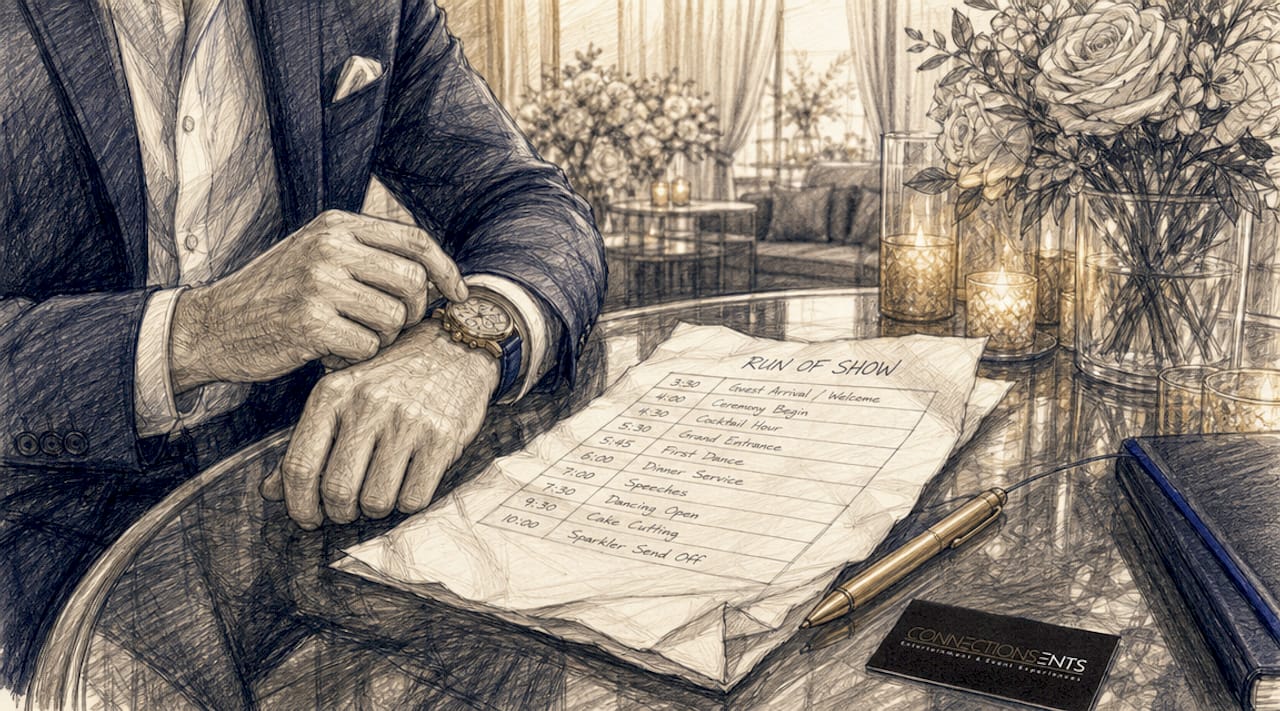
A wedding entertainment coordinator builds and manages a detailed run-of-show document covering every segment of your day. This includes ceremony start times, cocktail hour entertainment, dinner service, speeches, first dance, and the evening disco. Run-of-show plans with buffers and assigned cue responsibilities allow coordinators to absorb delays without any visible disruption to guests or the couple. That means if the caterers run ten minutes behind, the coordinator quietly extends the drinks reception entertainment rather than letting guests stand around wondering what happens next.
Coordinators also manage vendor communication on the day itself. Clear directional contact rules assign all vendor queries to the coordinator rather than the couple, preventing the cascade of small interruptions that collectively ruin a wedding day. Your DJ, your photographer, your florist: they all have one number to call, and it is not yours.
The practical benefits of this structure are significant:
- The ceremony starts on time because the coordinator has confirmed cues with the DJ and officiant in advance.
- Speeches run in the correct order because the coordinator has briefed each speaker on timing and sequence.
- The first dance happens at the right moment because the coordinator has signalled the DJ and cleared the floor.
- Guests are never left waiting because the coordinator has built buffer time into every transition.
- Unexpected delays are absorbed quietly because the coordinator has contingency plans for the most common disruptions.
Pro Tip: Ask your coordinator to share the run-of-show document with every vendor at least two weeks before the wedding. This single step eliminates the majority of day-of timing conflicts before they can start.
Most experienced coordinators begin support several weeks before the wedding, finalising timelines and confirming vendor details. Day-of coordination checklists are best started four to six weeks out to avoid version drift between what you expect and what vendors have planned.
Wedding entertainment coordinator vs other wedding professionals
One of the most common sources of confusion for couples is understanding exactly who does what. You may already have a venue coordinator and a wedding planner. So why would you also need a wedding entertainment coordinator? The answer lies in scope.
A venue coordinator is employed by the venue, not by you. Their responsibility is the venue’s operations: catering staff, room layout, licensing, and building logistics. They will not manage your DJ’s playlist or cue your first dance. A full wedding planner handles the entire planning process from venue selection to florals to budgeting, often over twelve months or more. A day-of coordinator focuses on logistics and execution across the whole event. A wedding entertainment coordinator specialises specifically in entertainment pacing, guest experience, and the timing of all performance elements throughout your reception.
Venue coordinators handle catering and venue operations while entertainment coordinators focus on event pacing and guest experience. These are genuinely different jobs, and assuming one covers the other is one of the most expensive assumptions couples make.
The table below summarises the key differences:
| Role | Primary focus | Employed by | Entertainment management |
|---|---|---|---|
| Venue coordinator | Venue operations and catering | The venue | No |
| Full wedding planner | End-to-end planning and design | The couple | Partially |
| Day-of coordinator | Logistics and execution on the day | The couple | Partially |
| Wedding entertainment coordinator | Entertainment pacing and guest experience | The couple | Yes, fully |
On the wedding day itself, these professionals collaborate rather than compete. A well-briefed entertainment coordinator works alongside the venue coordinator and any day-of coordinator to keep every element synchronised. The key point is that none of the other roles carry the specific responsibility of managing your entertainment flow from start to finish. That gap is precisely what an entertainment coordinator fills.
What are the practical benefits of hiring an entertainment coordinator?
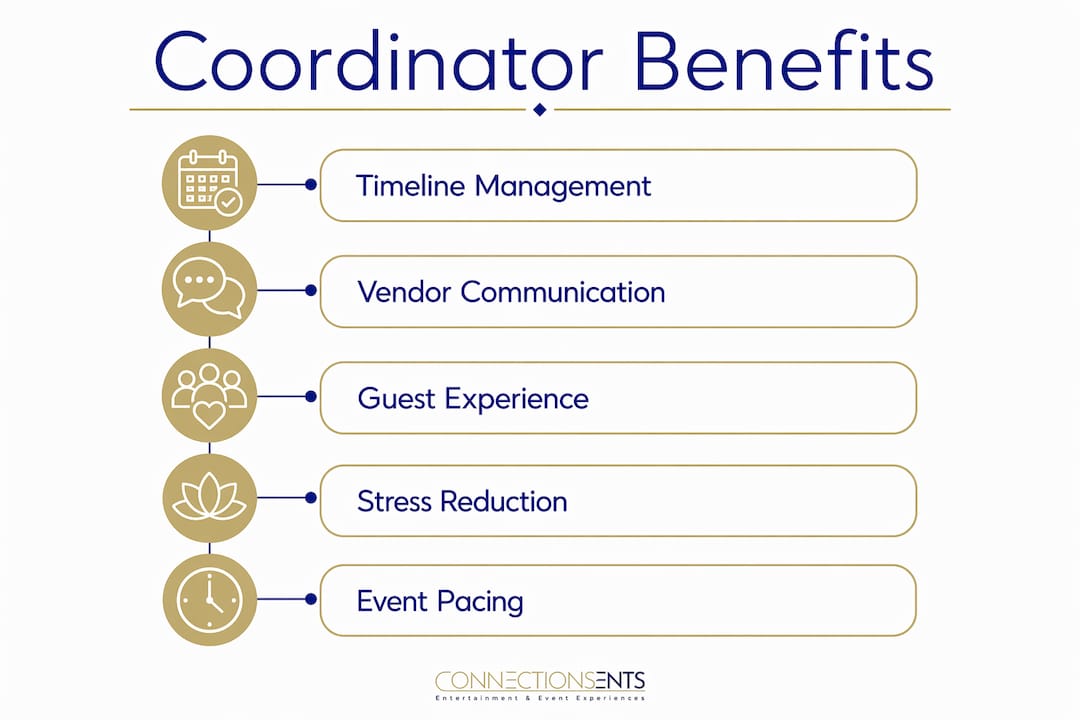
The advantages of hiring a wedding entertainment coordinator extend well beyond having someone to manage the DJ. The benefits split into two categories: what you gain as a couple, and what your guests experience as a result.
For couples, the most significant benefit is removal from the problem-solving role. A coordinator absorbs logistic responsibilities to protect you from becoming the default decision-maker on your own wedding day. Without this protection, couples spend their evening being approached by vendors, family members, and venue staff with questions that should never reach them. With it, you are free to be present for every moment that actually matters.
For guests, the benefit is a reception that feels effortless. Complex weddings with multiple vendors and tight schedules require careful timing to avoid guest wait times and rushed moments. When that timing is managed professionally, guests move through the evening without friction, which directly shapes how they remember your day.
Here are the most tangible advantages couples report after working with an entertainment coordinator:
- Stress reduction on the day. You make no operational decisions after the ceremony begins. Every question goes to the coordinator.
- Professional vendor management. Your DJ, live band, photo booth operator, and any interactive entertainers receive clear briefings and cues without involving you.
- Consistent energy throughout the evening. The coordinator monitors guest engagement and adjusts the programme in real time to maintain momentum.
- Smooth handling of surprises. Late arrivals, technical issues, and overrunning speeches are managed without the couple being aware.
- Stronger memories. When you are not managing logistics, you are fully present. Couples consistently report that this is the most underestimated benefit of professional coordination.
- Better guest experience. Guests notice when an event flows well, even if they cannot articulate why. A coordinator is the reason it does.
The emotional relief this creates is genuine and significant. Many couples describe the experience of having a coordinator as the single best investment they made in their wedding day. You can read more about the advantages for couples and guests when entertainment logistics are managed professionally.
How do entertainment coordinators improve guest experience?
Guest experience at a wedding is shaped by energy, pacing, and participation. An entertainment coordinator manages all three, often in ways that guests never consciously notice but always feel.
The coordinator works directly with your DJ or MC to pace music and announcements according to the mood in the room. Wedding DJs acting as MCs guide guests through events and keep energy consistent, but they need clear cues and a trusted point of contact to do this effectively. The coordinator provides exactly that, signalling when to shift from background dinner music to high-energy floor-fillers, or when to hold back to let a quiet moment breathe.
Interactive entertainment adds another dimension to this. Magicians and caricaturists engage guests naturally during transitions, encouraging conversation and shared laughter that add energy to the day without interrupting the formal programme. Managing these performers requires precise timing: a magician working the drinks reception needs to finish before guests are called to dinner, and a caricaturist needs space and light that the coordinator arranges in advance. You can explore a range of wedding live performer options to understand how different acts fit into a coordinated programme.
Guest experience is paramount and interactive entertainment creates shared joy and lasting memories that go well beyond passive background music. A coordinator who understands this distinction will actively shape the atmosphere rather than simply reacting to it.
The specific skills that distinguish a strong entertainment coordinator in this area include:
- Reading the room and adjusting the programme based on guest energy rather than sticking rigidly to a schedule.
- Communicating clearly with performers and technical crew using pre-agreed cue systems.
- Managing announcements so they feel natural and well-timed rather than disruptive.
- Anticipating transitions and preparing guests for them without creating awkward pauses.
- Knowing when to introduce interactive entertainment and when to let the dance floor speak for itself.
Pro Tip: When interviewing potential coordinators, ask them to describe a time they had to improvise on the day. Their answer will tell you more about their real capability than any portfolio or testimonial.
Key takeaways
A wedding entertainment coordinator is the single most effective way to protect your event’s energy, timing, and guest experience from the disruptions that derail even well-planned receptions.
| Point | Details |
|---|---|
| Timing is managed professionally | Coordinators build run-of-show documents with buffers, preventing delays from reaching the couple or guests. |
| Distinct from other wedding roles | Venue coordinators and planners do not fully cover entertainment pacing; this role fills a specific gap. |
| Couples are removed from problem-solving | All vendor queries go to the coordinator, freeing you to be present throughout your day. |
| Guest experience improves measurably | Smooth transitions and well-timed interactive entertainment create a reception guests remember positively. |
| Strong communication skills are non-negotiable | The best coordinators read the room and improvise confidently when plans shift. |
What I have learned from watching weddings with and without a coordinator
I have seen a lot of weddings from the inside, and the difference between a reception with a dedicated entertainment coordinator and one without is not subtle. It is the difference between a couple who spend their evening dancing and laughing with their guests, and a couple who spend it fielding questions from the caterer, chasing the best man for his speech notes, and apologising to the DJ for the late start.
The couples who skip this role almost always do so for one of two reasons. Either they assume the venue coordinator will cover it, or they feel it is an unnecessary expense. Both assumptions cost them more than the coordinator would have. The venue coordinator is managing the kitchen, the bar staff, and the room turnaround. They are not watching the dance floor to see whether the energy is dropping or briefing the magician on when to move from table to table.
What I find most striking is how often couples only realise the value of this role in hindsight. They describe their wedding as wonderful but admit they spent more of it managing logistics than they expected. The memories they most regret are the ones they missed because they were distracted. A good coordinator does not just manage your entertainment. They give you your wedding day back.
My advice when selecting an entertainment coordinator is straightforward. Look for someone who asks detailed questions about your guests, your preferences, and your priorities rather than someone who simply presents a standard package. The right person will want to understand your day before they start planning it. Ask them directly how they handle timing conflicts between vendors, and listen for specificity rather than reassurance. Experience matters, but so does the ability to think on their feet.
— Darren
Plan your wedding entertainment with Connections Entertainment
Connections Entertainment provides professional entertainment coordination and event management services across Norfolk and East Anglia, with experience across a wide range of wedding styles and venue types. The team manages everything from DJ hire and disco packages to live performers, photo booths, and interactive entertainment, all coordinated to keep your event flowing from start to finish. Whether you are planning an intimate ceremony or a large evening reception, the Connections Entertainment team works with you and your vendors to build a programme that reflects your day and runs without a hitch. Explore the full range of professional entertainers available for weddings, or get in touch to discuss your requirements directly.
FAQ
What does a wedding entertainment coordinator actually do?
A wedding entertainment coordinator manages the timing, pacing, and logistics of all entertainment elements at your reception, including DJ cues, live performer scheduling, announcements, and transitions between segments. They act as the single point of contact for all entertainment vendors on the day, keeping the couple free from operational decisions.
Is a wedding entertainment coordinator the same as a day-of coordinator?
No. A day-of coordinator manages overall event logistics across the whole wedding day, while a wedding entertainment coordinator specialises specifically in entertainment pacing and guest experience. On larger weddings, both roles may work alongside each other.
When should a wedding entertainment coordinator start planning?
Most coordinators begin detailed planning four to six weeks before the wedding, finalising timelines, confirming vendor details, and distributing the run-of-show document. This lead time prevents version drift between what the couple expects and what vendors have planned.
Do I still need a coordinator if my venue has its own events team?
Yes. Venue coordinators are responsible for catering, staffing, and venue operations, not entertainment pacing or guest experience management. The two roles cover different ground and work best when both are in place.
How do I choose the right entertainment coordinator for my wedding?
Ask candidates how they handle timing conflicts between vendors, how they read and respond to guest energy, and whether they have experience with the specific entertainment types you are planning. Coordinators who ask detailed questions about your guests and priorities are more likely to deliver a programme that genuinely fits your day.