
What is a wedding disco? Your complete guide
Discover what a wedding disco is and how it energizes your celebration! Learn about different setups, from DJs to live bands, for a perfect night.
TL;DR:
- A wedding disco is the lively entertainment centerpiece of a reception, designed to get guests dancing and create a festive atmosphere. There are three main types: traditional DJ discos, silent discos with wireless headphones, and live disco bands, each suited to different venue needs and budgets. Proper playlist structuring, early communication with the DJ, and thoughtful décor enhance the experience, making the celebration effortless and memorable.
A wedding disco is a dedicated music and dance entertainment format designed specifically for wedding receptions, where a professional DJ or curated playlist drives a lively party atmosphere for guests. The term covers everything from a traditional DJ setup spinning classic Motown and modern chart hits to a silent disco with wireless headphones, and even live disco bands that blend instruments with electronic beats. Unlike generic background music, a wedding disco is built around the dance floor. Its purpose is to get guests moving, keep energy high, and give the celebration a genuine party feel that carries the night through to the final song.
What is a wedding disco and how does it work?
A wedding disco is the music and entertainment centrepiece of your reception evening, typically running for three to five hours after the wedding breakfast. The industry term most professionals use is “wedding DJ disco,” though couples often simply call it the evening reception or the disco. At its core, it combines professional DJ services with sound equipment, lighting, and a curated music programme to create a shared dance party experience.
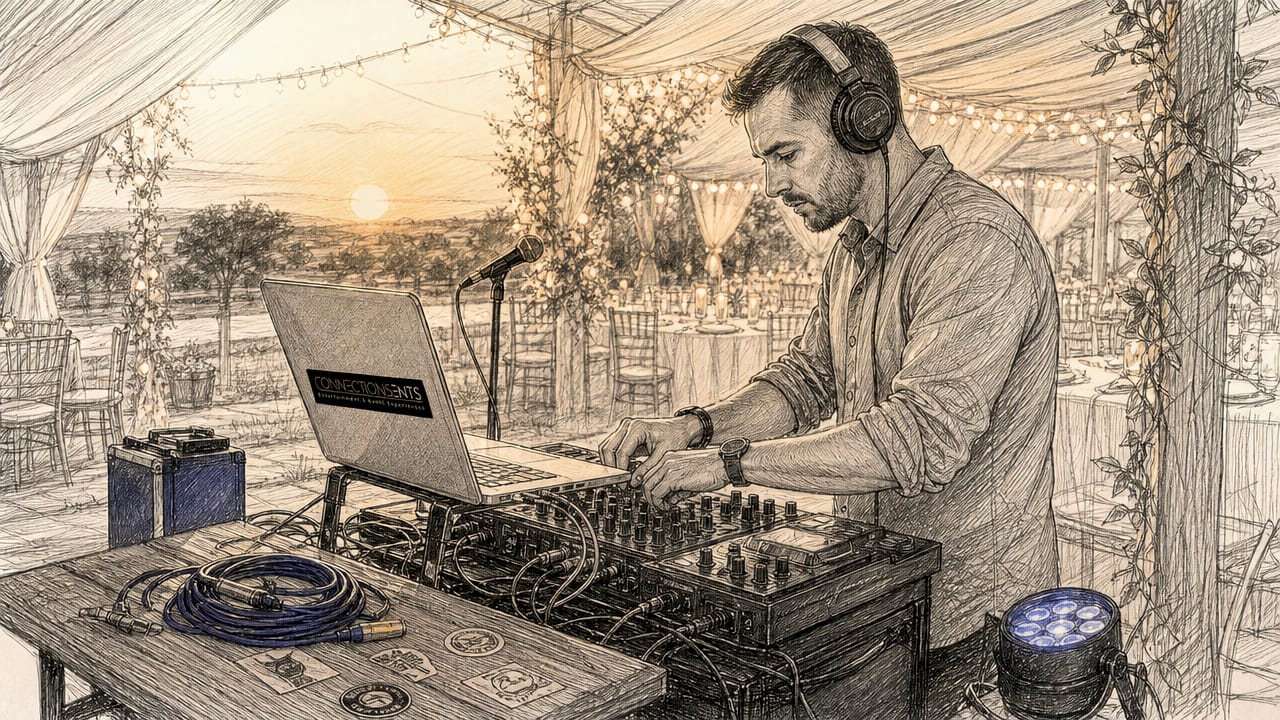
The DJ is the engine of the whole event. A skilled professional does far more than press play. They read the crowd, adjust tempo and genre in real time, manage microphone announcements, and time key moments such as the first dance and the cake cutting around the music flow. The result is a reception that feels spontaneous but is actually carefully orchestrated.
Wedding reception music at a disco typically spans several genres. Expect 1970s and 1980s disco classics from artists like Donna Summer and Chic, alongside Motown anthems, pop chart hits, and late-night floor-fillers. The exact mix depends entirely on your preferences and the DJ’s ability to read the room as the evening progresses.
What types of wedding disco are available?
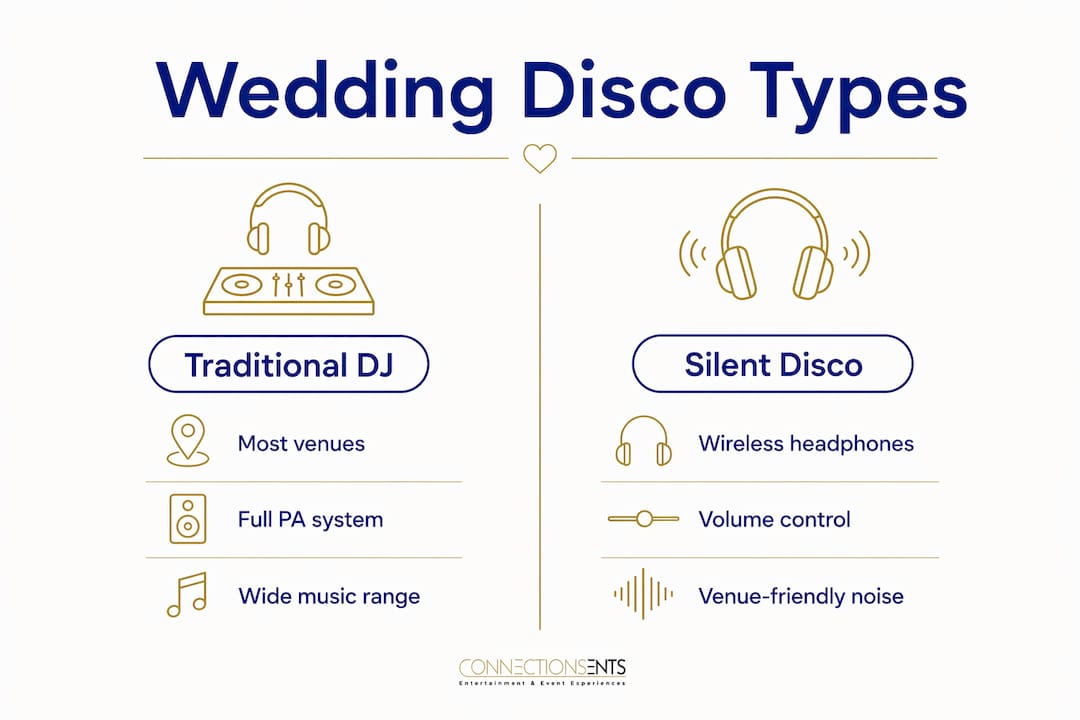
Wedding discos are not a single format. Three main types exist, each with distinct features, technical requirements, and atmospheres. Understanding the differences helps you choose the right option for your venue and guest list.
Traditional DJ disco
The traditional wedding DJ disco is the most common format in the UK. A professional DJ arrives with a full PA system, lighting rig, and a library of music spanning decades and genres. They set up before guests arrive, manage all announcements, and mix music live throughout the evening. This format suits most venues and guest sizes, and it gives you the most flexibility to request songs and adjust the programme on the night.
Silent disco
A silent disco is an event where guests wear wireless headphones listening to the same DJ or multiple simultaneous playlists. This format is ideal for venues with strict noise curfews, outdoor spaces, or listed buildings where sound levels are regulated. Guests can typically choose between two or three channels, each playing a different music style, so a guest who prefers 1980s pop can switch away from the current dance track without disrupting anyone else.
Silent discos give guests individual volume control, which also offers genuine accessibility benefits for neurodivergent guests or those with sensory sensitivities. The visual spectacle of a room full of people dancing in near-silence is also a memorable talking point.
Disco wedding bands
Some couples opt for a live disco band that performs classic disco and funk tracks with real instruments, sometimes supported by a DJ for the gaps between sets. This hybrid approach adds theatrical energy that a DJ alone cannot replicate. The trade-off is cost and logistics. Live bands require more space, longer setup times, and higher fees than a DJ-only setup.
Comparison of wedding disco types
| Type | Best for | Key advantage | Main consideration |
|---|---|---|---|
| Traditional DJ disco | Most venues and budgets | Flexible, wide music range | Dependent on DJ quality |
| Silent disco | Noise-restricted venues | Individual volume control, accessibility | Headphone logistics and cost |
| Disco wedding band | Couples wanting live performance | High-energy, theatrical atmosphere | Higher cost and space needed |
How to plan a wedding disco playlist that works
Playlist planning is where most couples either get it right or leave the dance floor half-empty by 10pm. The most effective approach structures your music around what professionals call “anchor buckets.” These are groups of five to six songs that define the mood at specific points in the evening, rather than one long random shuffle.
Here is a practical sequence for building your wedding disco playlist:
- Opening set (first 30 minutes). Start with recognisable, feel-good tracks that ease guests onto the floor. Think crowd-pleasing anthems rather than niche favourites. Songs like “September” by Earth, Wind and Fire or “Dancing Queen” by ABBA work because almost everyone knows them.
- First dance anchor. Your chosen first dance song sits here. Everything before it builds anticipation; everything after it signals that the party has officially started.
- Mid-evening build. This is where DJs plan around peak moments such as after the cake cutting to build energy progressively. The tempo rises, the genre shifts toward more energetic dance tracks, and the lighting intensifies.
- Peak hour (9pm to 10pm typically). Your highest-energy tracks belong here. This is when the dance floor should be at its fullest. Reserve your most-requested songs for this window rather than playing them early.
- Late-night wind-down. Slower tracks and nostalgic anthems bring the evening to a natural close without killing the mood abruptly.
Structuring playlists with anchor groups and guardrails maintains momentum far better than an unstructured list. Couples who hand a DJ 200 random songs without sequencing guidance often find the floor empties mid-evening because the energy never builds coherently.
Two lists every couple should give their DJ are the “do not play” list and the “do not play yet” list. The first removes songs that will clear the floor or cause family tension. The second holds back your biggest crowd-pleasers for the peak hour rather than burning them early.
Pro Tip: Give your DJ autonomy between your specified anchor songs. Allowing DJs flexibility to sequence music between your key moments produces a more responsive dance floor than a rigidly pre-set playlist.
A pre-set Spotify playlist cannot replace a live DJ for one critical reason: it cannot read the room. If guests are flagging at 8:30pm, a DJ drops a known floor-filler to pull them back. A playlist simply plays the next track regardless of what is happening in front of it.
Disco-themed décor ideas that set the atmosphere
Disco themes for weddings have moved well beyond the novelty category. When executed thoughtfully, disco-inspired décor creates a visual energy that amplifies the music and signals to guests that the evening is a genuine celebration rather than a formal sit-down affair.
The disco ball is the defining element. Disco ball decorations vary from large hanging installations above the dance floor to smaller table accents and photo booth backdrops. A single large mirror ball suspended over the dance floor, paired with a spotlight, scatters light across the entire room and immediately transforms the atmosphere.
Key décor elements to consider:
- Overhead mirror balls. A 30cm to 50cm mirror ball above the dance floor is the single most impactful visual addition to any wedding disco setup.
- Lighting effects. Disco balls paired with spotlights or laser beams create dynamic reflections and amplify the party energy. Most professional DJ packages include a basic lighting rig, but upgrading to include moving heads or laser effects makes a visible difference.
- Table accents. Small disco ball centrepieces or mirrored votives bring the theme to the dining tables without overwhelming the floral arrangements.
- Photo booth backdrops. A sequinned or mirrored backdrop doubles as a disco décor feature and a practical photo opportunity for guests.
- Invitation details. Incorporating disco ball motifs or metallic foiling into your stationery sets the tone before guests even arrive at the venue.
The balance between full-on disco theme and subtle glitz depends on your overall wedding aesthetic. A couple with a minimalist, neutral colour palette might choose a single statement mirror ball and warm amber uplighting. A couple embracing the full 1970s aesthetic might add sequinned table runners, gold balloon arches, and coloured spotlights. Both approaches work. The key is consistency between the décor, the music, and the overall visual identity of the day.
Practical tips for hosting a successful wedding disco
Getting the logistics right is as important as choosing the right songs. Even the best DJ and the most beautiful décor will fall flat if the sound equipment is underpowered for the room or the headphone distribution at a silent disco is chaotic.
Sound equipment and venue restrictions are the first things to address. Speak to your venue coordinator about their noise curfew, decibel limits, and any restrictions on external speakers before you book any entertainment. Many UK venues, particularly older buildings and licensed premises, have strict sound limits that affect what equipment a DJ can bring. Share these details with your entertainment provider at the point of booking, not the week before the wedding.
For silent discos, success depends on sufficient headphone channels, clear guest briefing, and vendor support for headphone distribution. Plan for a dedicated member of staff or a vendor representative to manage the headphone station throughout the evening. Guests who cannot figure out how to switch channels or adjust volume will disengage quickly.
Additional practical considerations:
- Collaborate early with your DJ. Share your anchor songs, your do-not-play list, and your timeline at least four weeks before the wedding. Last-minute briefings produce last-minute results.
- Plan the room layout. The dance floor should be visible from the bar and the seating area. Guests who can see others dancing are far more likely to join in.
- Manage volume for all guests. Not everyone wants to be next to the speakers all evening. A well-positioned sound system with balanced coverage across the room keeps guests comfortable and reduces complaints.
- Integrate other reception activities. Photo booths, sweet carts, and late-night food stations work best when positioned near but not on the dance floor, so they complement rather than compete with the music.
- Consider inclusivity. For guests with sensory sensitivities, designate a quieter area away from the main speakers. If you are hosting a silent disco, highlight the individual volume control feature in your guest communications.
Pro Tip: Ask your DJ or entertainment provider for a full event timeline at least two weeks before the wedding. Reviewing it together allows you to spot timing conflicts before they become problems on the day.
Key takeaways
A wedding disco succeeds when you combine the right format for your venue, a structured playlist with clear anchor points, and practical logistics planning well in advance of the day.
| Point | Details |
|---|---|
| Choose the right format | Match your disco type to your venue’s noise restrictions and your guests’ preferences. |
| Structure your playlist | Use anchor buckets and a do-not-play list rather than one long unsequenced shuffle. |
| Plan décor to complement music | A mirror ball and quality lighting transform the visual atmosphere as much as the music itself. |
| Brief your DJ early | Share your timeline, key songs, and venue restrictions at least four weeks before the wedding. |
| Prioritise logistics | Sound equipment, headphone management for silent discos, and room layout all affect the guest experience directly. |
Why the best wedding discos are never just about the music
I have seen hundreds of wedding receptions over the years, and the ones guests talk about for months afterwards share one quality: they felt effortless. The couple had clearly thought about the experience from the guest’s perspective, not just their own playlist preferences.
The most common mistake I see is couples over-specifying the music. They hand the DJ a 150-song list with strict instructions and then wonder why the floor empties at 9pm. A great DJ is a live performer, not a jukebox. When you give them the framework and then trust their professional judgement between your key moments, the result is almost always better than a rigidly controlled playlist.
The second thing I would encourage every couple to think about is the transition from the wedding breakfast to the disco. This is the moment the evening either takes off or stalls. A DJ who understands pacing will use the first 30 minutes to warm the room gradually rather than opening with the highest-energy track in the set. Guests need time to move from their seats, get a drink, and find their feet on the floor.
Disco themes for weddings are also more versatile than couples often assume. You do not need to commit to a full 1970s costume party to enjoy the visual impact of mirror balls and warm lighting. Some of the most elegant wedding discos I have seen used a single large mirror ball, amber uplighting, and a playlist that moved from Motown through to contemporary pop. The theme was present without being overwhelming. That balance is worth pursuing.
Finally, do not underestimate the value of a well-planned entertainment programme that integrates the disco with other evening elements. When the photo booth, the late-night food, and the dance floor are all working together rather than competing for attention, the whole evening flows naturally and guests stay longer.
— Darren
How Connections Entertainment can help with your wedding disco
Connections Entertainment specialises in providing professional DJ discos, silent disco packages, and live entertainment for weddings across Norfolk and East Anglia. Whether you are planning a traditional evening reception with a full lighting rig or a silent disco to work around a venue noise curfew, the team can match you with the right entertainment format for your day. Every booking includes a detailed planning consultation to cover your music preferences, venue requirements, and event timeline. To explore the full range of wedding entertainment options available, including DJs, disco bands, and event extras, visit the Connections Entertainment website and browse the services or make an enquiry directly online.
FAQ
What does a wedding disco typically include?
A wedding disco typically includes a professional DJ, a PA sound system, and a lighting rig covering the dance floor. Many packages also include a microphone for announcements and a consultation to plan the music programme in advance.
How long does a wedding disco last?
Most wedding discos run for three to five hours, usually beginning after the wedding breakfast and ending at the venue’s licensed curfew. The exact duration depends on your venue licence and the entertainment package you book.
What is the difference between a wedding DJ and a disco?
A wedding DJ is the professional who manages the music; the disco refers to the full entertainment setup including sound equipment, lighting, and the music programme. In practice, most couples book a DJ disco package that covers both.
Is a silent disco suitable for all wedding venues?
A silent disco is particularly effective where venues enforce noise restrictions but couples still want a vibrant dance experience. It works well in outdoor settings, listed buildings, and venues with early curfews, provided the headphone logistics are managed properly.
How many songs should you give your wedding DJ?
Give your DJ a shortlist of 20 to 30 priority songs across different points in the evening, plus a do-not-play list. Providing too many songs with no sequencing guidance reduces the DJ’s ability to read the room and maintain dance floor energy.