
What is a wedding band? Your complete guide
Discover what a wedding band is and how it plays a key role in your celebration. Explore types, styles, and booking tips for your big day!
TL;DR:
- A wedding band can refer to either a live musical group or the symbolic ring exchanged during your wedding ceremony. Booking a professional live band well in advance ensures availability, with costs ranging from £1,500 to over £4,000 depending on size and style. Live bands enhance the wedding experience by providing dynamic, responsive entertainment that creates lasting memories beyond just playing music.
A wedding band is either a live group of professional musicians hired to perform at your reception, or the symbolic ring exchanged during your ceremony. Both meanings matter when you are planning a wedding, and confusing the two can lead to some very different conversations with suppliers. This guide covers what a wedding band means in both contexts, explores the types and styles available, and gives you practical advice on booking live music entertainment for your big day. Whether you are searching for the right ring at H.Samuel or looking to hire a soul band for your evening reception, you will find clear answers here.
What is a wedding band in live music terms?
A wedding band, in the entertainment sense, is a group of professional musicians who perform live music at wedding ceremonies, drinks receptions, and evening receptions. The industry term for this type of act is a function band, a label that distinguishes these groups from touring acts or original-music artists. Function bands specialise in performing at weddings and similar private events, focusing on polished, crowd-pleasing popular music rather than original compositions. This distinction matters because a function band’s entire skill set is built around reading a room and keeping guests engaged, not showcasing original material.
Most wedding bands consist of between three and eight musicians, depending on your budget and venue size. A typical four-piece line-up includes a lead vocalist, guitarist, bassist, and drummer. Larger ensembles add keyboards, brass sections, or backing vocalists to create a fuller, more theatrical sound. The size of the band directly affects both the cost and the sonic impact on your reception.
How wedding bands differ from DJs and solo performers
A DJ plays prerecorded music and can offer an enormous catalogue of tracks, but a live band brings spontaneity, visual energy, and a performance that guests can watch as well as dance to. Solo performers, such as acoustic guitarists or pianists, suit ceremonies and drinks receptions but rarely have the power to fill a dancefloor for three hours. A wedding band occupies the middle ground: it delivers the energy of a live performance with the crowd-pleasing familiarity of well-known covers.
The choice between a band and a DJ often comes down to atmosphere and budget. Live music creates a sense of occasion that prerecorded tracks simply cannot replicate. If your priority is a packed dancefloor and a reception your guests will talk about for years, a live band is the stronger choice. You can read more about the impact of live performers on your wedding day to help you decide.
Pro Tip: Many couples book both a band and a DJ. The band performs two or three sets during the evening reception, and the DJ fills the gaps and plays until midnight. This combination gives you live energy and a broader music catalogue.
- Wedding band (function band): Live musicians performing covers at private events
- DJ: Prerecorded music with mixing and crowd interaction
- Solo performer: Single musician suited to background or ceremony music
- Tribute act: Musicians replicating a specific artist, such as an Abba or Elvis tribute
Types of wedding bands and wedding band styles
The phrase “types of wedding bands” applies equally to live music acts and to jewellery, so it is worth understanding both before you start making decisions.
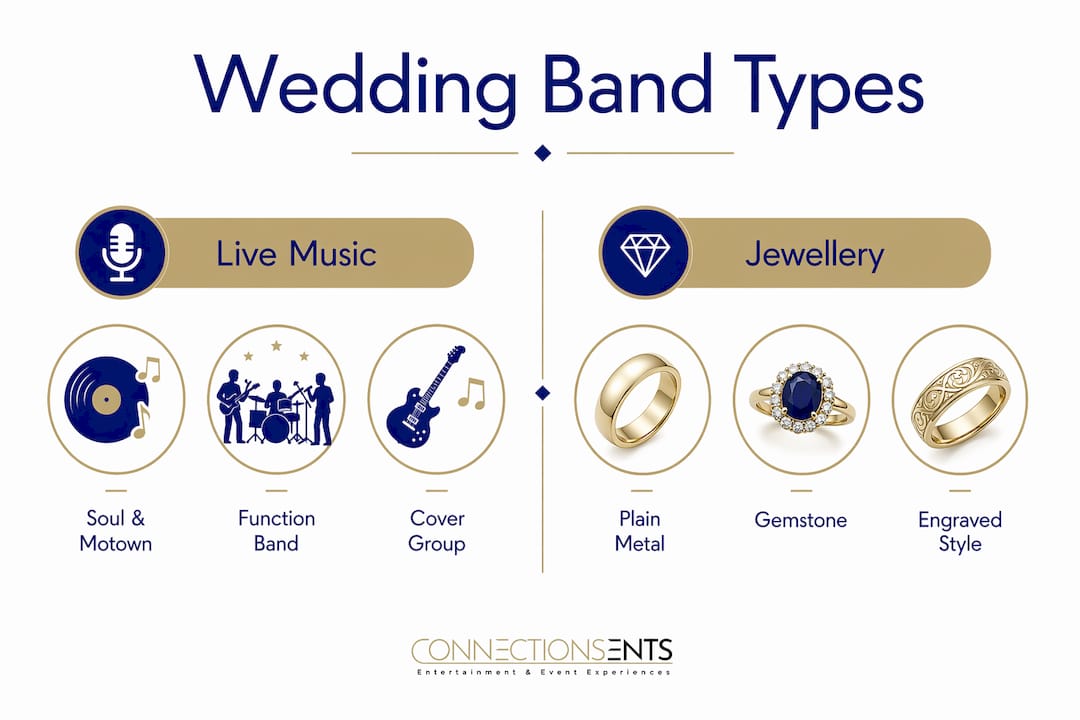
Live wedding band genres and line-ups
Wedding bands cover a wide spectrum of musical styles. The most popular options in the UK include:
- Soul and Motown bands: Classics from artists like Aretha Franklin, Stevie Wonder, and Marvin Gaye. These bands are perennially popular because the songs are universally known and work for all age groups.
- Pop and chart covers bands: Current hits and recent chart music, appealing to younger guests and couples who want a contemporary feel.
- Rock and indie bands: Covers of artists like Oasis, The Killers, and Arctic Monkeys. These work well for couples with a rock-leaning taste and a younger guest list.
- Jazz and swing bands: Suited to drinks receptions, outdoor ceremonies, or weddings with a vintage or Great Gatsby theme.
- Disco and funk bands: Focused on the 1970s and 1980s, with artists like Earth, Wind and Fire and Chic providing the backbone of the setlist.
- Acoustic duos or trios: Smaller, more intimate acts suited to ceremonies or smaller venues.
Setlists typically span soul, Motown, disco, and chart hits across several decades, which is precisely why function bands cater so effectively to mixed-age guest lists. A 65-year-old uncle and a 25-year-old cousin can both find something to dance to when the band moves from a Motown classic into a recognisable pop anthem.
Wedding band styles as jewellery
In the jewellery context, a wedding band is traditionally a plain metal circle symbolising eternal marriage, designed for comfortable daily wear. Modern options have expanded considerably beyond the plain gold band. Current styles include diamond-set bands, eternity rings with stones running the full circumference, shaped bands designed to sit flush against an engagement ring, and fully bespoke designs crafted to a couple’s specification.
The table below summarises the key differences between live band types and jewellery styles to help you see both meanings side by side.
| Category | Type | Key characteristic |
|---|---|---|
| Live music | Soul and Motown band | Timeless covers, suits all ages |
| Live music | Pop covers band | Current chart hits, contemporary feel |
| Live music | Jazz and swing band | Elegant, suited to ceremonies and drinks receptions |
| Live music | Rock and indie band | High energy, younger guest appeal |
| Jewellery | Plain metal band | Classic, understated, comfortable for daily wear |
| Jewellery | Diamond-set band | Adds sparkle, often paired with engagement ring |
| Jewellery | Eternity band | Stones around the full circumference, symbolic of endless love |
| Jewellery | Bespoke design | Crafted to personal specification, unique to the couple |
Style choices in both categories reflect your personal taste and your wedding theme. A couple planning a relaxed barn wedding in Norfolk might choose an acoustic folk trio and a simple rose gold band, while a couple hosting a formal London reception might opt for a twelve-piece soul orchestra and a diamond-set platinum ring.
How live wedding bands enhance the wedding day experience
Live bands perform a significant role beyond simply providing music for dancing. They set the mood and tone throughout the entire event, from the moment guests arrive to the final song of the night. A skilled band reads the energy in the room and adjusts its performance accordingly, something a playlist or DJ cannot do with the same instinctive precision.
Consider how a wedding day unfolds in musical phases. During the drinks reception, a jazz trio playing softly in the background creates an atmosphere of relaxed sophistication. As the evening reception begins, the full band takes the stage and builds energy gradually, drawing guests onto the dancefloor. By the second set, an experienced band knows which songs are landing and which are clearing the floor, and it adjusts its setlist in real time.
“Experienced bands adjust their setlist dynamically for guest engagement, reading the room to maintain dancefloor energy throughout the night.”
This adaptability is the defining advantage of live music over a fixed playlist. A band can extend a song if the dancefloor is packed, drop a slow number if the energy needs lifting, or take a request from the crowd mid-set. No algorithm or pre-programmed playlist can replicate that responsiveness.
Pro Tip: Ask your band about their experience with mixed-age guest lists. A band that regularly performs at weddings will have a tested strategy for keeping both older and younger guests engaged across a three-hour evening reception.
The visual element of a live performance also contributes to guest engagement in a way that is easy to underestimate. Guests who are not dancing will watch the band, chat about the performance, and feel more connected to the event. A strong frontperson who interacts with the crowd, calls out the couple’s names, and builds the energy of the room transforms a reception from a party into a genuine celebration.
Booking a wedding band: timelines, costs, and practical steps
Booking a live wedding band requires more planning than hiring a DJ, and the logistics are notably different. Booking a band entails performance schedules, technical setup, sound checks, and coordination with your venue, all of which need to be confirmed well in advance.
When to book
Book your wedding band 12 to 18 months in advance for peak season weddings, particularly for Saturday dates between May and October. The minimum comfortable booking window is 6 to 9 months, but the most sought-after bands fill their calendars quickly. Waiting until six months before a summer Saturday wedding significantly limits your options.
What to budget
Costs vary considerably depending on band size, genre, and experience level. A 3 to 4 piece party band typically starts at £1,500 to £2,000, while soul and Motown bands start at £3,000 to £4,000. This reflects the higher number of musicians, the cost of rehearsals, professional equipment, and the performance energy required for a full evening set. Larger ensembles with brass sections or backing vocalists will cost more. Budget for travel and accommodation if your venue is more than an hour from the band’s base.
Questions to ask before you book
- How many sets do you perform, and how long is each set?
- What is included in your standard package (sound equipment, lighting, PA system)?
- Do you offer a DJ service between sets?
- Can we request specific songs, and is there a limit on requests?
- What is your cancellation and rescheduling policy?
- Do you have public liability insurance?
- Can we see a recent live performance video or attend a showcase?
A pre-wedding meeting to discuss your timeline and song requests is strongly recommended. This meeting aligns expectations on both sides and gives you confidence that the band understands your vision for the day. If direct band availability is limited, professional entertainment agencies can assist in securing quality acts even at shorter notice, drawing on their ongoing industry connections and managed rosters.
Selecting music and setlists for your wedding band
A wedding setlist is not simply a list of your favourite songs. It is a carefully constructed programme designed to take your guests on an emotional journey from the first dance to the final number. Understanding how setlists work helps you collaborate more effectively with your band.
Most wedding bands structure their evening performance across two or three sets of approximately 45 to 60 minutes each. The first set typically opens with well-known, accessible songs that ease guests onto the dancefloor. The second set builds in energy and tempo, targeting the peak of the evening. A third set, where included, often ends with high-energy crowd favourites to close the night on a high.
When it comes to popular wedding band songs, certain tracks appear consistently across setlists because they work reliably for mixed audiences. Think of artists like Bruno Mars, Beyoncé, Stevie Wonder, and The Killers as staples that span age groups and musical tastes. Your band will have a tested core setlist built around songs like these, and you can personalise it with specific requests.
The key to a successful setlist is balance. Consider the following when working with your band:
- Your must-play songs: Identify five to ten tracks that are non-negotiable for you as a couple.
- Your do-not-play list: Be specific about songs you dislike or find inappropriate for the occasion.
- Guest demographics: A guest list with a significant proportion of older relatives benefits from more classic soul and Motown tracks.
- First dance song: Confirm whether the band performs this live or whether you prefer a recorded version.
- Ceremony and drinks reception music: Decide whether the band or a separate acoustic act covers these phases.
Allowing your band flexibility in song selection is one of the most practical decisions you can make. Experienced musicians know which songs keep a dancefloor full and which cause guests to sit down. You can find detailed guidance on requesting songs from your wedding band to make the process straightforward. Trusting your band’s expertise within the framework of your preferences produces a better result than a rigidly prescribed setlist.
Your wedding wish list for music should be a starting point for conversation with your band, not a final brief. The best outcomes come from genuine collaboration between couples and musicians.
Key takeaways
A wedding band is either a live group of professional musicians performing covers at your reception, or the symbolic ring you exchange at your ceremony, and understanding both meanings is the foundation of confident wedding planning.
| Point | Details |
|---|---|
| Dual meaning of wedding band | The term refers to both live music acts and the symbolic ring exchanged at the ceremony. |
| Book early for live music | Secure your wedding band 12 to 18 months in advance, especially for peak season Saturday dates. |
| Budget realistically | A 3 to 4 piece band starts at £1,500 to £2,000; soul and Motown acts typically start at £3,000 to £4,000. |
| Setlist collaboration | Provide must-play and do-not-play lists, then trust your band’s expertise to read the room. |
| Use an agency | Entertainment agencies can secure quality bands even at shorter notice through managed rosters. |
Why live music is the decision I always encourage couples to make
From my experience working in event entertainment, the couples who invest in a live wedding band consistently describe their reception as the highlight of the day. Not the flowers, not the venue, not the catering. The music.
What surprises many couples is how much of the band’s value lies in what happens between the songs. A skilled frontperson who acknowledges the couple, reads the crowd’s energy, and builds momentum across the evening creates a shared experience that a playlist simply cannot manufacture. I have seen receptions where a technically perfect DJ set left guests politely seated, and I have seen a four-piece soul band turn a half-empty dancefloor into a full one within two songs.
The most common mistake I see is couples over-prescribing the setlist. You hired professionals. Give them your must-plays and your do-not-plays, then step back and let them do what they do best. A band that has performed at two hundred weddings knows things about crowd psychology that no amount of Spotify playlist curation can replicate.
My honest advice: treat the music budget as seriously as you treat the catering budget. Both feed your guests. One of them they will remember for twenty years.
— Darren
Book your wedding band through Connections Entertainment
Connections Entertainment works with couples across Norfolk and East Anglia to match them with professional live wedding bands suited to their venue, guest list, and musical taste. Whether you are looking for a high-energy soul band, a sophisticated jazz trio, or a versatile pop covers act, the team can guide you through the booking process with confidence. Explore the full range of event entertainment options available for weddings, or browse the available entertainers directly to see which acts are right for your big day. Get in touch to check availability and start planning your perfect wedding reception.
FAQ
What is a wedding band in simple terms?
A wedding band is either a live group of musicians who perform at your wedding reception, or the ring you exchange during your ceremony. In entertainment, the industry term is a function band.
What is a wedding function band?
A function band is a group of professional musicians who specialise in performing popular cover songs at private events such as weddings, providing a dynamic and interactive experience for mixed-age audiences.
What is the difference between a wedding band and an engagement ring?
An engagement ring typically features a prominent stone symbolising a promise to marry, while a wedding band focuses on simplicity and eternity, traditionally a plain metal circle exchanged during the ceremony itself.
How far in advance should you book a wedding band?
You should book 12 to 18 months in advance for peak season weddings, with 6 to 9 months being the minimum comfortable window. Popular bands on Saturday dates fill their calendars quickly.
How much does a wedding band cost in the UK?
A 3 to 4 piece party band typically starts at £1,500 to £2,000, while soul and Motown bands start at £3,000 to £4,000, reflecting the larger line-up, rehearsal costs, and professional equipment required.