
What is a venue preferred supplier list?
Discover what a venue preferred supplier list is and how it empowers your event planning. Get insights to make informed choices today!
TL;DR:
- A venue preferred supplier list is a vetted roster of recommended or required vendors for events. It helps manage operational risks, insurance, and safety, but transparency regarding fees and selection criteria varies. Clarifying whether the list is advisory or mandatory and asking about financial arrangements ensures informed decisions and greater event flexibility.
A venue preferred supplier list is a vetted roster of suppliers that a venue recommends or requires clients to use for their event. You will encounter these lists when booking wedding venues, corporate event spaces, and private party venues across the UK. They cover everything from catering and floristry to entertainment, AV hire, and photography. Understanding the preferred supplier list meaning before you sign any venue contract gives you real power over your event planning decisions.
What is a venue preferred supplier list and why does it exist?
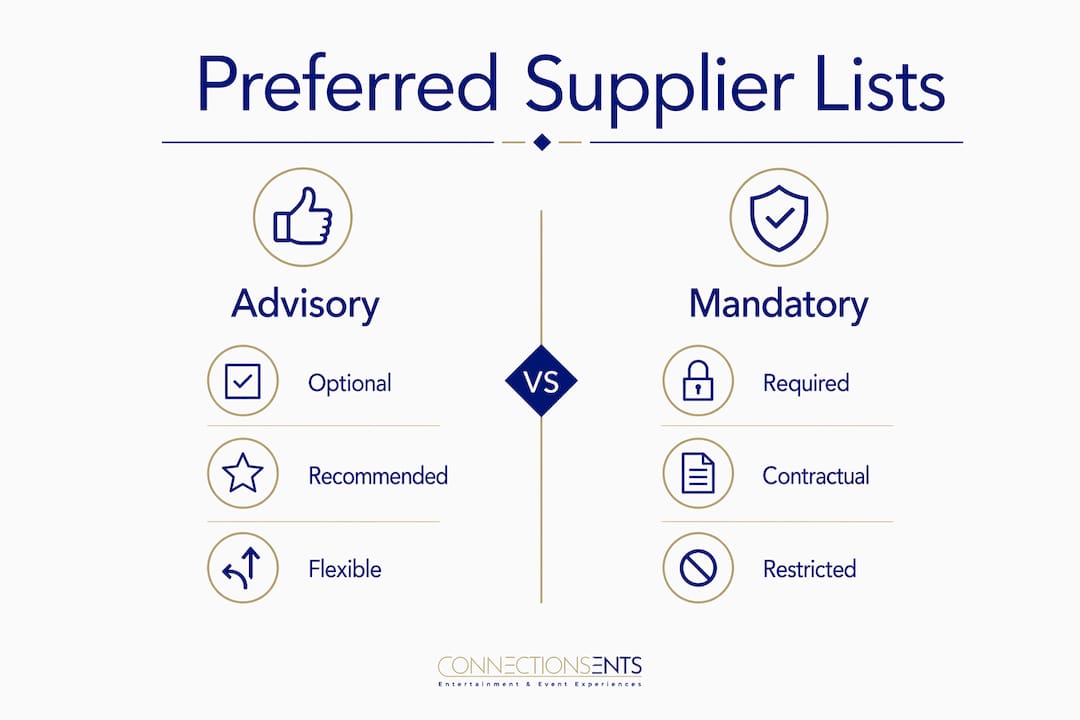
A venue preferred supplier list is a curated selection of businesses that a venue has approved, vetted, or chosen to recommend to its clients. The industry also refers to these as “approved supplier lists” or “recommended vendor lists,” and the terminology matters more than you might expect. Two distinct types exist: advisory lists, which are recommendations you are free to ignore, and approved or exclusive lists, which are mandatory and restrict your vendor choice entirely.

The distinction is critical. An advisory preferred supplier list is a convenience tool. A mandatory approved list is a contractual condition. Venue staff sometimes use both terms interchangeably, so always confirm in writing whether using a listed supplier is optional or compulsory before you sign anything.
These lists appear across all event types. Wedding venues in Norfolk and East Anglia frequently publish them for entertainment, catering, and décor. Corporate event spaces use them to manage AV, staging, and catering contractors. Private party venues rely on them to control noise levels, load-in logistics, and insurance compliance. The list is the venue’s way of saying: “We know these suppliers, and we trust them here.”
Why do venues maintain preferred supplier lists?
Venues maintain preferred supplier lists primarily to manage operational risk and protect their reputation. A supplier who has never worked at a venue before can cause real problems: incorrect assumptions about power capacity, unfamiliarity with load-in routes, or failure to meet noise curfews. Preferred suppliers know venue layouts, power limits, and loading times, which prevents disruptions and keeps the event day running smoothly.
Insurance and legal liability are equally significant drivers. Approved suppliers carry verified insurance and comply with venue-specific health and safety rules, with minimum Public Liability cover typically set at £1–2 million. That level of cover protects both the venue and the client if something goes wrong on the day.
The core reasons venues curate these lists include:
- Operational familiarity. Suppliers who know the site reduce coordination errors and last-minute surprises.
- Insurance compliance. Venues need proof that every contractor on site carries adequate Public Liability cover.
- Quality assurance. A track record at the venue gives staff confidence in a supplier’s reliability and professionalism.
- Health and safety. Site-specific rules around electrical loads, fire exits, and noise curfews require suppliers who understand the constraints.
- Reputation protection. A poor supplier experience reflects on the venue, not just the client.
Pro Tip: Ask the venue to confirm in writing whether their list is advisory or mandatory. This single question prevents the most common misunderstanding in venue supplier negotiations.
The dual nature of these lists is where confusion most often arises. An advisory list is a genuine recommendation based on experience. A mandatory approved list is a contractual requirement, and using an unlisted supplier without permission may breach your venue contract. Knowing which type you are dealing with shapes every decision that follows.
Are preferred supplier lists always ethical and transparent?
Preferred supplier lists are not always built on merit alone. Some venues charge suppliers an annual fee or commission to appear on their list, which creates a conflict of interest. A venue recommending a supplier because that supplier pays for the privilege is not the same as recommending one because they deliver outstanding results.
This practice matters because clients rarely know it is happening. You may assume a listed supplier is there because they are the best option for your event. In reality, they may simply be the supplier who paid the inclusion fee. Venues charging fees or commissions risk producing biased recommendations, and clients deserve to know about such arrangements before making decisions.
The Sustainable Wedding Alliance and other industry bodies are pushing for higher transparency standards. Ethical list curation should be based on merit, professionalism, and sustainability rather than financial incentives. Venues are increasingly encouraged to publish their selection criteria, review supplier feedback regularly, and prioritise local and sustainable businesses.
| Practice | Ethical standard | Problematic practice |
|---|---|---|
| Supplier selection basis | Merit, quality, and proven reliability | Payment of inclusion fees or commissions |
| Transparency to clients | Published selection criteria and disclosed financial arrangements | No disclosure of fees or conflicts of interest |
| List review process | Regular feedback review and supplier rotation | Static lists with no performance accountability |
| Client freedom | Advisory lists with clear opt-out process | Mandatory lists with no stated justification |
| Sustainability | Preference for local and sustainable suppliers | No environmental or ethical criteria applied |
The impact on couples and event planners is real. A mandatory list built on financial relationships rather than quality can force you towards suppliers who do not match your event vision, your budget, or your values. Asking a venue directly whether suppliers pay for list inclusion is a reasonable and increasingly common question. A venue that refuses to answer tells you something important.
For entertainment specifically, the concerns around supplier transparency in the industry are well documented. Clients benefit from understanding how lists are constructed before they commit to a venue.
How can you navigate and negotiate a venue’s supplier list?
Navigating a venue’s supplier list starts with one question: is this list advisory or mandatory? Clarify in writing whether the list is advisory or mandatory and ask about exceptions or fees before you sign your venue contract. Once you have that answer, you can plan accordingly.
Couples should feel empowered to choose outside vendors if those vendors meet the venue’s requirements. Lists are a convenience, not always a legal bind. Many venues allow outside suppliers provided they submit the correct documentation and comply with site rules.
Follow these steps to negotiate effectively:
- Confirm the list type in writing. Ask the venue coordinator to state clearly whether listed suppliers are mandatory or recommended.
- Request the selection criteria. Ask how suppliers qualify for the list and whether financial arrangements are involved.
- Identify your preferred outside suppliers. Research their credentials before approaching the venue with a variance request.
- Ask about a variance agreement. Many venues allow outside vendors who provide proof of insurance, licences, and a signed site walkthrough agreement.
- Check documentation requirements. Venues typically require proof of business licences, insurance, and a signed walkthrough agreement from any supplier working on site.
- Assess reliability independently. Check reviews, request references, and verify that your chosen supplier has experience at comparable venues.
- Get everything in writing. Any exception granted verbally is not enforceable. Confirm all agreements in your venue contract.
Pro Tip: Contact the venue at least three months before your event if you want to bring in an outside supplier. Early communication gives both parties time to complete documentation and resolve any compliance issues without pressure.
Mandatory approved supplier clauses can raise concerns under the Competition Act 1998 if they restrict client freedom without clear operational justification. This does not mean every mandatory list is illegal, but it does mean you have grounds to question restrictions that seem unreasonable. A venue that cannot explain why a supplier must be on the list may not have a defensible position.
For guidance on selecting the right venue for your event, understanding how supplier lists factor into your overall venue decision is part of the process.
What are the benefits and drawbacks of using preferred suppliers?
Using a venue’s preferred suppliers carries genuine advantages. Selecting suppliers familiar with a venue leads to a more cohesive event team and less coordination stress on the day. A DJ who has performed at your venue before knows exactly where to set up, how to manage the acoustics, and when to adjust for the room. That familiarity has real value.
The benefits of using preferred suppliers include:
- Proven venue knowledge. Preferred suppliers understand the physical constraints, power supply, and acoustics of the space.
- Reduced coordination effort. Venue staff and preferred suppliers have established working relationships, which speeds up logistics.
- Insurance and compliance confidence. Listed suppliers have already met the venue’s insurance and safety requirements.
- Lower risk of on-day problems. Familiarity with the site reduces the chance of avoidable errors.
The drawbacks are equally real and worth weighing carefully:
- Possible higher costs. Preferred suppliers may charge a premium, knowing they face less competition for your booking.
- Restricted creative choice. A mandatory list may not include suppliers who match your specific event style or vision.
- Potential conflicts of interest. If suppliers pay for list inclusion, the recommendation may not reflect genuine quality.
- Limited negotiating power. When choice is restricted, you have less leverage on price and terms.
The right approach depends on your priorities. If coordination and reliability matter most, working with preferred suppliers is a sound choice. If creative vision and budget control are your priorities, it is worth exploring whether the venue allows outside suppliers who meet their compliance requirements. For corporate events using AV and technical production, supplier familiarity with the venue’s technical infrastructure can be the difference between a polished event and a stressful one.
Key takeaways
A venue preferred supplier list is either an advisory recommendation or a mandatory contractual requirement, and knowing which type applies to your event is the single most important question to ask before signing.
| Point | Details |
|---|---|
| Two distinct list types | Confirm in writing whether the list is advisory or mandatory before signing your venue contract. |
| Insurance is non-negotiable | Approved suppliers carry minimum £1–2 million Public Liability cover; outside suppliers must match this standard. |
| Ethical curation matters | Ask whether suppliers pay for list inclusion, as financial arrangements can bias recommendations. |
| Negotiation is possible | Many venues allow outside suppliers who provide proof of insurance, licences, and a signed walkthrough agreement. |
| Familiarity has real value | Suppliers who know the venue reduce coordination errors and on-day disruptions for all parties. |
Darren’s view on preferred supplier lists
Working in event entertainment across Norfolk and East Anglia for many years, I have seen preferred supplier lists used brilliantly and badly. When a venue builds its list on genuine experience and merit, it is one of the most useful tools a couple or event planner has. You get a shortlist of suppliers who already know the space, the staff, and the expectations. That saves real time and reduces real risk.
What concerns me is the lack of transparency that still exists in parts of the industry. Clients who do not know that a supplier paid for list inclusion are not making an informed choice. That is not fair, and the industry is slowly recognising it. The Sustainable Wedding Alliance’s push for published selection criteria is a step in the right direction, but venues need to act on it rather than simply acknowledge it.
My advice to couples and event planners is straightforward. Ask the hard questions early. Find out how the list was built, whether financial arrangements exist, and whether you have the right to bring in outside suppliers. Most venues will work with you if you approach the conversation respectfully and come prepared with the right documentation. The venues that refuse to engage with those questions are telling you something worth knowing before you commit.
The balance between operational necessity and creative freedom is achievable. It just requires honest dialogue on both sides.
— Darren
Connections Entertainment and your venue supplier options
Connections Entertainment works with event planners, coordinators, and couples across Norfolk and East Anglia to provide professional event entertainment that meets venue requirements and client expectations. Whether you are working within a venue’s preferred supplier framework or bringing in entertainment independently, Connections Entertainment carries full Public Liability insurance and complies with venue-specific health and safety requirements. The team understands the documentation venues require and handles the compliance process directly. Browse the full range of vetted entertainers available for weddings, corporate functions, and private parties, and get in touch to discuss how Connections Entertainment can work within your venue’s guidelines.
FAQ
What does a venue preferred supplier list mean?
A venue preferred supplier list is a curated selection of suppliers that a venue recommends or requires clients to use. It exists to protect operational standards, manage insurance compliance, and reduce event-day risk.
Is a preferred supplier list mandatory or optional?
It depends on the venue. Advisory lists are optional recommendations, while approved or exclusive lists are contractual requirements. Always confirm in writing which type applies to your booking.
Can I use a supplier not on the venue’s list?
Many venues allow outside suppliers who provide proof of Public Liability insurance, business licences, and a signed site walkthrough agreement. Ask the venue about their variance process before assuming outside suppliers are prohibited.
Are preferred supplier lists legal in the UK?
Advisory lists are entirely legal. Mandatory approved supplier clauses can raise concerns under the Competition Act 1998 if they restrict client choice without clear operational justification. Seek clarification if a mandatory clause seems unreasonable.
Do suppliers pay to be on a venue’s preferred list?
Some venues charge suppliers an annual fee or commission for list inclusion. This practice can create a conflict of interest, so ask the venue directly whether financial arrangements exist between them and their listed suppliers.