
What is a venue hire agreement? Your guide
Discover what a venue hire agreement is and why understanding it is crucial for your event planning. Protect your interests today!
TL;DR:
- A venue hire agreement is a legally binding contract that defines responsibilities, risk allocation, and operational terms for events. It grants limited access rights rather than property ownership, and includes crucial clauses on access times, cancellation policies, and insurance requirements. Understanding and negotiating these terms helps prevent disputes and ensures your event runs smoothly.
When you book a venue for a wedding, corporate function, or private party, you are not just reserving a space on a calendar. A venue hire agreement, more formally known as a venue hire contract, is a legally binding document that defines every significant term of your booking, from payment schedules to who is liable if something goes wrong. Many event planners treat it as a formality and sign without reading closely. That approach creates real risk. Understanding what these contracts contain, and where they can catch you out, is one of the most practical things you can do before your event day arrives.
Table of Contents
- Key takeaways
- What is a venue hire agreement, and why does it matter?
- Key components of a venue hire contract
- How venue hire contracts differ from leases
- How to negotiate and draft a strong agreement
- Common pitfalls in venue hire agreements
- My perspective on venue hire contracts
- Planning your event with Connections Entertainment
- FAQ
Key takeaways
| Point | Details |
|---|---|
| More than a booking form | A venue hire agreement is a legally binding contract that allocates risk and defines responsibilities for both parties. |
| Licence, not a lease | Venue hire grants limited access rights rather than a property interest, meaning the venue retains overall control. |
| Cancellation clauses matter | Clear cancellation windows with defined refund thresholds protect your financial exposure if plans change. |
| Access times cause disputes | Setup and pack-down periods must be explicitly written into the hire window to avoid unexpected charges. |
| Insurance is non-negotiable | Public liability cover is typically required before your event, and third-party suppliers may need their own policy too. |
What is a venue hire agreement, and why does it matter?
A venue hire agreement is a legally binding contract between a venue owner or manager and the person or organisation hiring the space. It sets out the terms under which the space can be used, the responsibilities each party holds, and how risk is shared if something unexpected happens. The document goes well beyond confirming the date and price. It defines what you are permitted to do, what the venue is obligated to provide, and what happens if either side fails to deliver.
You will encounter these contracts across a broad range of events: weddings, birthday celebrations, corporate conferences, charity fundraisers, and product launches all typically require one. The formal industry term for this type of document is a venue hire contract, though the phrases venue rental agreement and event hire agreement are used interchangeably in practice.
One of the most important things to understand from the start is that venue hire is short-term use, granting limited access rights rather than any ongoing interest in the property. This is not the same as renting a flat or leasing a commercial space. The distinction has direct consequences for what you can and cannot do, and it shapes how responsibilities are divided. A well-drafted agreement manages expectations clearly, which is why venue hire agreements reduce disputes by clarifying permitted uses, insurance obligations, and compliance requirements rather than simply confirming a rental fee.
Key components of a venue hire contract
Understanding what to include in venue hire documentation is where most event planners gain or lose leverage. These are the clauses that define your experience and your exposure.
Event details, access, and times
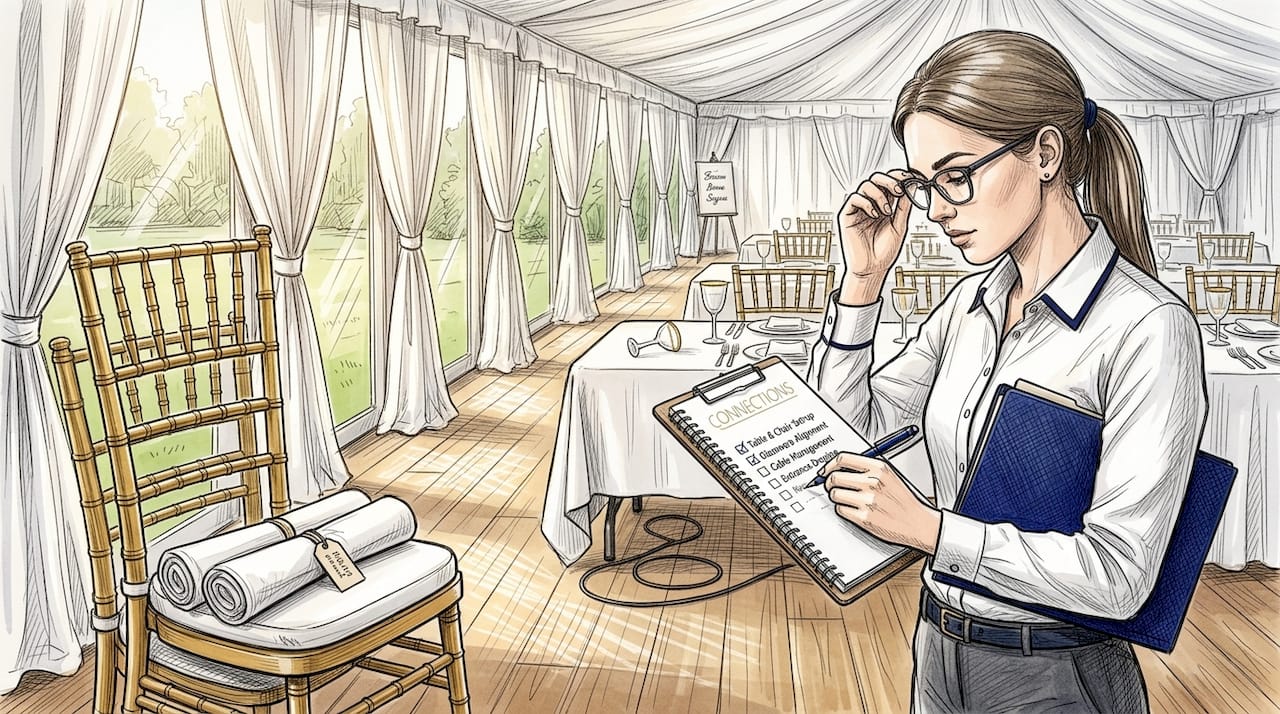
The agreement should state the event date, start time, end time, and critically, the access window for setup and pack-down. This distinction matters more than most people realise. Practitioners consistently identify access time clauses as a common source of misunderstandings, because hirers assume their booking begins when guests arrive, not when the caterers and DJ need to get in. If your setup time is not written into the hire period, you may face additional charges or find another event blocking access to the space.
Hire fees, deposits, and payment schedules
Deposits and payment schedules govern exactly when a booking becomes binding and protect the venue if the hirer defaults. A typical structure includes a non-refundable deposit paid at signing to secure the date, followed by a balance due some weeks before the event. You need to know what triggers the binding commitment and what happens if a payment is late.
Cancellation and rescheduling terms
This is one of the clauses people read most carefully after something goes wrong, and least carefully beforehand. Cancellation terms should define clear windows with corresponding refund or rescheduling rules. A common structure looks like this:
| Notice given | Refund entitlement |
|---|---|
| 30 or more days before event | Full refund of hire fee |
| 14 to 29 days before event | Partial refund (typically 50%) |
| Under 14 days before event | No refund |
These thresholds vary by venue and contract, but having them written clearly protects both sides. Also check whether the agreement contains a force majeure clause, which covers cancellations caused by events outside anyone’s control, such as extreme weather or public health restrictions.
Insurance and liability
Insurance provisions typically require the hirer to hold valid public liability cover and provide proof before the event takes place. The agreement should also clarify the liability limits and indemnity arrangements between both parties. If you are bringing in external suppliers such as a live band, a catering company, or a photo booth provider, check whether the agreement extends liability to them or requires them to hold their own cover. This is a gap that catches many hirers off guard.
Venue and hirer responsibilities
The agreement should specify what each party is responsible for. Typical hirer obligations include leaving the space clean, reporting damage, and not exceeding the stated guest capacity. Venue obligations often include providing the agreed facilities, staffing, and AV equipment in working order. Typical clauses cover damage, cleaning requirements, and local regulation alignment. Neither side should be left guessing.
Restrictions and regulatory requirements
Many venues operate under licences that impose specific constraints on your event. Venues must integrate operational constraints such as liquor licensing conditions, noise curfews, and fire safety requirements directly into the contract terms. If your event runs past 11pm but the venue holds a licence that expires at that time, that is something you need to know before you book the entertainment, not after.
Pro Tip: Always ask the venue to confirm in writing which licence conditions apply to your specific event date and time. Verbal assurances are not enforceable if the written contract says otherwise.
How venue hire contracts differ from leases
The legal distinction between a venue hire contract and a lease is more than a technicality. It affects your rights, your ability to negotiate, and your exposure to risk.
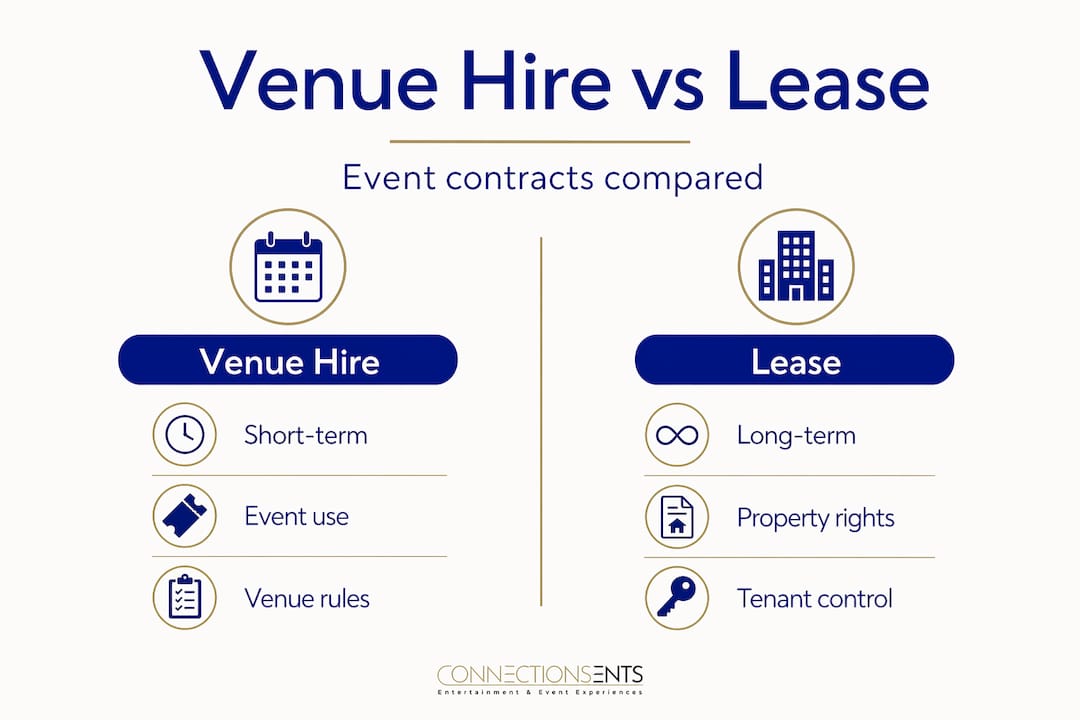
A lease grants the tenant a property interest, which means legal control over the space for the duration of the agreement. A venue hire contract operates as a licence. Use as a licence rather than a lease means the venue owner retains overall control and can restrict or vary how the space is used. You are granted access, not ownership of the space during that period.
Here is how the three common arrangements compare:
| Feature | Venue hire agreement | Lease | Licence |
|---|---|---|---|
| Duration | Short-term, single event | Fixed term (months or years) | Short-term, revocable |
| Property interest | None | Yes | None |
| Owner retains control | Yes | No (during term) | Yes |
| Negotiable terms | Moderate | High | Low |
| Typical use | Events and functions | Commercial tenancy | Temporary access |
The practical implication is that the venue can enforce rules you did not anticipate if they are written into their standard terms. They may also reserve the right to cancel your booking under defined circumstances, such as prior damage to the property or a breach of their conditions. Understanding this dynamic puts you in a much stronger position when you sit down to review or negotiate the contract.
Pro Tip: If the venue advertises something in their brochure or sales materials but it is not in the written contract, ask for it to be added explicitly before signing. Promotional materials are not part of the legally binding agreement.
How to negotiate and draft a strong agreement
Knowing how to draft a venue agreement, or at least how to review one critically, is a skill that pays off every time you plan an event. Here is a practical approach to take.
Check alignment across all documents. Compare the verbal quote, the venue’s marketing materials, and the written contract side by side. Misalignment between verbal quotes and written terms is a common source of disputes. If the brochure promises AV equipment and the contract says “subject to availability,” that is a discrepancy worth resolving before you sign.
Clarify the full access window in writing. Confirm that your hire period includes setup and pack-down time. Explicitly including setup and pack-down times within the hire period prevents disputes about access and additional charges. Ask specifically: “Does our booking window include time for suppliers to arrive and for the space to be cleared at the end?”
Negotiate cancellation terms before you need them. Review the cancellation thresholds carefully and consider whether they are realistic for your event timeline. Payment terms and cancellation policies are among the most critical clauses to manage financial risk for both sides. If the notice periods feel too short or the penalties too steep, raise this during negotiation rather than after a problem arises.
Confirm insurance requirements upfront. Ask the venue exactly what level of public liability cover you need, who needs to hold it, and when they need proof. If you are working with external suppliers, find out whether their insurance must be listed in the agreement or submitted separately.
Clarify supplier and vendor arrangements. Some venues have preferred supplier lists or restrictions on external contractors. If you have already booked a specific caterer, entertainment company, or decorator, confirm this is permitted under the contract terms before finalising those bookings.
Read the small print on venue rights. Check whether the venue has the right to cancel or modify the booking, and under what conditions. Understand what compensation, if any, applies if they do so.
Request clarification on anything unclear. A one-size-fits-all agreement rarely fits specific venues or events. If a clause does not make sense in the context of your event, ask the venue to explain it or amend it. Any agreed changes should be added to the contract in writing, not just confirmed by email or conversation.
Pro Tip: Before signing, send a brief summary of your understanding of the key terms back to the venue contact in writing. If there are misunderstandings, this surfaces them before they become disputes.
Common pitfalls in venue hire agreements
Even experienced event planners overlook certain aspects of venue hire contracts. These are the areas that most frequently cause confusion or conflict.
- Discrepancies between promises and paperwork. What a sales manager tells you during a site visit and what appears in the contract can differ considerably. Always get verbal commitments put in writing before signing.
- Confusion over setup times. Assuming your band or caterer can arrive at the same time as guests is one of the most common and costly mistakes. Your suppliers often need two to four hours of access before the event begins.
- Insurance gaps for third-party contractors. Third-party suppliers often require their own insurance and compliance terms. If you assume the venue’s policy covers your DJ or florist, you may be wrong.
- Underestimating noise and licensing restrictions. A noise curfew at 10pm can significantly affect your entertainment choices. Check this before booking acts or planning the evening’s schedule.
- Missing the cancellation penalty structure. Many hirers only read cancellation clauses after a problem arises. By then, the window for a meaningful refund may have closed.
- Ignoring force majeure and venue cancellation rights. The venue may have the right to cancel your booking under certain conditions. Understand what those conditions are and what your recourse would be.
Pro Tip: Ask the venue for examples of situations where they have previously invoked their cancellation rights or amended bookings. Their answer will tell you a great deal about how they operate in practice.
My perspective on venue hire contracts
In my experience working with event organisers across a wide range of functions, the single biggest source of pre-event stress is not the entertainment or the catering. It is a contract dispute that could have been avoided with a closer read of the agreement three months earlier.
What I have found time and again is that hirers focus almost entirely on the headline price and the date. They gloss over the access windows, the insurance requirements, and the cancellation structure. Then something changes, whether it is a supplier running late, a guest list growing beyond capacity, or a date needing to shift, and suddenly those overlooked clauses become extremely consequential.
The venues I have seen operate most smoothly are the ones whose contracts reflect how they actually work day to day, not a generic template downloaded from the internet. That means specific access times, realistic cancellation windows, and clear guidance on what external suppliers are permitted. When both sides sign something that genuinely reflects the reality of the event, disputes become rare.
My honest advice is this: treat the contract review as an extension of the planning process, not a bureaucratic hurdle. Ask questions. Request amendments. If a venue is unwilling to clarify a clause or confirm a verbal promise in writing, that tells you something important about how they will behave when things get complicated. Understanding why venues partner with entertainment companies often comes down to shared clarity on exactly these kinds of operational terms.
— Darren
Planning your event with Connections Entertainment
Once you understand your venue hire contract and have the terms confirmed, the next step is bringing your event to life. Connections Entertainment works with clients across Norfolk and East Anglia to provide professional entertainment for weddings, corporate functions, private parties, and more. Whether you need a DJ, live band, tribute act, photo booth, or a full event production package, the team is experienced in coordinating with venues and working within the operational constraints that venue agreements set out. You can explore the full range of event entertainment options to understand what might suit your event, or browse the full entertainers listing to find the right performers for your occasion. For any questions about how entertainment bookings work alongside your venue arrangements, the Connections Entertainment team is happy to help.
FAQ
What is a venue hire agreement?
A venue hire agreement is a legally binding contract between a venue owner and a hirer, setting out the terms, responsibilities, and risk allocation for a specific event. It covers booking details, payment terms, cancellation policies, insurance requirements, and permitted uses of the space.
Is a venue hire contract the same as a lease?
No. A venue hire contract grants a licence to use the space temporarily rather than a property interest. The venue retains overall control and can enforce restrictions, which differs significantly from a commercial lease where the tenant holds legal control during the term.
What should I check before signing a venue rental agreement?
Check that access times include setup and pack-down, that cancellation thresholds are clearly defined, that insurance requirements are specified, and that all verbal promises from the venue are reflected in the written terms. Any discrepancy between the quote and the contract should be resolved before signing.
Can a venue cancel my booking under a hire agreement?
Yes. Most venue hire agreements include clauses that allow the venue to cancel under defined circumstances, such as breach of contract terms or damage to the property. Check these conditions carefully and confirm what compensation or rebooking arrangements apply.
Do my suppliers need their own insurance under a venue hire agreement?
In most cases, yes. Third-party contractors such as catering companies, entertainment providers, and decorators are typically required to hold their own public liability cover. Check the agreement for specific requirements and confirm these with each supplier before your event.