
What is a venue entertainment calendar?
Discover what is a venue entertainment calendar and how it enhances event planning. Learn to streamline bookings and reduce double bookings!
TL;DR:
- A venue entertainment calendar is a strategic, centralized scheduling tool that coordinates bookings, availability, and operational details over months. It differs from the run-of-show, which manages minute-by-minute event execution, and should be used proactively for long-term planning. Proper management and stakeholder access to the calendar enhance operational efficiency and event success.
If you think a venue entertainment calendar is simply a list of upcoming gigs pinned to a noticeboard, you are leaving a significant amount of value on the table. A venue entertainment calendar is a strategic scheduling system that coordinates bookings, availability, performer logistics, and operational details across weeks and months. It is the document that prevents double bookings, guides promotional timing, and gives every stakeholder — from the venue manager to the AV technician — a shared source of truth. This article explains what the calendar actually is, how it differs from other planning documents, and how to build and manage one that genuinely improves your events.
Table of Contents
- Key takeaways
- What is a venue entertainment calendar?
- Building an effective entertainment calendar
- Advanced scheduling strategies
- Entertainment, logistics, and event day operations
- My perspective on getting calendars right
- How Connections Entertainment can help
- FAQ
Key takeaways
| Point | Details |
|---|---|
| More than a date list | A venue entertainment calendar is a centralised scheduling system, not a simple list of events. |
| Distinct from run-of-show | The calendar handles long-term, macro-level planning; the run-of-show manages minute-by-minute event execution. |
| Plan 6 to 12 months ahead | Booking entertainment well in advance secures artist availability and allows sufficient time for promotion. |
| Use data to fill gaps | Ticket sales and attendance patterns help you schedule premium events on peak nights and fill mid-week slots strategically. |
| Recurring nights build loyalty | Consistent themed events, such as monthly jazz nights, generate steady revenue and habitual audiences. |
What is a venue entertainment calendar?
At its core, a venue entertainment calendar is a centralised scheduling system that brings together all scheduled bookings, availability windows, and key operational logistics in one place. It tells you who is performing, when, in which space, and what resources are needed to make it happen. For venue operators, organisers, artists, and promoters alike, it serves as the single authoritative record for all entertainment programming.
What makes it different from a basic diary entry is the depth of information it contains and the way it is actively managed. A well-built calendar does not just show you what is happening next Saturday. It shows you whether the stage is already allocated, whether the AV team has been notified, which nights are still dark, and what contracts are pending. Understanding event entertainment value starts here, with the infrastructure that makes it all possible.
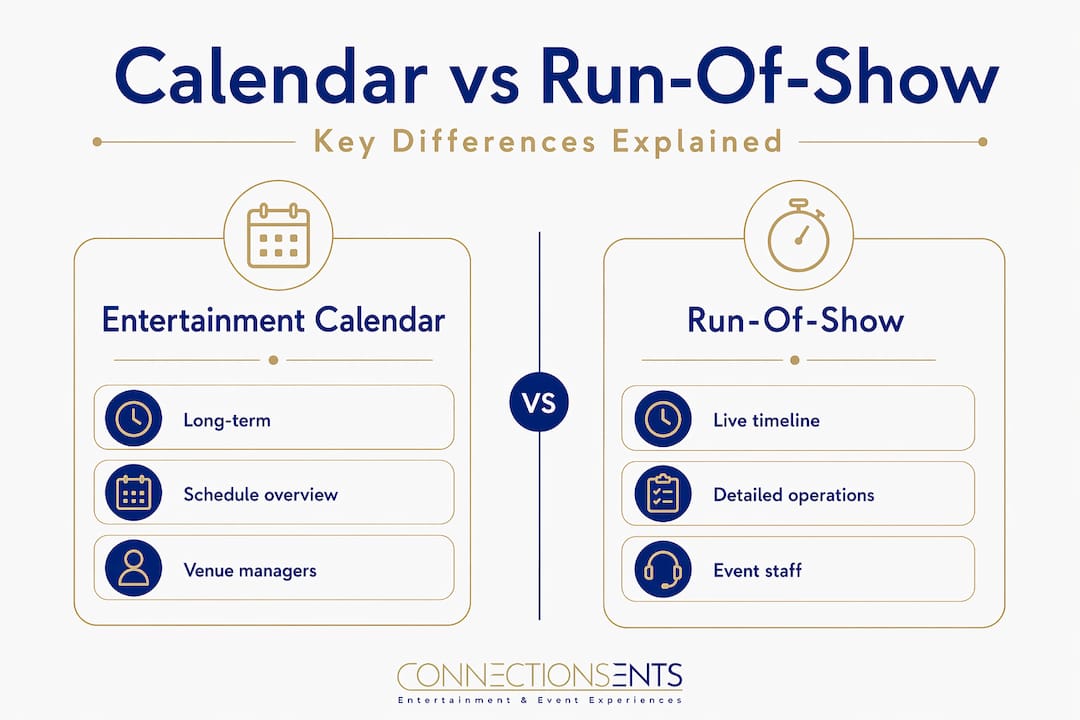
Calendar vs. run-of-show: a critical distinction
One of the most common points of confusion in venue event planning is mixing up the entertainment calendar with the run-of-show. They serve completely different purposes, and conflating the two creates real problems for your team.
| Document | Timeframe | Purpose | Audience |
|---|---|---|---|
| Entertainment calendar | Weeks to months ahead | Long-term booking and availability management | Venue managers, promoters, bookers |
| Run-of-show | Day of the event | Minute-by-minute event execution timeline | On-site production team, emcee, AV crew |
The run-of-show is a detailed live timeline that tells your on-the-ground team exactly what is happening at 7:14pm versus 7:30pm. The entertainment calendar, by contrast, is the macro-level document that informed the run-of-show’s existence in the first place. Separating these two documents keeps your attendee-facing team focused without distracting them with behind-the-scenes logistics that are not relevant to their role on the day.
Think of it this way: the calendar decides that a tribute band is playing on the 14th. The run-of-show dictates that the band’s soundcheck is at 5pm, doors open at 7pm, the support act takes the stage at 7:30pm, and the headline act begins at 9pm.
Building an effective entertainment calendar
Creating a venue entertainment calendar that actually works requires more than opening a spreadsheet and typing in some dates. The most effective calendars share a consistent set of features and are maintained through disciplined habits.

What every calendar entry should include
A complete calendar entry should capture all the details that any stakeholder might need at a glance. Effective entertainment calendars include the following for every booking:
- Event title and type (e.g. live music, DJ night, comedy show, tribute act)
- Date, start time, and estimated end time
- Venue space or room (particularly relevant for multi-room venues)
- Performer or act name, plus agent or supplier contact details
- Booking status (enquiry, confirmed, contracted, or cancelled)
- Technical requirements (stage size, AV needs, sound restrictions)
- Promotional deadlines (when social media posts, posters, and ticket listings go live)
- Key internal contacts responsible for each booking
This level of detail transforms the calendar from a passive record into an active management tool.
Choosing the right tool
For most venue organisers, a live, collaborative digital platform is non-negotiable. Static spreadsheets saved on a single computer are one of the leading causes of double bookings and miscommunication. Google Sheets, Notion, Airtable, and dedicated event management software all offer real-time updates that every team member can access. Automation tools and calendar integrations with ticketing platforms and communication channels drastically reduce scheduling errors and last-minute changes.
Pro Tip: Share view-only access to your entertainment calendar with external stakeholders such as artists, agents, and AV suppliers. This eliminates the back-and-forth of confirmation emails and reduces the risk of misaligned expectations.
Planning horizon and booking lead times
Industry best practice is to plan 6 to 12 months in advance. This window matters for two reasons. First, in-demand performers book up quickly, and securing acts early gives you genuine choice rather than whatever is left available. Second, promotional lead time is directly tied to ticket sales. An event announced two weeks before the date will almost always underperform against one that has been marketed for six to eight weeks.
You can also use your work calendar to layer promotional milestones on top of booking dates, so your team always knows when to begin pushing ticket sales and social content.
Advanced scheduling strategies
Once you have the fundamentals in place, the real power of a venue entertainment calendar comes from using it as a strategic planning asset rather than a reactive booking log.
Using data to drive smarter bookings
Venue managers who treat entertainment calendars as data assets rather than wish lists gain a measurable advantage. Historical ticketing data, attendance patterns, and bar revenue figures can tell you far more than intuition alone. Here is a practical framework for applying data to your scheduling decisions:
- Identify your peak nights. Review ticket sales and attendance records to confirm which days of the week and which months consistently outperform others.
- Schedule premium bookings on peak slots. Analysis of ticket sales shows that higher-profile acts placed on peak weekend evenings generate significantly stronger revenue than the same acts on quiet mid-week nights.
- Fill mid-week gaps intentionally. Use slower nights for niche genres, local showcases, or emerging artists. These events cost less to stage and serve a different audience segment without cannibalising weekend sales.
- Map dark nights. Identify nights that are consistently unbooked and set a target to fill a percentage of them each quarter.
- Review and adjust quarterly. Treat your calendar as a living document. Pull attendance data every three months and adjust upcoming bookings accordingly.
Pro Tip: Create a simple data table inside your calendar tool that tracks actual attendance vs. projected attendance for every event. Over time, this becomes a reliable forecasting resource that informs every future booking decision.
Recurring nights and artist residencies
One of the most underused strategies in venue entertainment planning is the recurring event night. Residencies and recurring series fill traditionally slow nights and generate reliable revenue streams that do not depend on each individual event being a marquee booking.
The principle is straightforward. A venue that establishes a consistent night with a recognisable identity, such as “Jazz Tuesdays” or a monthly comedy club night, builds a habitual audience. Recurring event series generate steady midweek revenue, build community identity, and give local emerging artists a reliable platform. Audiences stop needing to be convinced to attend because the night becomes part of their routine.
The scheduling consideration to keep in mind is frequency and duration. A weekly residency that runs for 12 months without variation will experience audience fatigue. Seasonal residencies, or those that rotate the featured artist within a consistent format, tend to sustain engagement far more effectively.
Entertainment, logistics, and event day operations
A venue entertainment calendar does not exist in isolation. It sits at the centre of a broader ecosystem of technical, operational, and legal planning. When this integration works well, events run smoothly. When it breaks down, the consequences show up immediately on the night.
How the calendar connects to production planning
Every booking on your entertainment calendar carries logistical implications. A live band requires a stage of a certain size, a PA system with specified power output, and loading-in time before doors open. A DJ needs a booth, specific lighting configurations, and potentially access to the venue several hours in advance. Entertainment planning must account for venue capabilities including sound restrictions, stage size, and legal requirements from the very moment a booking is made, not the week before the event.
This means your entertainment calendar should be actively shared with your production and technical teams as soon as a booking is confirmed. Key operational details to coordinate from the calendar include:
- Stage and space requirements confirmed against actual venue dimensions
- Sound and AV specifications matched to in-house or hired equipment
- Load-in and soundcheck schedules communicated to technical staff
- Licensing and legal obligations such as venue entertainment licences verified for each event type
- Promotional assets such as artist bios, photos, and stage plots received in advance
The cost of poor integration
Poor early planning consistently leads to rushed programmes, technical failures, and disjointed guest experiences. A band booked without confirming stage dimensions may arrive to find they cannot set up their full kit. A headline DJ secured without checking the licensing hours may be forced to cut their set short. These are not extraordinary scenarios. They happen regularly at venues where the entertainment calendar is treated as a booking list rather than an operational planning hub.
“Entertainment choices shape guest experience flow and must align with venue safety, technical capacities, and event goals rather than being selected in isolation.” — Entertainments Planning That Actually Works
The run-of-show document, when built properly, draws directly from the information already captured in the entertainment calendar. A well-structured run-of-show coordinates timing, communications, role ownership, and contingency planning for the actual event day. But it can only be as detailed and accurate as the calendar information that feeds into it.
My perspective on getting calendars right
I have worked with a lot of event organisers and venue managers over the years, and the single most common mistake I see is treating the entertainment calendar as a retrospective record rather than a forward-looking strategic tool. The calendar gets updated after bookings are made rather than being used to drive the booking decisions in the first place.
What changed things for me was watching a venue use three months of attendance data to restructure their entire autumn programme. They moved a big-name tribute act from a Thursday to a Saturday, replaced it with a local jazz residency on Thursdays, and saw both events outperform their previous benchmarks. The data was not complicated. It was just being used.
I would also say that the confusion between calendar and run-of-show causes more operational chaos than people realise. I have seen AV crews arrive on site with conflicting instructions because the entertainment calendar and the run-of-show were never properly aligned. The artists had one version of the schedule and the technical team had another.
The other thing I feel strongly about is stakeholder access. Keeping the calendar locked away on one person’s computer, or only sharing it in weekly email updates, is a recipe for preventable errors. When your booker, your venue manager, your technical lead, and your marketing team can all see the same live document, the quality of decision-making across the board improves immediately.
My practical advice: build your calendar in a tool that allows role-based access, connect it to your ticketing and promotional workflows, and review it as a team at least monthly. Treat it as the data asset it genuinely is.
— Darren
How Connections Entertainment can help
If you are working through the practical challenges of venue event planning, from sourcing quality acts to managing a reliable entertainment schedule, Connections Entertainment is well-placed to support you.
Based in Norfolk and serving venues across East Anglia and the wider UK, Connections Entertainment offers a thorough range of entertainment options including live music, DJs, tribute acts, photo booths, and full event coordination. Whether you are building out a recurring programme of events or booking a one-off evening that needs to land perfectly, the team brings the experience and supplier network to make it straightforward.
You can explore the full catalogue of available entertainers to find acts suited to your venue and audience. For a broader understanding of how entertainment fits into the overall event experience, the guide to event entertainment value is a useful starting point. And if you are looking for inspiration to build themed recurring nights into your calendar, the party entertainment services page showcases options that work consistently across a range of event formats and audience types. Connections Entertainment is the kind of partner that makes the planning process less stressful and the results more consistent.
FAQ
What does a venue entertainment calendar include?
A venue entertainment calendar includes event titles, dates, times, venue spaces, performer contacts, booking statuses, technical requirements, and promotional deadlines. It is a centralised operational document, not simply a list of events.
How is a venue entertainment calendar different from a run-of-show?
The entertainment calendar handles long-term scheduling across weeks and months, while the run-of-show is a detailed, minute-by-minute timeline used on the actual day of the event. Keeping them separate prevents confusion between the operational and the attendee-facing teams.
How far in advance should I plan a venue entertainment calendar?
Industry best practice recommends planning 6 to 12 months ahead. This secures artist availability, allows proper contract and licensing lead times, and provides sufficient promotional runway to drive ticket sales.
What is a venue entertainment licence?
A venue entertainment licence is a legal permission granted by your local authority that allows your venue to host specific types of live or recorded entertainment. The licence typically specifies permitted activities, hours of operation, and any conditions relating to noise or audience capacity.
How do recurring event nights benefit a venue?
Recurring nights build habitual audiences, generate consistent midweek revenue, and strengthen venue identity. A well-run recurring series reduces the promotional effort needed for each individual event because the audience already knows to expect it.