
What is a venue entertainment audit?
Discover what a venue entertainment audit is and how it enhances your events. Ensure compliance and elevate the guest experience today!
TL;DR:
- A venue entertainment audit assesses a venue’s music, safety, and operational compliance to improve guest experience and reduce risks. Regular audits help ensure licensing accuracy, brand consistency, and operational clarity, leading to better reputation and revenue. Conducting structured, recurring evaluations from a guest perspective makes venues more compliant, predictable, and memorable.
A venue entertainment audit is defined as an independent, systematic evaluation of a venue’s entertainment programming, music policy, and event infrastructure to ensure operational consistency, regulatory compliance, and an improved guest experience. The industry term for this process is an “entertainment facility evaluation,” though venue owners and event planners commonly call it a venue audit or entertainment assessment. Focused audits can take as little as 15–30 minutes using a structured checklist, while comprehensive reviews cover every aspect of a venue’s entertainment operation. UK regulatory bodies such as PPL PRS and the Licensing Act 2003 set the compliance framework within which these audits operate. Understanding what a venue entertainment audit involves is the first step towards running events that are both legally sound and genuinely memorable.
What are the essential components of a venue entertainment audit?
A venue entertainment audit covers six core areas. Each one affects either compliance, guest experience, or both.
Music licensing and copyright compliance sits at the top of every audit checklist. Music licensing costs for UK venues typically range from £250 to £1,200 annually depending on venue capacity and usage, with additional licence variation fees from £100 to £500. TheMusicLicence from PPL PRS is the primary requirement for any venue playing recorded or live music to the public.
The essential components to assess during an entertainment venue assessment include:
- Music licensing status. Confirm TheMusicLicence from PPL PRS is current and covers all intended uses, including background music, live performances, and DJ sets.
- Brand fit and music programming. Check whether the music played in each zone matches the venue’s identity and target atmosphere. Staff using personal playlists is one of the most common causes of inconsistent guest experience.
- Sound quality and AV infrastructure. Assess speaker placement, volume levels, and audio visual equipment condition across all areas of the venue.
- Safety and capacity compliance. Review crowd control procedures, emergency exit access, and maximum capacity limits in line with the Licensing Act 2003.
- Operational procedures. Evaluate how staff manage entertainment controls, including who has authority to change music, adjust volume, or stop a performance.
- Daypart consistency. Confirm that entertainment programming shifts appropriately from daytime to evening, and from one event type to another, without jarring transitions.
Pro Tip: Walk the venue as a guest would, starting from the entrance. You will notice volume imbalances, dead zones, and mood mismatches that staff working behind the scenes simply cannot detect.
A licensed venue for events must satisfy all of these components before hosting public entertainment. Missing even one area creates both legal and reputational risk.
Why is conducting a venue entertainment audit important?
A venue entertainment audit protects your business on three fronts: legal compliance, brand reputation, and guest satisfaction. Venues that skip regular assessments tend to discover problems only after a complaint, a fine, or a poor review.
The importance of venue audits becomes clear when you look at the compliance risks alone. The Live Music Act 2012 provides certain exemptions for smaller performances, but it does not exempt venues from paying PPL PRS fees. Many venue owners assume their entertainment licence covers music copyright. It does not. These are two separate legal obligations, and confusing them is one of the most common and costly mistakes in the industry.
The benefits of a thorough entertainment venue assessment go well beyond avoiding fines:
- Compliance protection. A regular audit confirms your licences are current, correctly scoped, and matched to your actual entertainment activity.
- Brand alignment. Consistent music programming across zones and dayparts reinforces your venue’s identity and sets the right atmosphere for every event type.
- Guest experience improvement. Auditing from the guest perspective reveals volume problems, dead zones, and mood inconsistencies that directly affect satisfaction and repeat bookings.
- Operational clarity. Audits define who controls entertainment decisions, reducing confusion among staff and preventing unauthorised changes during events.
- Revenue protection. A venue with a strong entertainment reputation commands higher hire fees and attracts better suppliers. Poor entertainment quality erodes both.
“Auditing transcends compliance and becomes a strategic business tool when auditors and management collaborate from the earliest stages of event planning. Effective entertainment auditing for larger venues requires a 360° collaboration between finance, production, and security teams.”
The role of entertainment in party planning is well documented, and venues that treat audits as a strategic tool rather than a box-ticking exercise consistently outperform those that do not.
How to conduct an effective venue entertainment audit
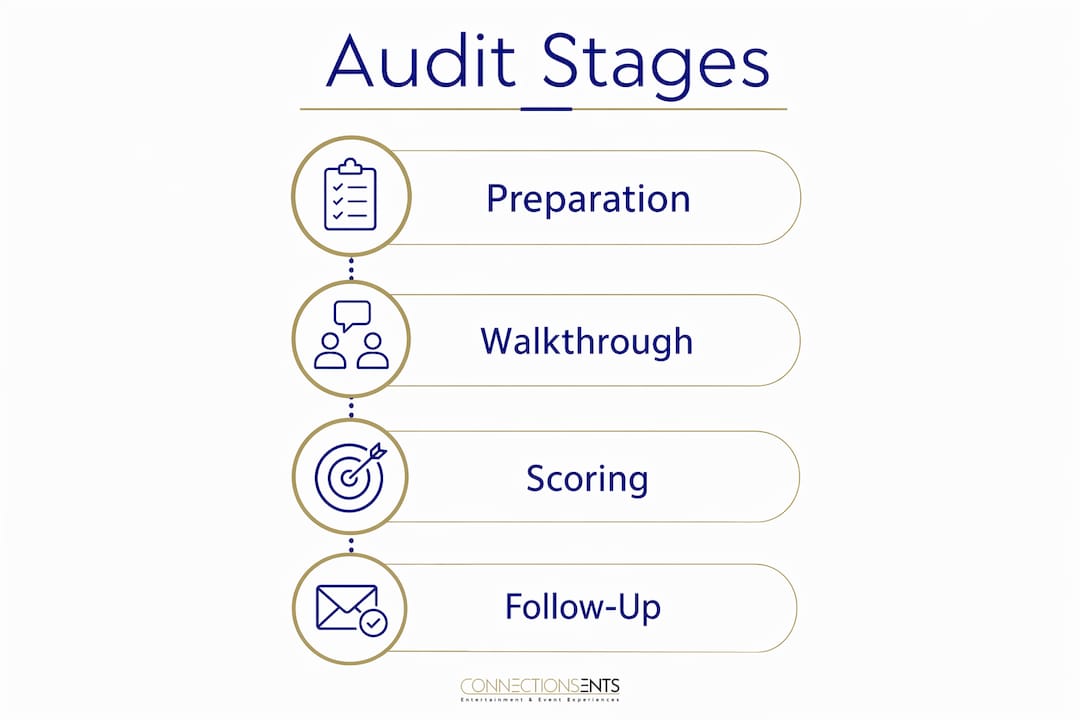
The venue audit process follows four clear stages: preparation, walkthrough, scoring, and follow-up. Each stage builds on the last, and skipping any one of them reduces the audit’s value significantly.
Stage 1: Preparation
Gather all relevant documents before you set foot on the floor. These include your current PPL PRS licence, your premises licence under the Licensing Act 2003, your entertainment event calendar, and any existing music or AV policies. If you work with external suppliers, collect their contracts and technical riders too. Reviewing your venue preferred supplier list at this stage helps you identify whether your suppliers meet the compliance standards your audit will test.
Stage 2: The walkthrough
Conduct the audit from the guest perspective, not from a management desk. Enter through the main entrance and move through every zone the public accesses. Note the volume level, music genre, atmosphere, and any AV equipment issues at each point. Pay particular attention to transitions between zones, such as from a reception area to a dining room, or from a bar to a dance floor. These transitions are where brand inconsistency most often appears.

Stage 3: Scoring and assessment
| Audit area | What to assess | Score guide |
|---|---|---|
| Music licensing | PPL PRS licence current and correctly scoped | Pass / Fail |
| Music programming | Genre and volume appropriate to zone and daypart | 1–5 scale |
| AV infrastructure | Equipment condition, speaker placement, sound clarity | 1–5 scale |
| Safety compliance | Capacity limits, crowd control, emergency access | Pass / Fail |
| Staff controls | Clear ownership of entertainment decisions | 1–5 scale |
| Brand consistency | Music matches venue identity across all zones | 1–5 scale |
Scoring systems guide corrective actions clearly. A score of 0–2 issues across the checklist suggests the system is working well. Six or more issues signals a rebuild of your entertainment policy is needed.
Stage 4: Follow-up and iteration
Document every finding immediately after the walkthrough. Assign a named person to each corrective action and set a deadline. The most common fixes include replacing personal playlists with curated, brand-approved music programmes, updating PPL PRS licences to reflect new event types, and installing volume limiters in zones where noise complaints have occurred.
Pro Tip: Schedule your next audit date before you close the current one. Venues that treat audits as recurring events rather than one-off tasks catch emerging issues months earlier.
For venues hosting live music shows, the walkthrough stage should include a full sound check assessment during a live performance, not just during setup.
How to integrate entertainment audits into venue operations
Embedding the venue audit process into your regular operations is what separates venues that improve consistently from those that plateau. A single audit produces a snapshot. A recurring audit programme produces a trend line you can act on.
The most practical ways to integrate entertainment assessments into your venue management routine include:
- Post-event debriefs. Add a five-minute entertainment review to every post-event debrief. Quarterly or monthly brief audits incorporated into post-event routines capture critical details before staff turnover or memory fade occurs.
- Entertainment calendar planning. Use audit findings to shape your venue entertainment calendar. If an audit reveals that Saturday evening music programming consistently underperforms, adjust the calendar before the next booking cycle.
- Cross-departmental collaboration. Share audit results with your finance, production, and operations teams. Cross-departmental collaboration between finance, production, and security is particularly important for larger venues operating under 2026 safety and operational regulations.
- Supplier reviews. Use audit data to evaluate your entertainment suppliers objectively. If a DJ or AV company consistently contributes to low scores in a particular zone, that is a supplier conversation you need to have.
- Licence renewal preparation. Audit findings provide the documentation you need when renewing your PPL PRS licence or applying for a licence variation. Regulators respond well to venues that can demonstrate a history of proactive compliance management.
- Tracking and reporting. Keep a simple audit log, whether in a spreadsheet or a venue management system, that records scores, findings, and actions over time. This log becomes your evidence base for both internal decisions and external compliance reviews.
Understanding why venues partner entertainment companies often comes down to exactly this kind of operational discipline. External partners bring consistency and compliance knowledge that internal teams sometimes lack.
Common pitfalls and expert tips for venue entertainment audits
Most venues make the same mistakes during entertainment assessments. Knowing them in advance saves you time, money, and reputational damage.
- Confusing entertainment permission with music copyright. Your premises licence permits you to stage entertainment. It does not cover the music you play. PPL PRS TheMusicLicence is a separate legal requirement, and most venues underestimate this distinction until they receive a compliance notice.
- Treating audits as one-off events. An annual audit is better than nothing, but it misses the operational drift that happens month to month. Staff change, suppliers change, and music policies erode without anyone noticing until a guest complains.
- Ignoring zone and daypart consistency. A venue that plays the right music in the bar but the wrong music in the dining room has a brand problem. Guests experience the whole venue, not individual zones in isolation.
- Underestimating the role of staff. Staff who are not trained on entertainment policies will default to personal preferences. That means personal playlists, inappropriate volume levels, and music that does not match the event type.
- Auditing only from a management perspective. Managers see what they expect to see. Guests experience what is actually there. The gap between those two perspectives is exactly what a well-conducted audit is designed to close.
Pro Tip: Treat the audit as a strategic partnership between your management, finance, and production teams, not as a task for one person to complete alone. The more perspectives involved, the more issues you will catch.
The role of venue coordinators is central to making audits work in practice. Coordinators who understand the audit process can embed it into their event planning workflow without adding significant administrative burden.
Key takeaways
A venue entertainment audit is the most direct tool available for protecting compliance, strengthening brand consistency, and improving the guest experience across every event you host.
| Point | Details |
|---|---|
| Define the audit scope clearly | Cover music licensing, AV infrastructure, brand consistency, safety, and staff controls in every review. |
| Separate licensing from copyright | Your premises licence and PPL PRS TheMusicLicence are distinct legal obligations. Both are required. |
| Audit from the guest perspective | Walk every zone as a guest would to reveal inconsistencies that management walkthroughs miss. |
| Make audits recurring, not one-off | Monthly or quarterly brief audits catch operational drift far earlier than annual reviews. |
| Involve all departments | Finance, production, operations, and security all contribute to a complete entertainment assessment. |
Why I think most venues are auditing backwards
Most venue owners I speak with treat an entertainment audit as something they do after a problem appears. A licensing notice arrives, a guest complaint lands, or a supplier delivers a poor performance, and suddenly everyone wants to review the process. That reactive approach costs more than the audit itself would have.
The venues that get this right treat the audit as a planning tool, not a post-mortem. They run a short checklist after every significant event, they share findings across departments, and they use the data to shape their entertainment calendar months in advance. The result is not just better compliance. It is a venue that feels consistent and intentional to every guest who walks through the door.
The other thing I have noticed is how often the guest perspective gets overlooked. Venue managers know their space so well that they stop experiencing it the way guests do. Walking in through the front entrance, sitting at a table in the dining room, and standing near the dance floor at peak volume reveals a completely different picture than reviewing a spreadsheet in the office. That shift in perspective is often the single most valuable thing an audit produces.
If you are an event planner working with venues, push for audit transparency. Ask to see the venue’s music licence, their AV maintenance records, and their post-event debrief notes. Venues that have nothing to hide will share these readily. Venues that hesitate are telling you something important about how they operate.
— Darren
How Connections Entertainment supports your venue’s entertainment quality
Connections Entertainment works with event planners and venue owners across Norfolk and East Anglia to build entertainment programmes that are both compliant and genuinely engaging. Whether you are reviewing your current entertainment setup or planning a new event series, understanding what event entertainment delivers for UK venues is a practical starting point. The team at Connections Entertainment brings experience across weddings, corporate functions, and private events, with a clear understanding of UK licensing requirements and guest experience standards. If your audit has identified gaps in your entertainment offering, external entertainment options provide a direct route to filling them with professional, vetted performers and AV support.
FAQ
What is a venue entertainment audit?
A venue entertainment audit is an independent, systematic evaluation of a venue’s music policy, entertainment programming, and event infrastructure. Its purpose is to confirm regulatory compliance and improve guest experience consistency.
How long does a venue entertainment audit take?
Focused audits using a structured checklist take 15–30 minutes. Comprehensive reviews covering all zones, licensing documents, and operational procedures take considerably longer.
What licences does a UK venue need for entertainment?
UK venues require a premises licence under the Licensing Act 2003 and TheMusicLicence from PPL PRS for any music played publicly. These are separate legal obligations and both are required.
How often should a venue conduct an entertainment audit?
Monthly or quarterly brief audits integrated into post-event debriefs are more effective than a single annual review. Frequent, short audits catch operational drift before it becomes a compliance or guest experience problem.
Who should be involved in a venue entertainment audit?
Effective audits involve management, finance, production, and security teams. For larger venues, cross-departmental collaboration is particularly important under 2026 safety and operational regulations.