
What is a private party venue brief?
Discover what is a private party venue brief and learn how to streamline your event planning by outlining key requirements for venues.
TL;DR:
- A private party venue brief is a concise document outlining essential event details to help venues assess their suitability before booking. It includes key information such as date, guest numbers, format, access, exclusivity, equipment, and catering needs to ensure accurate proposals. Clear, detailed briefs prevent misunderstandings, save time, and promote successful event planning.
A private party venue brief is a concise document that specifies your event’s key requirements, logistics, and expectations so that venues can assess whether they are the right fit before you commit to a booking. In the industry, this document is also called an event brief or venue specification. Understanding what is a private party venue brief gives you a clear advantage when sourcing spaces, because venues treat it as an intake specification that aligns their services with your needs before any production complexity arises. A well-crafted brief covers everything from guest numbers and catering requirements to exclusivity preferences and access timing. Get it right from the start, and you save hours of back-and-forth with venues that were never going to work for you.
What key information must a private party venue brief include?
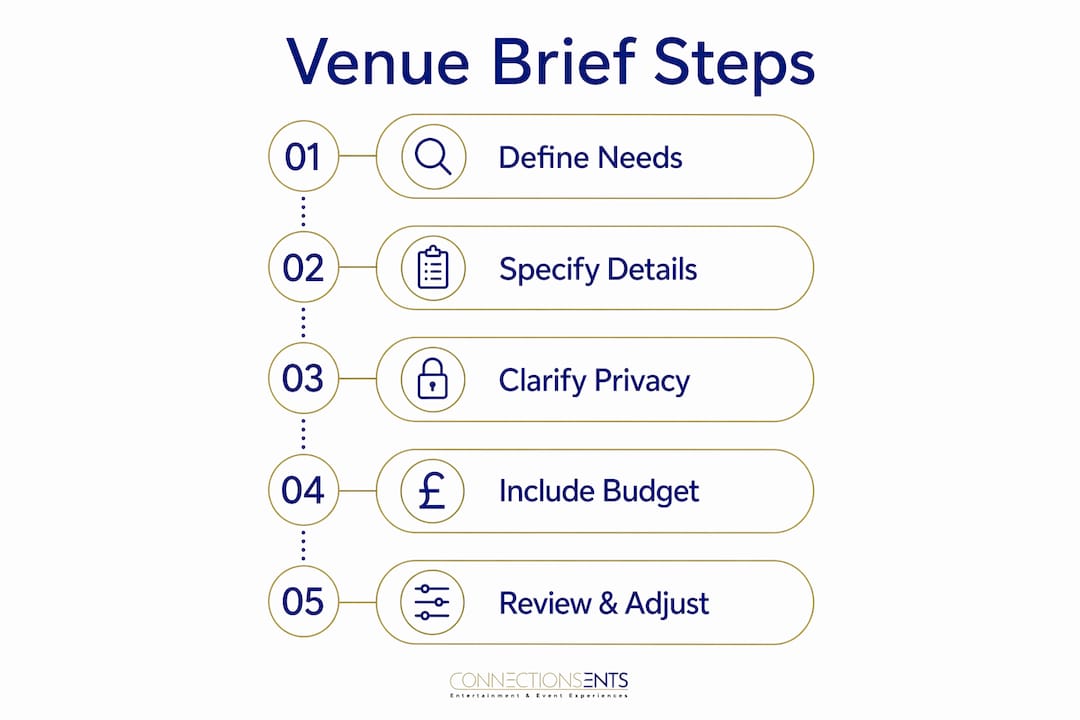
A venue brief for a private party must contain enough detail for a venue coordinator to say yes or no without needing a follow-up call. According to the platform VenueNow, a strong brief includes event title, date, format, location preferences, budget, expected attendees, and agenda. That list sounds straightforward, but each item carries more weight than most first-time planners expect.
The core elements every brief needs
Start with the non-negotiables. These are the details that determine whether a venue is physically capable of hosting your event:
- Event title and format: Is this a sit-down dinner, a cocktail reception, a birthday celebration with a dance floor, or a garden party? The format dictates room layout, furniture requirements, and flow.
- Date, time, and duration: Include the full event window, not just the guest hours. Setup and breakdown timing must be specified so the venue hire period covers all necessary access, not just the hours guests are present.
- Expected guest count: A venue suitable for 100 people can feel cavernous and impersonal for a party of 30. Knowing your guest count upfront is critical because it determines capacity, layout suitability, and catering ratios.
- Location preferences and access logistics: Specify the area or postcode range you are targeting, proximity to public transport, and any parking requirements.
- Equipment and catering requirements: List your AV needs, staging, lighting, and whether you require the venue’s in-house catering or plan to bring an external caterer.
- Budget guidance: You do not need to reveal your maximum figure, but providing a realistic range prevents venues from sending proposals that are wildly over or under your expectations.
- Accessibility and accommodation needs: If guests are travelling from outside the area or have mobility requirements, state this clearly so the venue can confirm suitability.
- Exclusivity preferences: Do you want a reserved room, a semi-private area, or a full property buyout? This single detail shapes the entire venue search and is covered in depth in the next section.
Going beyond the basics
The basics get you shortlisted. The detail gets you the right venue. Specifying AV requirements, Wi-Fi needs, and access windows in your brief reduces the assumptions a venue makes when quoting from its default package. If you need a DJ booth, a photo booth, or a live band setup, include the technical footprint each requires. Venues that cannot accommodate a full band stage will tell you immediately rather than after you have paid a deposit.

Pro Tip: Include your entertainment requirements in the brief from day one. If you are working with an entertainment provider like Connections Entertainment, ask them for a technical rider or space requirement summary to attach directly to your venue brief.
How does exclusivity affect your venue brief and venue selection?
Exclusivity is the most misunderstood element in any private event space overview. The word “private” does not automatically mean exclusive. Venues can be private by policy or by nature, and the difference between those two categories has a significant impact on your guests’ experience.
Understanding the three levels of privacy
| Exclusivity Level | What It Means | Typical Impact on Brief |
|---|---|---|
| Reserved Room | A dedicated room within a larger venue; other events may run simultaneously in adjacent spaces | Specify soundproofing needs and shared corridor access |
| Semi-Private Area | A sectioned-off area within a shared space, such as a restaurant or bar | Clarify partition type, noise boundaries, and shared facilities |
| Full Property Buyout | Sole use of the entire venue including all rooms, outdoor areas, car parks, and staff | State all spaces required and confirm no overlapping bookings |
Most complaints about private party venues stem from guests discovering that “private” meant a reserved room while a corporate function ran next door. Specifying which spaces and durations are exclusive in your brief is the single most effective way to avoid that outcome.
How exclusivity affects pricing and experience
Full property buyouts cost significantly more than reserved rooms, but they deliver a fundamentally different atmosphere. When you have sole use of a venue, your guests move freely between spaces, the décor is consistent throughout, and there is no risk of strangers wandering into your celebration. For milestone birthdays, anniversaries, or any event where atmosphere is central to the experience, a buyout is worth the additional investment.
Semi-private areas sit in a grey zone. They are often marketed as private but rely on physical partitions or staff management to maintain separation. If the venue is busy, those boundaries can feel porous. Your brief should ask venues to confirm exactly how they enforce the separation and what happens if the adjacent area becomes noisy.
Pro Tip: When you receive a venue proposal, ask the coordinator to confirm in writing which specific spaces are included in your exclusive hire and during what hours. Verbal assurances on venue access carry no legal weight and cannot resolve disputes later.
What are the most common pitfalls in a venue brief?
Most venue mismatches are not caused by bad venues. They are caused by incomplete briefs. An event brief sets the boundaries and direction for event execution, and when those boundaries are vague, venues fill the gaps with their own assumptions.
Here are the most common mistakes and how to avoid each one:
Omitting setup and breakdown times. Many planners specify the party hours but forget to account for the two hours needed to set up a photo booth, arrange florals, and do a sound check. Specify when your team arrives and departs so the venue can confirm the full hire window is available, not just the guest-facing hours.
Being vague about guest numbers. Writing “approximately 80 to 120 guests” forces the venue to plan for the maximum while charging you accordingly. Nail down a realistic headcount before you send the brief. If numbers are genuinely uncertain, provide a firm minimum and a realistic maximum, and flag that you will confirm closer to the date.
Underestimating equipment and catering specifics. A brief that says “we need a DJ” tells a venue almost nothing. State the power requirements, the space needed for decks and speakers, whether you need a stage or a raised platform, and whether the DJ is bringing their own equipment or using the venue’s in-house system. The same level of detail applies to catering: a buffet for 80 people has very different spatial and logistical requirements from a three-course seated dinner.
Ignoring licensing and noise restrictions. Licensing, noise, and compliance issues must be surfaced early in the brief, not discovered after signing a contract. Ask venues to confirm their premises licence covers your event type, your finish time, and any live music or amplified sound you plan to include.
Failing to mention operational constraints. If your event has a strict finish time due to transport arrangements, state it. If you have guests with dietary requirements that go beyond standard options, list them. If you are planning a surprise element that requires a specific room layout to be revealed at a certain point in the evening, explain it. Venues that understand your operational needs can plan accordingly.
Treating the brief as a formality. Some planners send a brief as a box-ticking exercise and then negotiate everything verbally. This creates risk. Including detailed operational requirements in your written brief reduces mismatches and ensures the venue’s response is based on your actual needs, not a generic package.
Pro Tip: Review your brief from the venue coordinator’s perspective before sending it. Ask yourself: could they quote accurately and confirm suitability based on this document alone? If the answer is no, add more detail.
How do you use your venue brief to find and book the right venue?
A completed brief is a tool, not just a document. The way you deploy it determines how efficiently you find the right space and how confidently you can negotiate terms.
Using the brief with venue-finding platforms and agents
Platforms like VenueNow allow you to submit a brief directly to multiple venues simultaneously, which compresses the sourcing timeline considerably. When you use a brief-based submission, venue coordinators respond with tailored proposals rather than generic brochures. This makes comparison straightforward because every response is answering the same set of questions.
If you are working with a venue-finding agent or event management company, share the brief at the very first conversation. Agents use it to filter their database before making any recommendations, which means you only see options that genuinely match your requirements.
Evaluating venue responses against your brief
When proposals arrive, score them against your brief criteria rather than reacting to the most attractive photography or the lowest headline price. Check the following:
- Does the proposed capacity match your guest count without feeling oversized or cramped?
- Has the venue confirmed the full access window including setup and breakdown?
- Is the exclusivity level explicitly stated and does it match what you specified?
- Are the AV and catering arrangements aligned with your requirements, or has the venue substituted its default package?
- Does the pricing reflect the full hire period, or are there additional charges for access outside standard hours?
Any proposal that sidesteps your brief criteria without explanation deserves a direct follow-up question before you proceed.
Adjusting the brief based on feedback
Initial venue responses often reveal gaps in your brief. If three venues independently ask the same clarifying question, that is a signal to add the answer to your brief before approaching the next batch. This iterative process makes your brief sharper with each round and reduces the time venues spend seeking clarification.
When you reach the negotiation stage, reference your brief explicitly. If a venue’s proposal includes a curfew that conflicts with your stated finish time, point to the brief as the basis for renegotiating. A written brief gives you a clear reference point that verbal discussions rarely provide.
For events with significant entertainment requirements, it is worth reading about entertainment briefs for private events alongside your venue brief. The two documents work together: the venue brief confirms the space is suitable, and the entertainment brief confirms the performers and technical setup can operate within it. Understanding what a venue entertainment calendar covers also helps you check that your chosen date does not conflict with existing bookings or venue-wide events.
Key takeaways
A private party venue brief is the single most effective tool for matching your event’s requirements to the right space, and its quality directly determines the quality of the proposals you receive.
| Point | Details |
|---|---|
| Define the brief early | Write your venue brief before approaching any spaces to avoid wasting time on unsuitable options. |
| Specify exclusivity clearly | State whether you need a reserved room, semi-private area, or full buyout to prevent guest experience issues. |
| Include full access timing | Cover setup and breakdown windows, not just guest hours, so the hire period is accurately costed. |
| Detail equipment and catering | List AV, staging, and catering specifics to prevent venues from defaulting to their standard package. |
| Address licensing upfront | Confirm noise restrictions, finish times, and live music permissions in the brief before signing any contract. |
What i have learned from years of venue briefing
After working on private party planning across Norfolk and East Anglia, the pattern I see most consistently is this: the events that run smoothly are almost always the ones where the brief was thorough before a single venue was contacted. The events that hit problems mid-planning are almost always the ones where the brief was written after the venue was chosen, as a retrospective justification rather than a genuine specification.
The most common misunderstanding I encounter is around exclusivity. Clients tell me they booked a “private venue” and then feel genuinely surprised when another party is audible through a partition wall. The venue was not lying. The client simply did not specify what “private” meant to them. That is a brief problem, not a venue problem.
My practical advice for first-time private party planners is to write the brief in two passes. The first pass covers the basics: date, numbers, format, budget, and location. The second pass covers the operational detail: access times, equipment needs, catering specifics, licensing requirements, and exclusivity scope. Most people stop after the first pass and wonder why they receive proposals that do not quite fit.
One more thing worth saying: keep the brief concise. A four-page document filled with aspirational language and vague preferences is harder for a venue coordinator to act on than a single well-structured page with clear, specific answers. The goal is not to impress the venue with the depth of your vision. The goal is to give them enough information to tell you honestly whether they can deliver it.
— Darren
How connections entertainment supports your private party planning
Once your venue brief is in place, the next step is aligning your entertainment with the space you have secured. Connections Entertainment works with private party clients across Norfolk and East Anglia to match entertainment to venue specifications, ensuring that DJs, live acts, photo booths, and lighting packages all fit within the confirmed space and access windows. Explore the full range of party entertainment options to see what is available for your event. For a broader understanding of how entertainment adds value to any private occasion, the guide to event entertainment in the UK is a practical starting point. Get in touch with Connections Entertainment to discuss how your venue brief and entertainment plan can work together from day one.
FAQ
What is a private party venue brief?
A private party venue brief is a short written document that outlines your event’s key requirements, including date, guest numbers, format, exclusivity preferences, and logistics. Venues use it to assess whether they can meet your needs before providing a proposal.
How long should a venue brief be?
A venue brief for a private party should fit on one to two pages. It needs enough detail for a venue to quote accurately and confirm suitability, but not so much that key information is buried in unnecessary context.
What is the difference between a reserved room and a full venue buyout?
A reserved room gives you a dedicated space within a larger venue where other events may run simultaneously. A full buyout means you have sole use of the entire property, including all rooms, outdoor areas, and shared facilities, for the duration of your hire.
Should i include my budget in the venue brief?
Including a realistic budget range in your brief is advisable. It prevents venues from submitting proposals that are significantly over or under your expectations, which saves time for both parties during the sourcing process.
Do i need a separate entertainment brief alongside my venue brief?
Yes. A venue brief confirms the space is suitable, while an entertainment brief confirms that performers and technical requirements can operate within it. The two documents complement each other and together reduce the risk of day-of surprises.