
What is a licensed venue for events in the UK?
Discover what a licensed venue for events is in the UK. Learn how proper licensing ensures your event is both enjoyable and compliant.
TL;DR:
- A licensed venue in the UK is a premises holding a valid premises licence or club premises certificate authorising activities like alcohol sales and regulated entertainment. These licences are issued by local authorities under the Licensing Act 2003 and must explicitly cover each planned activity for the event to be legal. Verifying a venue’s specific licences and conditions before booking minimizes legal risks and ensures compliance with the four licensing objectives.
A licensed venue for events in the UK is any premises holding a valid premises licence or club premises certificate that authorises licensable activities such as selling alcohol, providing regulated entertainment, and serving late night refreshment. These licences are granted by local authorities under the Licensing Act 2003, which sets the legal framework governing how and where these activities can take place. Without one of these documents, a venue cannot legally host many of the activities most people consider standard at a celebration or corporate function. Understanding what qualifies as a licensed venue is the first step toward planning an event that is both enjoyable and fully compliant with UK law.
What is a licensed venue for events, and what types of licences apply?
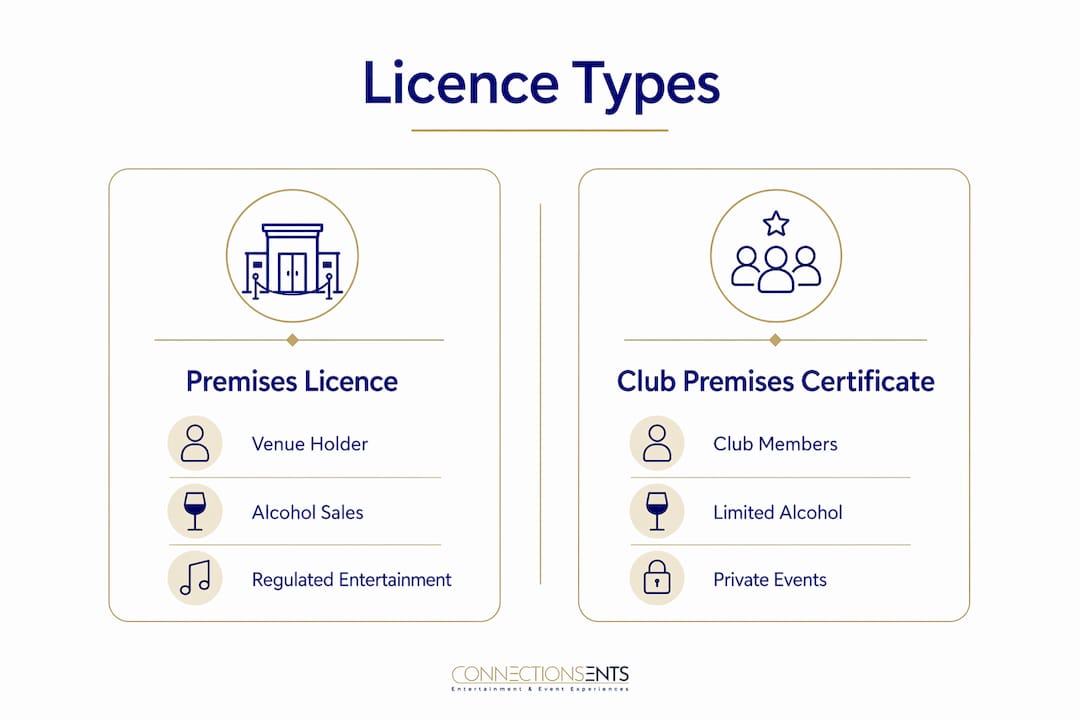
The term “licensed venue” is widely used, but the precise legal term under UK law is a premises holding a premises licence or club premises certificate. These are the two primary documents that determine whether a location is authorised to carry out licensable activities, which are defined in Section 1 of the Licensing Act 2003.
Premises licence vs club premises certificate
A premises licence applies to commercial venues open to the general public, such as hotels, restaurants, pubs, and dedicated event spaces. It specifies exactly which licensable activities are permitted, the hours during which they can take place, and any conditions attached. A club premises certificate, by contrast, applies to qualifying members’ clubs such as working men’s clubs or sports clubs, where alcohol is supplied to members rather than sold to the public. Both documents are issued by the local licensing authority and are publicly accessible.
The four licensable activities these licences can cover are:
- Retail sale of alcohol (or supply to members in the case of clubs)
- Regulated entertainment, including live music, recorded music, plays, films, and indoor sporting events
- Late night refreshment, meaning the supply of hot food or drink between 11pm and 5am
- Club activities specific to members’ clubs
A critical point many event planners overlook is that a premises licence must explicitly include regulated entertainment in addition to alcohol sales to legally host music or dancing. A venue licensed only for alcohol cannot lawfully provide a live band or DJ without that additional authorisation on its licence.
Temporary Event Notices and personal licences
For events in non-licensed venues or for extending the hours of an existing licence, organisers can apply for a Temporary Event Notice (TEN). TENs provide temporary authorisation for licensable activities at events with fewer than 500 attendees. They are a practical solution for one-off gatherings in village halls, private gardens, or community spaces, but they come with strict limitations discussed later in this article.
A personal licence is a separate document held by an individual, not a premises. Most licensed venues also require a designated premises supervisor (DPS), a personal licence holder who takes legal responsibility for alcohol sales on site. A DPS is mandatory for most venues licensed to sell alcohol, and their presence is a strong indicator that a venue takes its legal obligations seriously.
| Licence type | Who holds it | What it covers |
|---|---|---|
| Premises licence | The venue or business | Alcohol, entertainment, late night refreshment at a fixed location |
| Club premises certificate | A qualifying members’ club | Alcohol supply and entertainment for members |
| Temporary Event Notice | An individual organiser | Short-term licensable activities, under 500 attendees |
| Personal licence | An individual | Authorises that person to sell or authorise alcohol sales |
Common venues that typically hold premises licences include hotels, banqueting suites, theatres, sports stadiums, and licensed restaurants. When you book a licensed event space at one of these locations, the venue’s existing licence generally covers your event, provided your planned activities fall within the scope of what the licence authorises.
How do licensed venues ensure safety and legal compliance?
Licensed venues are legally obliged to uphold the four licensing objectives set out in the Licensing Act 2003. These objectives are the foundation of every premises licence and club premises certificate in England and Wales.
The four objectives are:
- Preventing crime and disorder at and around the venue
- Ensuring public safety for all attendees and staff
- Preventing public nuisance, including noise and anti-social behaviour
- Protecting children from harm, including age verification for alcohol
Every condition attached to a premises licence exists to support one or more of these objectives. This means that when you book a licensed venue, you are not simply hiring a room. You are engaging with a regulated environment where the operator is legally accountable for maintaining these standards throughout your event.
The DPS plays a central role in this. They are personally responsible for ensuring alcohol is served lawfully, that capacity limits are respected, and that licence conditions are met. Licensed venues reduce liability for event organisers because the venue operator carries a significant portion of the legal responsibility for compliance. If something goes wrong at an unlicensed gathering, the organiser may face direct legal consequences with no regulatory framework to fall back on.
Safety measures commonly mandated by licence conditions include trained door staff, CCTV systems, noise limiters, age verification policies, and maximum occupancy controls. These are not optional extras. They are conditions the venue must meet to retain its licence. For you as an organiser, this translates directly into peace of mind.
Pro Tip: Ask the venue manager to share a copy of their premises licence before you sign a booking contract. The licence document lists every authorised activity and any conditions attached. This takes five minutes and can prevent significant problems on the day.
Working with licensed venues and vetted vendors also reduces the administrative burden on you as an organiser. The venue’s existing compliance infrastructure means you are not starting from scratch on safety planning. You can focus on the experience rather than the paperwork.
What common misconceptions surround licensed venues?
Several persistent myths cause event planners to make costly assumptions about venue licences. Understanding these misconceptions protects you from last-minute cancellations, fines, or events that cannot legally proceed as planned.
A general business licence covers all event activities. This is incorrect. Mistaking licence types is one of the most common errors organisers make. A business registration or public assembly permit does not authorise alcohol sales or regulated entertainment. These require specific licensable activity authorisations within a premises licence.
If a venue sells alcohol, it can host live music. Not necessarily. Many venues licensed for alcohol are not authorised for regulated entertainment. A restaurant with an alcohol licence cannot automatically host a live band unless its premises licence explicitly includes regulated entertainment as an authorised activity.
Community and school venues are always exempt from licensing. This is partially true but frequently misunderstood. Community premises such as village halls may not require a premises licence for events under 500 attendees, but this depends on the specific activities planned and the venue’s existing authorisations. Organisers must verify each venue’s status with the local licensing authority rather than assuming an exemption applies.
A Temporary Event Notice is a reliable fallback for any event. TENs are useful but limited. TENs have strict annual limits per person and per premises, and they can be objected to by the police or environmental health authorities if they conflict with licensing objectives such as public safety or noise control. Relying on a TEN for a large or complex event is a significant risk.
Checking the venue’s website is sufficient verification. A venue’s marketing materials may describe it as “fully licensed” without specifying which activities are covered or whether the licence is current. The only reliable verification is checking the actual premises licence document or consulting the local authority’s public register.
The practical consequence of these misconceptions is clear. An organiser who books a venue assuming it covers all planned activities, without reading the licence, may arrive on the day to find that alcohol cannot be served or that the DJ cannot legally perform. Verifying specific licences before signing any contract is not optional. It is the minimum due diligence every organiser should carry out.
How to find and verify a licensed venue for your event
Finding the right licensed facilities for events requires more than a Google search. The process involves checking official records, asking the right questions, and understanding exactly what a venue’s licence permits.
Start with the local authority’s public register. Every licensing authority in England and Wales maintains a public register of premises licences and club premises certificates. You can search these registers online or contact the authority directly. This tells you whether a venue holds a current licence and what activities it covers.
When speaking with venue managers, ask these specific questions:
- Does your premises licence include regulated entertainment, and does that cover live music and DJ performances?
- What are your licensed hours, and do they cover the full duration of our event?
- What is your maximum licensed capacity for this type of event?
- Who is your designated premises supervisor, and will they be present throughout?
- Are there any licence conditions that would affect our planned activities, such as noise restrictions or age policies?
Pro Tip: Request a copy of the premises licence schedule, not just a verbal confirmation. The schedule is a one-page summary of all authorised activities and conditions. Any reputable venue will provide this without hesitation.
Understanding licensed hours is particularly relevant for weddings and late-night events. A venue may be licensed for alcohol until midnight but only for regulated entertainment until 11pm. If your event programme includes a DJ set running until 1am, you need to confirm the licence explicitly covers that. For events at licensed venues for weddings, this detail is especially worth checking early in the planning process, as wedding receptions frequently run later than standard licensed hours.
Capacity limits are another area where organisers sometimes encounter surprises. A venue’s fire safety capacity and its licensed capacity are not always the same figure. The licensed capacity may be lower, and exceeding it is a breach of the premises licence conditions. Confirm both figures before finalising your guest list.
Working with entertainment providers who regularly operate in licensed venues is also a practical advantage. Professionals such as DJs, live bands, and photo booth operators who work frequently in licensed event spaces understand the compliance requirements and can flag potential issues before they become problems. You can browse professional entertainers who are experienced in working within licensed venue frameworks across Norfolk and East Anglia.
For events where no suitable licensed venue is available, a TEN remains an option. However, given the strict volume limits and potential objections that authorities can raise, it is worth consulting an event planning checklist to ensure all compliance steps are covered before submitting the notice. A well-structured event planning checklist can help you track licence verification alongside catering, entertainment, and logistics in a single process.
Key takeaways
A licensed venue for events in the UK is defined by its premises licence or club premises certificate, which must explicitly authorise each planned activity, including alcohol sales and regulated entertainment, before any event can legally proceed.
| Point | Details |
|---|---|
| Legal definition matters | A licensed venue holds a premises licence or club premises certificate under the Licensing Act 2003. |
| Licences are activity-specific | Alcohol and entertainment authorisations are separate; always verify both are included. |
| TENs have real limitations | Temporary Event Notices are capped at 500 attendees and can be objected to by authorities. |
| Verify before you book | Request the premises licence schedule from the venue manager before signing any contract. |
| Licensed venues reduce your risk | Venues legally obliged to meet licensing objectives carry significant compliance responsibility on your behalf. |
Why licensed venues are non-negotiable in my experience
I have worked across hundreds of events in Norfolk and East Anglia, and the single most consistent source of last-minute stress is an organiser discovering, too late, that their venue’s licence does not cover what they planned. It is rarely a deliberate oversight. Most people simply do not know what questions to ask, and venues do not always volunteer the detail unprompted.
What I find most telling is how often the phrase “fully licensed” appears in venue marketing without any specifics attached. That phrase means almost nothing on its own. A venue can be licensed for alcohol but not for a DJ. It can be licensed for entertainment until 10pm but not midnight. The gap between what a venue implies and what its licence actually permits is where events run into trouble.
The four licensing objectives are not bureaucratic box-ticking. They exist because events without proper oversight genuinely do cause harm, whether through noise complaints that end a party early, overcrowding incidents, or alcohol-related disorder. When a venue takes its licence seriously, you feel it in the quality of the operation. The staff are trained, the procedures are clear, and the environment is genuinely safer for everyone attending.
My honest recommendation is this: treat licence verification the same way you treat venue capacity or catering confirmation. It is not a legal formality to delegate. It is a core part of your event planning process, and getting it right early saves considerable difficulty later.
— Darren
Plan your event with Connections Entertainment
Once you have confirmed your venue’s licence covers your planned activities, the next step is building an entertainment programme that makes the most of that space. Connections Entertainment works with event organisers across Norfolk and East Anglia to provide professional DJs, live music, tribute acts, photo booths, and full event coordination. Every entertainer on the roster is experienced in working within licensed venue frameworks, which means fewer complications and a smoother event day for you. Explore the full range of event entertainment options to understand what works best for your venue type, or browse the DJ disco services available for licensed venues across the region.
FAQ
What qualifies as a licensed venue under UK law?
A venue qualifies as licensed when it holds a valid premises licence or club premises certificate issued by the local licensing authority under the Licensing Act 2003. The licence must explicitly authorise the specific activities planned, such as alcohol sales or regulated entertainment.
Can any venue host a party with alcohol and music?
No. A venue must hold a premises licence that specifically authorises both alcohol retail and regulated entertainment to legally host a party with a bar and live or recorded music. A licence covering only one of these activities does not extend to the other.
What is a Temporary Event Notice and when do I need one?
A Temporary Event Notice is a short-term authorisation for licensable activities at events with fewer than 500 attendees, used when a venue does not hold a premises licence or when extending existing licensed hours. It must be submitted to the local licensing authority in advance and can be objected to by the police or environmental health.
How do I check if a venue is properly licensed?
Contact the local licensing authority for the area where the venue is located and request a search of the public register. You can also ask the venue directly for a copy of their premises licence schedule, which lists all authorised activities and conditions.
Do licensed venues for weddings need special licences?
Weddings held at a venue require the premises to hold a licence for the specific activities planned, including alcohol and entertainment, and the venue must also be approved for civil ceremonies if a legal marriage is to take place there. These are two separate authorisations, and both must be confirmed before booking.