
What is a dry hire venue? Your complete guide
Discover what a dry hire venue is and learn how to plan your event with total control over catering, décor, and entertainment. Click to explore!
TL;DR:
- A dry hire venue provides only the physical space, requiring event organizers to source and manage all other services independently. While the venue fee is typically lower, the total event costs can surpass full-service options due to external catering, staffing, and equipment expenses, demanding careful planning and coordination. This model offers maximum creative control but suits experienced planners with strong supplier relationships and ample lead time for logistics management.
A dry hire venue is a space rented without any bundled services, meaning you source and manage catering, staffing, AV, décor, and entertainment entirely yourself. The term “dry” refers to the absence of hospitality services, as opposed to a “wet hire” arrangement where food, drink, and staffing come included. Typical inclusions cover the room itself, basic furniture, WiFi, toilets, and a site contact, while everything else is your responsibility. For event planners in the UK, understanding this distinction is the foundation of every venue decision you will make.
What is a dry hire venue and what does the term mean?
A dry hire venue is defined as a hired space that provides the physical environment and little else, leaving the organiser to build the event from scratch. The industry also uses the term “blank canvas venue” to describe the same concept, particularly when the space is stripped back to bare walls and floors with minimal infrastructure. Blank canvas venues range from converted warehouses and art galleries to historic halls and purpose-built event spaces, all united by the same principle: you bring the experience.
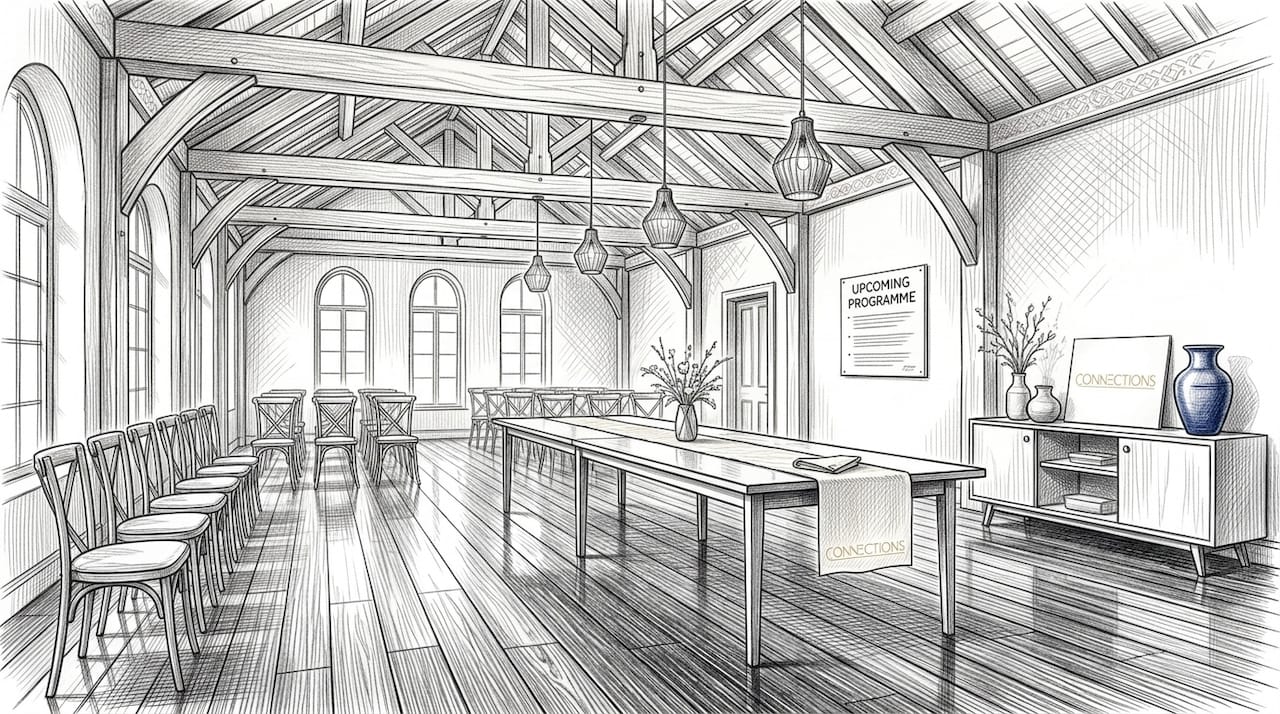
The word “dry” has a straightforward origin. In hospitality, a “wet” venue is one that holds a licence to serve alcohol and provides bar services as part of the package. A dry venue removes that layer entirely, and over time the term expanded to cover the removal of all bundled services, not just the bar. This linguistic history matters because it explains why the same space can sometimes be offered on both a dry and a wet hire basis depending on the package you select.
What you actually receive with a dry hire booking varies considerably between venues. Some spaces provide kitchen access, fixed projectors, or built-in PA systems as part of the base hire. Others hand you a set of keys and expect you to supply everything from tables to power distribution boards. Confirming exactly what is and is not included before you sign any contract is not optional. It is the single most consequential step in the entire booking process.
What is included and excluded in a dry hire venue package?
Understanding the typical contents of a dry hire package prevents costly surprises on the day. Most venues offer a broadly consistent set of inclusions, but the gaps between them can be significant.
Common inclusions in a dry hire venue:
- The event space itself, including access to all agreed rooms and outdoor areas
- Basic furniture such as trestle tables and stacking chairs (quantities vary)
- Toilet facilities and cloakroom access
- WiFi connectivity, though bandwidth may not suit large-scale AV production
- A site contact or venue manager present during the event
- Heating, lighting, and mains power access via standard sockets
Typical exclusions you will need to source independently:
- Catering and bar services, including all food, drink, and licensed bar staff
- AV equipment such as PA systems, lighting rigs, projectors, and screens
- Event décor, floral arrangements, linen, and centrepieces
- Event staffing including waiting staff, security, and cloakroom attendants
- Cleaning before and after the event, beyond basic venue preparation
- Furniture upgrades, staging, or dance floors beyond the base provision
Some venues provide kitchen access and fixed AV infrastructure; others do not. A venue that advertises a “fully equipped kitchen” may mean a domestic-grade oven rather than a commercial catering kitchen. Always ask your caterer to inspect the kitchen before you commit to the venue, not after.
Pro Tip: Request a full written inventory of everything included in your hire fee before signing. Walk the venue with your caterer and AV supplier present so they can assess the space against their own technical requirements.
The concept of a preferred supplier list is another important nuance. Many dry hire venues impose approved or preferred suppliers for catering, bar services, or AV to manage risk, insurance compliance, and quality standards. This limits your freedom to choose any supplier you like, so clarify this policy at the very first enquiry stage.
Dry hire vs full-service venues: flexibility, cost, and responsibility
The dry hire versus full-service comparison is not simply about price. It is about how much control you want and how much coordination you are prepared to manage.
| Factor | Dry hire venue | Full-service venue |
|---|---|---|
| Creative control | High: you choose every supplier and detail | Limited: venue packages define the offering |
| Venue hire fee | Generally lower | Generally higher, reflecting bundled services |
| Total event cost | Often higher once all suppliers are added | More predictable; costs are consolidated |
| Coordination effort | High: you manage multiple supplier relationships | Low: venue team handles most logistics |
| Catering flexibility | Full freedom (subject to approved lists) | Restricted to in-house or preferred caterers |
| Risk level | Higher: more variables to manage | Lower: single point of accountability |
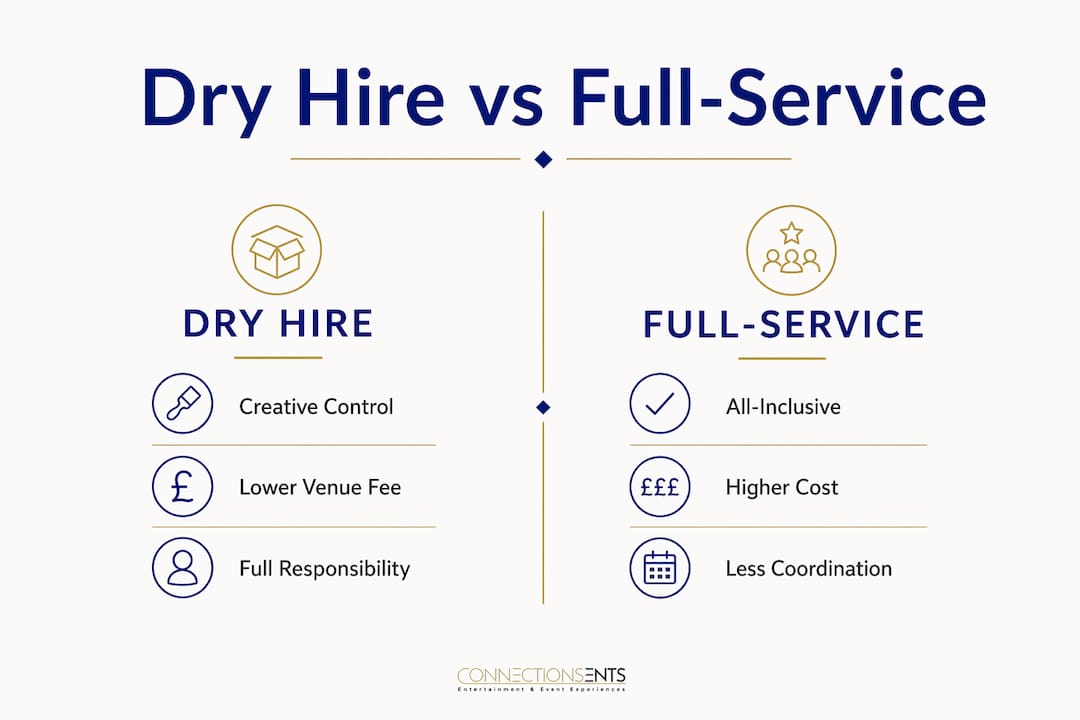
External catering can cost 15 to 25% more than in-house options at full-service venues. This is a critical figure for budget planning, because many organisers choose dry hire expecting to save money, only to find that the combined cost of external catering, staffing, AV hire, and décor exceeds what a full-service package would have cost. The venue hire fee is cheaper; the total event cost is frequently not.
That said, dry hire delivers genuine value in specific circumstances. If you have an existing relationship with a caterer who charges competitive rates, or if your event requires a production setup that a full-service venue cannot accommodate, the flexibility justifies the complexity. Brand activations, product launches, and events with bespoke aesthetic requirements are natural candidates for dry hire. A corporate dinner with 80 guests who simply want good food and a reliable evening is often better served by a full-service venue.
Pro Tip: Build a full line-item budget before choosing between dry hire and full-service. List every supplier you will need, get indicative quotes, and compare the total against a full-service package. The entertainment budget breakdown approach works equally well for corporate events and private parties.
Dry hire offers freedom versus accountability: full creative control comes with full responsibility for event integration and management. This is not a warning to avoid dry hire. It is a prompt to go in with your eyes open.
What planning challenges come with dry hire, and how do you manage them?
Coordination burden in dry hire is consistently underestimated. Planners must manage deliveries, supplier schedules, technical checks, and setup logistics independently, and this is the single most common source of day-of problems. The following steps give you a structured approach to managing the complexity.
Start planning at least three months out. Lead times of 3+ months are recommended to coordinate multiple suppliers effectively. Popular caterers, AV companies, and entertainment acts book up quickly, particularly for Saturday events between April and October.
Map every supplier you need before you book the venue. Create a master supplier list covering catering, bar, AV, lighting, décor, furniture hire, security, cleaning, and entertainment. Identify which of these the venue restricts through an approved supplier policy.
Conduct a detailed venue walk-through with your key suppliers. Treat the venue as a technical production shell and verify all operational parameters: kitchen usability, power and data capacity, load-in and load-out windows, parking for supplier vehicles, and any noise restrictions or curfews.
Build a consolidated event-day schedule. List every supplier arrival time, setup window, and departure slot. Share this with all parties at least four weeks before the event. Conflicts between supplier schedules are far easier to resolve in advance than on the day.
Confirm insurance and licensing requirements. Check whether your caterer holds public liability insurance, whether your bar supplier holds a temporary event notice (TEN) or relies on the venue’s licence, and whether your AV company’s equipment is PAT tested. Dry hire venues place the compliance burden on the organiser.
Consider engaging a professional event coordinator. If you are managing more than six suppliers or planning an event for over 100 guests, a dedicated coordinator pays for itself in reduced stress and avoided mistakes. Many coordinators in Norfolk and East Anglia specialise in exactly this kind of multi-supplier event management.
Plan contingencies for supplier failure. Identify backup options for your highest-risk suppliers, particularly catering and entertainment. A supplier who cancels two weeks before your event is a manageable problem if you have a contingency plan. Without one, it becomes a crisis.
What types of events and organisers suit dry hire venues?
Dry hire venues suit organisers with strong supplier relationships and specific creative needs. They are less suited to those wanting turnkey, low-coordination events. Knowing which category you fall into saves considerable time and money.
Events that work well in dry hire spaces:
- Brand activations and product launches where the physical environment must reflect a specific brand identity that a standard full-service venue cannot deliver
- Weddings with bespoke aesthetic requirements, such as couples who want a specific caterer, a particular florist, or a production-level lighting design that a hotel ballroom cannot accommodate
- Corporate away days and team events where the organiser has an in-house events team or a trusted agency managing supplier relationships
- Arts and cultural events held in galleries, warehouses, or industrial spaces where the raw architecture is part of the event’s appeal
- Large-scale private parties where the organiser has hosted similar events before and has an established network of reliable suppliers
Organisers who are less well served by dry hire:
- First-time event planners without existing supplier relationships, who will spend significant time sourcing and vetting every element from scratch
- Those working to tight timelines of less than six weeks, where coordinating multiple suppliers becomes genuinely difficult
- Organisers whose priority is a stress-free experience rather than creative control, and who would rather pay a premium for a single point of accountability
- Events with modest budgets where the cost of sourcing external catering, AV, and staffing will exceed the savings made on the venue hire fee
The venue types most commonly offered as dry hire include converted warehouses, art galleries, historic halls, civic buildings, and purpose-built blank canvas spaces. Each brings its own operational constraints. A Victorian warehouse may have limited power capacity. A listed historic hall may restrict the use of open flames, confetti, or adhesive fixings on walls. Understanding the specific constraints of your chosen space is as important as understanding the dry hire model itself.
Key takeaways
A dry hire venue gives you full creative control but places the entire coordination and cost burden on you as the organiser.
| Point | Details |
|---|---|
| Dry hire definition | A venue rented without bundled services; you source catering, AV, staffing, and décor independently. |
| Inclusions vary widely | Always request a written inventory; never assume kitchen quality or AV provision without verification. |
| Total costs often exceed expectations | External catering alone can cost 15 to 25% more than in-house options at full-service venues. |
| Lead time is critical | Start coordinating suppliers at least three months before the event to avoid scheduling conflicts. |
| Suitability depends on experience | Dry hire rewards experienced planners with supplier networks; it adds significant risk for first-time organisers. |
Why I think dry hire venues are misunderstood by most event planners
Most articles about dry hire frame it as a budget choice. In my experience, that framing causes more problems than it solves. Planners choose a dry hire venue expecting to save money, then discover that the catering, AV, staffing, and décor they need to source independently costs more than a full-service package would have. The venue hire fee is lower. The total event cost is frequently higher.
The real reason to choose dry hire is creative control, not cost. If you need a specific caterer, a particular entertainment format, or a production setup that a hotel ballroom simply cannot accommodate, dry hire is the right tool. If you are choosing it primarily to save money without a detailed budget comparison, you are taking a risk that often does not pay off.
The other thing I see consistently underestimated is the coordination overhead. Managing six to ten suppliers across a single event day is a full-time job in the weeks leading up to it. Planners who have never done it before routinely underestimate how much time it takes to align load-in schedules, confirm insurance documents, chase outstanding contracts, and handle the inevitable last-minute changes. If that description sounds daunting, either engage a professional coordinator or reconsider whether a full-service venue better matches your capacity. There is no shame in choosing the option that fits your actual situation rather than the one that sounds more creative.
One practical habit I recommend to every organiser using a dry hire space: walk the venue twice. Once when you first view it, and once again with your caterer and AV supplier present. The questions they ask will reveal operational constraints you would never have thought to check yourself. That second walk-through has saved more than a few events from serious day-of problems.
— Darren
How Connections Entertainment supports dry hire event planning
Sourcing entertainment for a dry hire venue is one of the most rewarding parts of the planning process, because you have complete freedom to choose acts and formats that genuinely fit your event. Connections Entertainment offers a wide range of professional entertainers for events across Norfolk and East Anglia, from DJs and live bands to photo booths, tribute acts, and lighting packages. Whether you are planning a wedding, a corporate function, or a private party in a blank canvas space, the team at Connections Entertainment can help you match the right entertainment to your venue and audience. For a broader overview of what entertainment can bring to your event, the guide to event entertainment value is a practical starting point. Get in touch to discuss your dry hire event and find out what is available for your date.
FAQ
What does dry hire mean for a venue?
Dry hire means renting a venue space without any bundled services such as catering, bar, AV, or staffing. You are responsible for sourcing and managing all additional event elements independently.
What is typically included in a dry hire venue?
Most dry hire venues include the event space, basic furniture, WiFi, toilet facilities, and a site contact. Catering, décor, AV equipment, and event staffing are almost always excluded and must be arranged separately.
Is dry hire cheaper than a full-service venue?
The venue hire fee is generally lower with dry hire, but total event costs are often higher once external catering, staffing, AV, and décor are added. External catering can cost 15 to 25% more than in-house options at full-service venues.
How much lead time do you need for a dry hire event?
A minimum of three months is recommended to coordinate multiple suppliers effectively. Popular caterers, entertainment acts, and AV companies book up quickly, particularly for weekend events during peak season.
Can you use any supplier at a dry hire venue?
Not always. Many dry hire venues operate preferred or approved supplier lists for catering, bar services, or AV, which limits your freedom to choose any supplier. Always confirm the venue’s supplier policy before booking.