
What is a dedicated event space? Your 2026 guide
Discover what is a dedicated event space and why it’s essential for your event planning. Maximize control and guest experience in 2026!
TL;DR:
- A dedicated event space offers exclusive use of a venue, providing full control over the environment, schedule, and guest experience. Its level of exclusivity, infrastructure, and support services directly impact privacy, flexibility, and operational ease for various occasions. Careful review of contractual exclusivity and infrastructure features ensures a smooth, stress-free event aligned with your specific needs.
A dedicated event space is defined as a venue or area reserved exclusively for your event, giving you full control over the environment, schedule, and guest experience without interference from unrelated bookings. The term “dedicated event space” is widely used in event planning, though the industry also refers to these as exclusive use venues or purpose-built event facilities. Whether you are organising a corporate conference, a wedding reception, or a private celebration, understanding this distinction shapes every decision you make about booking, budgeting, and logistics.
Dedicated event venues differ from general-purpose hired rooms in one fundamental way: the space exists to serve your event alone. Venues such as TriVision Event Center and Navy Pier illustrate the range available, from purpose-built facilities with production-grade infrastructure to grand multi-room complexes accommodating everything from intimate gatherings to events hosting thousands of guests. Ginny Lawson PR describes exclusive use as covering the entire venue including all rooms, halls, and gardens, offering complete privacy and the freedom to tailor your event schedule without compromise. That level of control is the defining benefit of a dedicated space, and it is what separates it from a standard room hire or a shared public venue.
What is a dedicated event space and what makes it exclusive?
Exclusivity in a dedicated event space is not a single fixed concept. It exists on a spectrum, and where your booking sits on that spectrum determines how much privacy and control you actually receive. Understanding this before you sign a contract protects you from surprises on the day.
At the most basic level, exclusivity can mean sole use of a single room while other events run elsewhere in the building. At the other end, full venue exclusivity covers every room, corridor, terrace, car park, and outdoor area on the property. The difference matters enormously for guest experience, noise management, and the overall atmosphere you create.
Beck and Bulow note that venues differ significantly on exclusivity terms, making explicit clarification a non-negotiable step for any planner. The key areas to confirm before booking include:
- Whether shared facilities such as lobbies, toilets, and car parks are included in your exclusive use
- Whether outdoor spaces like terraces, gardens, or courtyards are part of your booking
- Whether staff from other events will be present on the property during your hire period
- Whether the venue can receive deliveries or set-up crews for other events while yours is running
“Exclusive use can range from having only the main event room to the entire property, including amenities like parking, terraces, and shared dining — and this directly affects privacy and control.” — Beck and Bulow
Premium pricing for full exclusivity reflects the genuine operational commitment from the venue. When a property closes its doors entirely to other bookings, it forgoes other revenue. For planners, that cost buys something real: the ability to run your event on your own timeline, decorate every corner of the space, and guarantee your guests are not sharing facilities with strangers.
How do dedicated event spaces differ from dry hire venues?
The hire model you choose shapes the entire planning process. Two of the most common models are dry hire and what is often called wet hire or a fully supported dedicated venue. Knowing the difference prevents budget miscalculations and last-minute scrambles for suppliers.
Dry hire is defined by Town Hall Spaces as a venue rental that includes the room, basic furniture, and Wi-Fi but excludes catering, bar services, AV equipment, decoration, and event staff. You receive the physical space and little else. This model suits experienced planners with established supplier networks, but it places the full coordination burden on you.

A fully supported dedicated event space, by contrast, bundles operational services into the hire. This typically includes in-house catering, AV technicians, event coordinators, and sometimes entertainment packages. The planning workload is substantially lower, and the risk of supplier no-shows or equipment failures is reduced because the venue manages those elements directly.
The table below summarises the key differences to help you decide which model suits your event:
| Feature | Dry hire | Fully supported dedicated space |
|---|---|---|
| Room and furniture | Included | Included |
| Catering and bar | Not included | Usually included or available |
| AV equipment and technicians | Not included | Usually included |
| Event staff and coordination | Not included | Usually included |
| Decoration and styling | Not included | Varies by venue |
| Planning workload | High | Lower |
| Flexibility for external suppliers | High | May be restricted |
| Typical cost structure | Lower base cost, higher add-ons | Higher base cost, fewer add-ons |
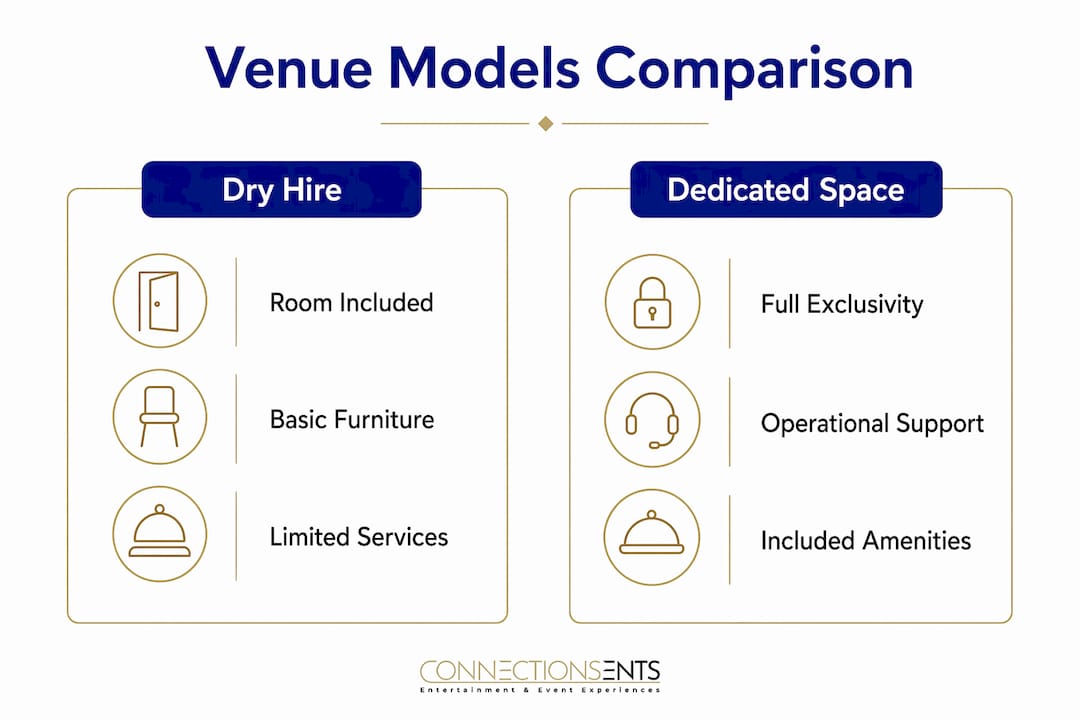
For a deeper look at the dry hire model specifically, the complete dry hire guide from Connections Entertainment covers what to expect and how to plan effectively for that format.
Pro Tip: If you choose dry hire, treat the venue as a blank canvas and build a detailed supplier checklist covering AV, catering, staffing, decoration, and entertainment before you confirm the booking. Costs escalate quickly when these are sourced separately under time pressure.
Town Hall Spaces confirm that dry hire coordination requires planners to budget for and manage all external suppliers independently, which increases both complexity and risk. For first-time event organisers or those planning large-scale occasions, a fully supported dedicated space often represents better value when the full cost of external suppliers is factored in.
What features and infrastructure do dedicated event spaces offer?
The physical and operational features of a dedicated event space are what separate a genuinely capable venue from one that simply has a large room. When you are evaluating specialized event locations, the infrastructure on offer determines whether your event runs smoothly or requires constant improvisation.
TriVision Event Center demonstrates what purpose-built infrastructure looks like in practice. The venue offers over 6,000 sq ft of uninterrupted floor space with configurable layouts that adapt to different event formats without operational compromise. That kind of flexibility means the same venue can host a theatre-style conference in the morning and a standing reception in the evening, with a full reset in between.
Key features to look for in a dedicated event space include:
- Configurable layouts: Theatre, banquet, classroom, cabaret, and standing reception configurations should all be achievable within the same footprint
- Production-grade AV: Built-in sound systems, projection screens, LED walls, and lighting rigs reduce the need for external AV hire
- Control rooms: Dedicated technical spaces allow AV operators to manage sound and vision without disrupting the guest area
- Green rooms and prep spaces: Separate areas for performers, speakers, or wedding parties to prepare away from guests
- Loading bays and service access: Practical logistics matter; venues with dedicated service entrances allow set-up and breakdown without disrupting the guest experience
- Dedicated support staff: On-site coordinators who know the space and can troubleshoot in real time
Venues with operational control rooms and flexible floor plans enable complex event programmes without compromise, supporting smooth transitions between keynote sessions, breakout workshops, and evening receptions within a single footprint. This is particularly valuable for corporate events where the programme shifts format multiple times throughout the day.
Scale is another defining characteristic. Dedicated event spaces range from boutique halls suited to gatherings of under 20 guests to large purpose-built complexes accommodating thousands. Navy Pier in Chicago, for example, supports events from intimate business meetings to galas hosting 2,800 guests, all within a single managed venue. That range of scale means there is a dedicated space suited to almost any occasion size, provided you match the venue’s capacity to your guest list accurately.
For planners thinking about how entertainment integrates with venue infrastructure, a venue entertainment calendar can help you understand how flexible spaces are programmed and what operational features support live acts, DJs, and technical production.
What occasions benefit most from a dedicated event space?
Dedicated event venues deliver the greatest value when the occasion demands privacy, a tailored atmosphere, or a complex programme that a general-purpose room simply cannot support. Matching the venue type to the event format is one of the most practical decisions you will make during the planning process.
The following occasions consistently benefit from booking a dedicated space:
Corporate conferences and off-sites: Multi-session programmes with keynote presentations, breakout workshops, and networking receptions require a venue that can reconfigure between formats. A dedicated space with multiple rooms and AV infrastructure handles this without the logistical friction of a hotel conference suite shared with other businesses.
Weddings and civil ceremonies: A dedicated wedding venue gives couples exclusive use of the ceremony space, reception hall, and grounds. This means no other wedding parties, no shared timelines, and complete freedom to personalise every detail from floral arrangements to lighting. For ideas on taking a wedding celebration further, the wedding party options guide from Connections Entertainment offers practical inspiration.
Private celebrations and milestone events: Birthday galas, anniversary dinners, and charity fundraisers benefit from the privacy and atmosphere control that a dedicated space provides. Guests are not sharing the venue with strangers, which changes the social dynamic significantly.
Team events and company parties: Office parties and team-building events work best in spaces that can be fully branded and themed. A dedicated venue allows you to transform the environment completely, which a shared hotel bar or restaurant simply cannot offer. Connections Entertainment’s guide to office party themes shows how much a dedicated space amplifies themed events.
Product launches and brand activations: These events depend on controlled environments where every visual and sensory element reinforces the brand message. A dedicated space with configurable AV and layout options makes this achievable.
Dedicated event spaces serve occasions ranging from 10 to 2,800 guests, covering conferences, galas, business meetings, and social gatherings. The key is not just finding a space large enough for your guest list, but finding one whose layout options, support services, and exclusivity terms match the specific format of your event. A seated gala dinner has entirely different requirements from a standing cocktail reception, even if the guest numbers are identical.
For corporate event planners specifically, the guide to creating a corporate event in Norwich from Connections Entertainment covers how to align venue choice with programme requirements in practical detail.
Key takeaways
A dedicated event space is defined by exclusivity, operational infrastructure, and the ability to tailor every element of the guest experience to your specific occasion.
| Point | Details |
|---|---|
| Exclusivity varies significantly | Confirm exactly which areas are included in your exclusive use before signing any contract. |
| Dry hire shifts responsibility to you | Budget for all external suppliers separately, including AV, catering, staffing, and decoration. |
| Infrastructure determines event quality | Look for configurable layouts, production-grade AV, and dedicated support spaces as standard. |
| Match venue to occasion format | A seated dinner and a standing reception need different layouts, even at the same guest count. |
| Scale range is wide | Dedicated spaces exist for gatherings of under 20 to events hosting thousands, so size is not a barrier. |
Why I always tell planners to read the exclusivity clause first
When people ask me what separates a good dedicated event space booking from a stressful one, my answer is always the same: read the exclusivity clause before you fall in love with the room.
I have seen planners book what they believed was a fully private venue, only to discover on the day that the car park was shared with a neighbouring business, the lobby was accessible to the public, and the garden they had planned to use for drinks was technically outside their hire agreement. None of this was hidden. It was all in the contract. They simply had not asked the right questions early enough.
The most common misconception I encounter is that “exclusive use” automatically means the entire property. It frequently does not. Many venues use the phrase to describe sole use of a single room or floor, while other events run elsewhere in the building. Beck and Bulow make this point clearly: full venue exclusivity is a specific and often premium product, not the default interpretation of the term.
My practical advice is to ask three questions before you commit to any dedicated space. First, what exactly is included in my exclusive use, room by room and area by area? Second, will any venue staff be serving other clients during my hire period? Third, can I access the space for set-up and breakdown outside the core hire hours, and is that included in the price?
Beyond exclusivity, I would encourage planners to evaluate operational infrastructure as seriously as they evaluate aesthetics. A beautiful room with no AV control room, no loading bay, and no on-site coordinator will create problems that no amount of decoration can solve. Venues with dedicated technical infrastructure, as TriVision Event Center demonstrates, allow you to run complex programmes without the constant risk of something going wrong at a critical moment.
The dry hire versus fully supported question also deserves honest reflection. Dry hire gives you freedom, but freedom has a cost in time, coordination effort, and risk. If you are planning your first large event or working to a tight timeline, a fully supported dedicated space often delivers better results even at a higher base price.
— Darren
Make your dedicated space unforgettable with Connections Entertainment
Booking the right venue is only part of the equation. The entertainment you bring into that space is what guests remember long after the evening ends. Connections Entertainment works with event planners across Norfolk and East Anglia to match the right entertainment to the right venue, whether that is a DJ for a corporate dinner, a live band for a wedding reception, or a tribute act for a private celebration. The team understands how dedicated event spaces work operationally, which means entertainment is planned around your venue’s layout, AV infrastructure, and programme schedule rather than bolted on as an afterthought. Explore the full range of event entertainment options and see how professional entertainment transforms a dedicated space into a genuinely memorable occasion. Browse the full entertainers catalogue to find the right fit for your event.
FAQ
What is the difference between exclusive use and a private event area?
Exclusive use means your group has sole access to the entire venue or a defined portion of it, with no other unrelated events running concurrently. A private event area is a designated section within a larger venue that may still operate other events elsewhere on the property.
What does dry hire mean for a dedicated event space?
Dry hire covers the room, basic furniture, and Wi-Fi but excludes catering, AV, staffing, and decoration. Planners must source and coordinate all additional services independently, which increases both workload and budget complexity.
How do I choose the right dedicated event space for my occasion?
Match the venue’s layout options, capacity, and included services to your specific event format. Confirm the exact scope of exclusivity, check AV and support infrastructure, and clarify whether the hire is dry or fully supported before committing.
Can dedicated event spaces accommodate both small and large gatherings?
Yes. Dedicated event spaces range from boutique halls for under 20 guests to purpose-built venues accommodating thousands, making them suitable for intimate private dinners and large-scale corporate conferences alike.
Do dedicated event spaces always include catering and AV?
Not always. Fully supported venues bundle these services into the hire, while dry hire venues provide the space only. Always confirm what is included in writing before signing the event space rental agreement.