
Wedding reception music flow: your 2026 guide
Master your wedding reception music flow with our guide! Create the perfect atmosphere, keep energy high, and ensure no awkward pauses.
TL;DR:
- Effective wedding reception music flow involves carefully planning each phase to maintain energy and guest engagement. A professional DJ enhances the experience by reading the room, managing transitions, and using a detailed timeline. Trusting the DJ’s expertise ensures a lively, memorable event for all guests.
Wedding reception music flow is the purposeful arrangement and timing of songs across your reception to shape atmosphere, energy levels, and guest engagement. Get it right and your guests move from cocktails to the dance floor without a single awkward lull. Get it wrong and even the best venue feels flat. The industry term for this practice is reception music programming, though most couples and DJs simply call it music flow. This guide covers every phase of your reception, from the first background track to the final song of the night, so you can plan with confidence.
How to plan a wedding reception music flow timeline
A structured music timeline is the foundation of every successful reception. Without one, even a brilliant playlist falls apart because songs land at the wrong moment.
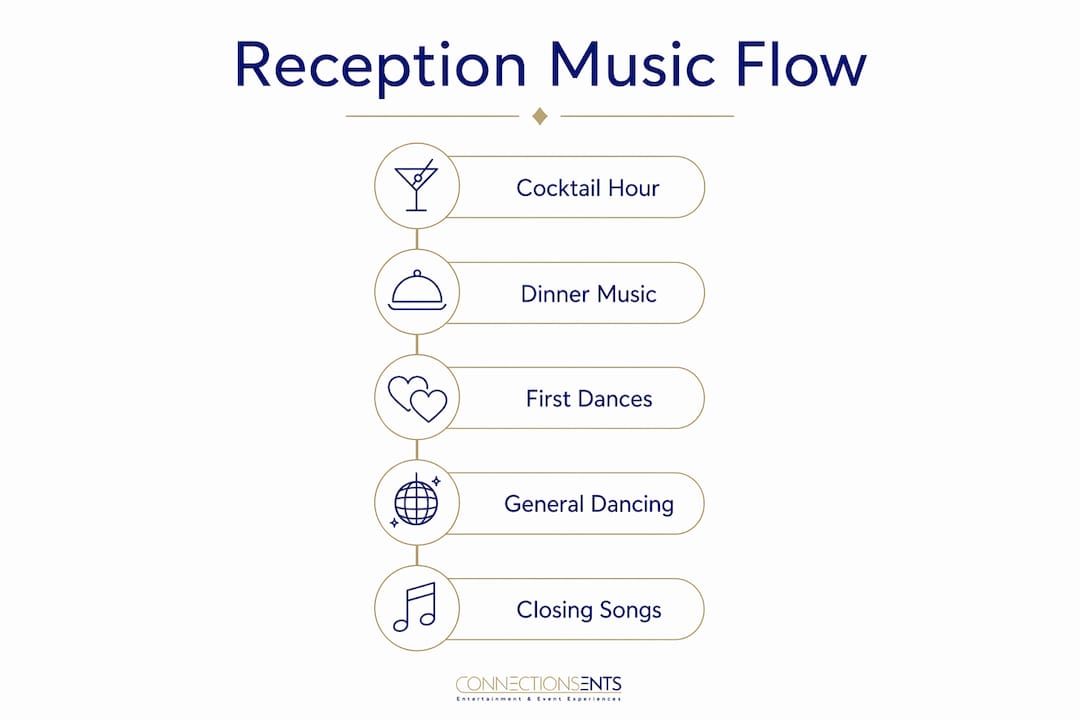
A typical 4–5 hour reception moves through these phases in order:
- Cocktail hour (45–60 minutes): Guests arrive, drinks are served, and the mood is set. Soft background music carries conversations without competing with them.
- Grand entrance (5 minutes): One or two high-energy tracks announce the wedding party and couple. Choose something that gets an immediate reaction.
- Dinner (60–90 minutes): Music drops in volume and energy. Guests need to hear each other across the table.
- First dance and parent dances (15–20 minutes): Emotional, personal tracks chosen by the couple. These are the reception’s most memorable moments.
- Cake cutting (5–10 minutes): A fun, lighter track works well here. It signals the shift from formality to celebration.
- Dancing (90–120 minutes): The main event. Energy builds from warm-up tracks to peak anthems.
- Last dance (1 song): A deliberate, memorable closing track. It tells guests the night is ending on a high.
A 4–5 hour reception generally requires 75–100 songs to maintain a consistent atmosphere across dinner and dancing. That breaks down to roughly 15–25 songs for dinner and 40–50 songs for a two-hour dance block. Those numbers give you a clear target when building your wedding music playlist.
Pro Tip: Share your detailed timeline with your DJ at least two weeks before the wedding. Include every announcement cue, the pronunciation of names for the grand entrance, and the exact moment you want each dance to begin. A detailed reception timeline helps your DJ manage transitions without needing to interrupt you on the night.
What songs and genres work best at each reception stage?
Song selection is where most couples spend the most time, and rightly so. The goal is a wedding music playlist that satisfies guests aged 25 and guests aged 75 without feeling like a compromise.
Cocktail hour: background music for weddings
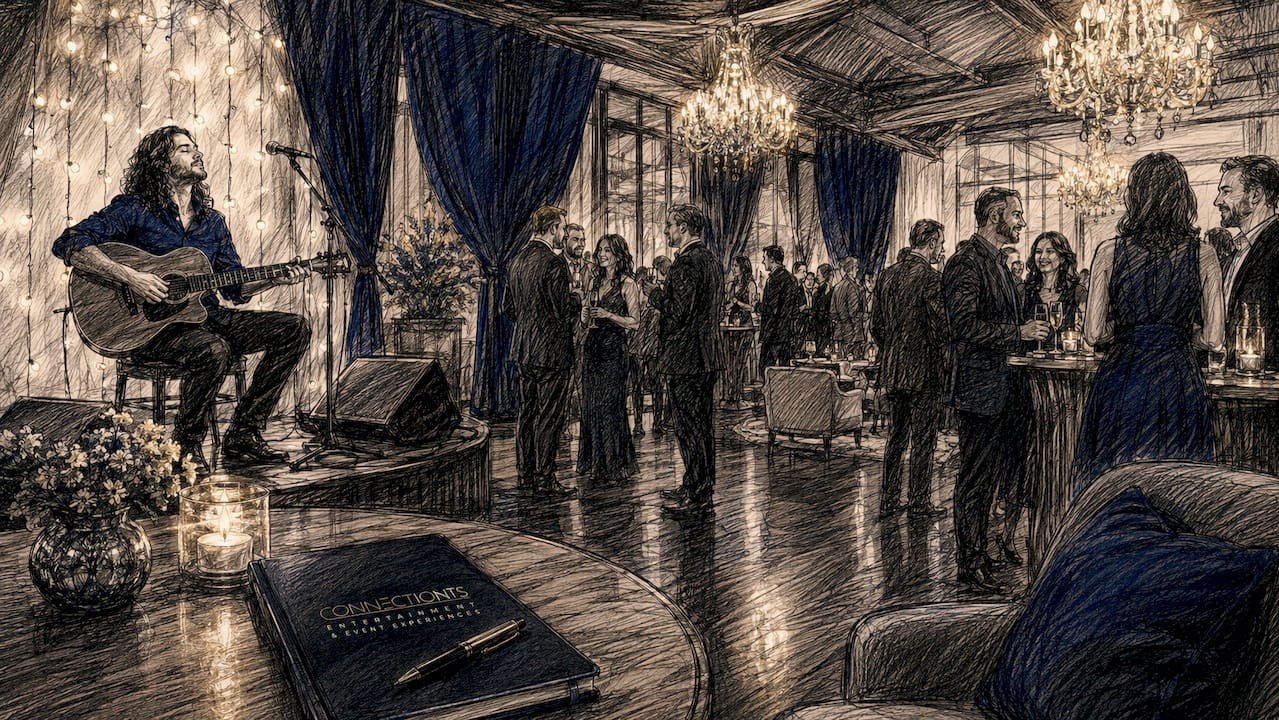
Cocktail hour music should feel welcoming and unobtrusive. Think jazz standards, acoustic covers, bossa nova, or light pop. The volume stays low enough for easy conversation. Live acoustic music during cocktail hour provides adaptable ambiance that a static playlist cannot match, because musicians read the room in real time and adjust accordingly. If live musicians are not in your budget, a carefully curated Spotify playlist of acoustic covers works well as a fallback.
Dinner: soft and unobtrusive
Dinner music should sit in the background, not demand attention. Soul, Motown, classic film scores, and soft pop all work. Keep the tempo moderate and avoid anything with a heavy beat that pulls focus away from conversation. Dinner service typically lasts 60–90 minutes, so you need enough variety to avoid repetition without introducing jarring genre shifts.
Dancing: building energy with anchor tracks
The dance floor section is where your reception music ideas need the most thought. The key principle is a phased build-up, not an immediate peak.
- Warm-up tracks (first 20–30 minutes): Familiar, feel-good songs that ease guests onto the floor. Think Motown classics, 80s anthems, or well-known pop hits.
- Mid-section (next 30–40 minutes): Energy rises. Current chart hits, 90s bangers, and crowd-pleasing classics keep momentum going.
- Peak dancing (final 30–40 minutes): Your biggest anthems. Reserve these for when the floor is full and the energy is at its highest.
- Closing track: One deliberate song that ends the night memorably.
The 30% Rule for dance sets recommends that at least 30% of your tracks are anchor songs. Anchor tracks are timeless hits that span age groups, such as “Mr Brightside” by The Killers, “September” by Earth, Wind and Fire, or “Uptown Funk” by Bruno Mars and Mark Ronson. They act as a reset button when a niche genre set loses part of the crowd.
Pro Tip: Build your playlist with at least three distinct genre zones: classics (Motown, soul, rock), mid-era hits (80s and 90s), and current chart tracks. Rotating through these zones keeps every age group engaged and prevents any single guest demographic from feeling left out.
How do professional DJs enhance music flow at your reception?
A professional DJ does far more than press play. Understanding this distinction is what separates a great reception from a forgettable one.
Professional DJs read the room and dynamically manage energy, unlike static playlists, ensuring higher guest engagement by adjusting song selection and pacing in real time. A playlist cannot notice that the dance floor has emptied or that a particular genre is clearing tables. A skilled DJ can.
Here is what a professional DJ brings to your reception that a playlist cannot:
- MC duties: Announcing the grand entrance, calling guests to the dance floor, and coordinating the cake cutting all require a confident, well-briefed voice.
- Timing coordination: DJs make critical timing calls roughly every fifteen minutes to keep the event flowing, liaising with caterers and photographers to align music cues with key moments.
- The Bridge and Build strategy: This technique uses anchor tracks to connect varied genres and transition between them without energy dips. Tempo matching ensures one song leads naturally into the next.
- Real-time adjustment: If a set of niche tracks clears the floor, a DJ pivots immediately. A playlist simply continues regardless.
- Do-not-play list management: A good DJ honours your exclusions as firmly as your requests.
“A playlist without a skilled DJ risks becoming disjointed. Responsiveness to guest reactions is what fills the floor and keeps the party alive.” — DJ Brian Anderson
The role of your wedding MC is often filled by your DJ, which makes the briefing conversation before your wedding one of the most important planning steps you will take. Give your DJ a written timeline, a pronunciation guide for all names, and a clear list of your must-play and do-not-play tracks.
Step-by-step guide to executing perfect music flow on your big day
Planning the music is one thing. Executing it without chaos on the day is another. Follow these steps to give your reception the best possible chance of running smoothly.
- Categorise your playlist before you share it. Divide tracks into four groups: slow and emotional, warm-up, peak dancing, and classics. Label them clearly so your DJ can locate the right track at the right moment without guessing.
- Create a written reception music timeline. Include every phase, the approximate start time, the track or genre for that phase, and any announcement cues. Share this with your DJ, venue coordinator, caterer, and photographer.
- Coordinate music cues with other vendors. Your photographer needs to know when the first dance starts. Your caterer needs to know when dinner music should fade for speeches. Misaligned cues are the most common cause of awkward silences.
- Set clear rules for guest requests. Decide in advance whether your DJ should accept requests, filter them, or decline them entirely. Unmanaged requests can derail a carefully planned music flow for receptions.
- Brief your DJ on energy management. Tell them where you want the energy to peak and where you want it to soften. A DJ who knows your intentions can make better real-time decisions.
Common mistakes vs. best practice
| Common mistake | Best practice |
|---|---|
| Playing peak anthems in the first hour | Reserve your biggest tracks for the peak dancing phase |
| No written timeline shared with vendors | Distribute a detailed timeline at least two weeks before the wedding |
| Ignoring energy transitions between phases | Plan deliberate warm-up and cool-down tracks between major phases |
| Insufficient DJ briefing | Provide a written timeline, pronunciation guide, and do-not-play list |
| Accepting all guest requests without a filter | Set a clear request policy with your DJ before the wedding |
Dumping top dance songs too early wastes energy and leaves nowhere to go. Professionals reserve peak anthems for the party peak to sustain momentum through the final hour. This single principle, applied consistently, is what keeps dance floors full until the last song.
Pro Tip: Ask your DJ to request songs guidance on managing guest requests professionally. A good DJ will have a system for filtering requests that honours your vision without offending guests.
Key takeaways
Effective wedding reception music flow depends on structured phase planning, multi-generational song selection, and a well-briefed professional DJ working from a detailed written timeline.
| Point | Details |
|---|---|
| Plan by phase | Divide your reception into cocktail, dinner, dances, dancing, and closing for targeted music choices. |
| Hit the right song count | Aim for 15–25 dinner songs and 40–50 dance tracks for a standard 4–5 hour reception. |
| Use anchor tracks | Fill at least 30% of your dance set with timeless crowd-pleasers to keep all age groups on the floor. |
| Brief your DJ in writing | Share a full timeline, name pronunciations, and a do-not-play list at least two weeks in advance. |
| Save your best for last | Reserve peak anthems for the final dancing phase to sustain energy and momentum. |
Music flow is a narrative, not just a playlist
I have seen hundreds of receptions over the years, and the ones that guests still talk about months later share one thing: the music told a story. It did not just play songs. It moved people from one emotional state to the next with intention.
The couples who hand their DJ a Spotify link and say “just play this” almost always end up with a reception that feels flat by 9pm. The couples who sit down with their DJ, walk through the timeline, explain which moments matter most, and trust the professional to fill the gaps, those are the receptions where the dance floor stays full until the venue lights come on.
Music at a reception is best thought of as storytelling, creating a warm-up, emotional depth, an energy peak, and a grand finale for maximised enjoyment. That framing changes how you approach every decision, from the cocktail hour background track to the song you choose to close the night.
My honest advice is this: do not try to control every song. Give your DJ a clear framework, your non-negotiables, and your vision for the night. Then let them do what they do best. The couples who trust that process consistently have the best receptions. The ones who micromanage every track often find the night feels rigid and loses its spontaneity.
Balance your personal taste with crowd-pleasers. Your guests will remember how the night felt, not whether every song was your personal favourite.
— Darren
Plan your wedding music with Connections Entertainment
Connections Entertainment works with couples across Norfolk and East Anglia to deliver wedding entertainment that fits the reception perfectly, from the first cocktail hour track to the final dance. The team includes experienced wedding DJs who specialise in reading the room, managing announcements, and keeping energy exactly where it needs to be throughout the night. Whether you want a DJ who doubles as MC, live musicians for your drinks reception, or a full wedding entertainment package, Connections Entertainment can match you with the right act for your vision. Browse the full range of wedding entertainers and get in touch to discuss a plan built around your reception timeline.
FAQ
What is wedding reception music flow?
Wedding reception music flow is the curated sequencing and timing of music across each phase of a reception, from cocktail hour to the last dance, to shape atmosphere and guest energy throughout the event.
How many songs do I need for a wedding reception?
A 4–5 hour reception typically requires 75–100 songs in total, with 15–25 tracks for dinner and 40–50 tracks for a two-hour dance block.
Should I hire a DJ or use a playlist for my reception?
A professional DJ is the stronger choice because they read the room in real time and adjust song selection and pacing dynamically, something a static playlist cannot do.
What are anchor tracks and why do they matter?
Anchor tracks are timeless, cross-generational hits that keep diverse guest groups engaged. Filling at least 30% of your dance set with anchor songs prevents energy dips when niche genre sets lose part of the crowd.
When should I share my music timeline with my DJ?
Share your written timeline, name pronunciation guide, and do-not-play list at least two weeks before your wedding so your DJ can prepare transitions and announcement cues in advance.