
Wedding evening entertainment transition: 2026 guide
Master the wedding evening entertainment transition with our 2026 guide! Keep your guests engaged and energized from start to finish.
TL;DR:
- Effective wedding evening entertainment transitions maintain guest engagement by ensuring smooth handoffs between activities, preventing energy dips. Planning around key timeline anchors, assigning a dedicated show caller, and selecting interactive entertainment fill gaps seamlessly, creating a cohesive experience. Proper coordination and strategic buffers keep the celebration flowing naturally from cocktail hour to late-night dancing.
A wedding evening entertainment transition is the process of moving your guests smoothly from one reception activity to the next, maintaining energy and engagement without awkward lulls or confusion. Most couples invest heavily in their ceremony and décor but underestimate how much the flow of the evening shapes the overall guest experience. The difference between a reception that feels electric and one that drags often comes down to how well each segment connects to the next. This guide covers the key timeline anchors, entertainment choices, music techniques, and coordination tactics you need to plan a reception evening that keeps everyone engaged from cocktail hour to the final song.
What is the wedding evening entertainment transition?
The wedding evening entertainment transition refers specifically to the planned handoffs between each segment of your reception programme. Industry professionals sometimes call this “show flow” or “event pacing,” and both terms are worth knowing when you speak to your DJ, MC, or event coordinator. The concept covers every moment where guests shift from one activity to another: cocktail hour moving into dinner, dinner giving way to speeches, speeches leading into the first dance, and the first dance opening the floor to everyone. Each of these handoffs carries risk. If they are not planned, guests drift, energy drops, and the evening loses its momentum.
The core principle is that smooth transitions protect the party vibe you have worked hard to create. A poorly timed gap between dinner and dancing can empty a dance floor before it has even opened. A speech that runs long can push your DJ’s set into overtime and leave guests restless. Understanding this gives you a clear planning framework: identify every handoff in your evening, assign responsibility for each one, and build in enough flexibility to absorb the small delays that always occur at real weddings.
What are the key timeline anchors for a wedding reception evening?
Most receptions run five to seven hours with clearly defined blocks for each activity. Knowing the recommended duration for each block gives you a realistic foundation to build your programme around.
| Reception segment | Recommended duration |
|---|---|
| Cocktail hour | 45 to 60 minutes |
| Grand entrance and first dances | 15 to 20 minutes |
| Dinner service | 75 to 90 minutes |
| Speeches and toasts | 15 to 25 minutes total |
| Open dancing | 90 to 120 minutes |
These durations are not arbitrary. They reflect the natural rhythm of how guests eat, socialise, and shift into a party mindset. Dinner running beyond 90 minutes, for example, tends to reduce dancing time and leaves guests feeling sluggish rather than energised.
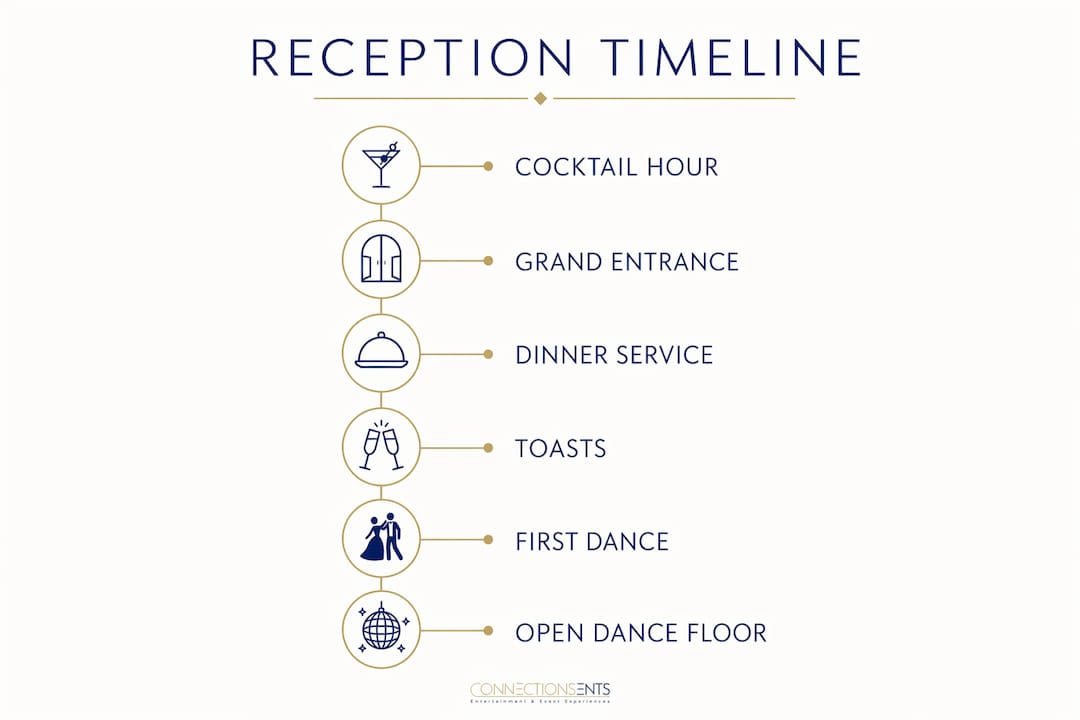
The anchor moments within this framework are the points where your entertainment must actively support the transition rather than simply fill time. According to the Revel reception planning template, a well-structured evening opens the dance floor around 7:25 pm with crowd-pleasing songs, drops a late-night snack at 9:00 pm to re-energise guests, and closes with a final song around 9:55 pm. This structure keeps the evening predictable for your vendors while feeling spontaneous to your guests.
Key anchor moments to plan around:
- Cocktail hour: Guests arrive, mingle, and settle. Background music or a live performer sets the tone.
- Grand entrance: High-energy moment that signals the party has officially started.
- Dinner: Ambient music keeps conversation flowing without competing with it.
- Speeches and toasts: Limit speakers to two or three, each speaking for two to three minutes, to prevent this segment from stalling the evening.
- First dance: The emotional centrepiece that transitions the room from seated to standing.
- Open dancing: The sustained entertainment block that carries the evening to its close.
Building transition buffers of five to ten minutes after high-friction moments such as seating, toasts, and dinner service allows your team to reset without creating dead time. These buffers are not wasted minutes. They are the breathing room that prevents one small delay from cascading into a noticeably late programme.
How do you plan entertainment activities for smooth transitions?
Selecting the right entertainment for transitional periods is one of the most practical decisions you will make during your wedding planning. The goal is to keep guests occupied and engaged during the natural pauses in the programme, without creating a separate “show” that competes with the main event.
Interactive entertainment during transitions enhances guest engagement and blends naturally into the event flow. Close-up magicians and caricaturists are particularly effective during drinks receptions and the gap between dinner and dancing because they move through the crowd rather than requiring guests to gather in one place. This format replaces passive waiting with shared participation, which reduces social friction and creates conversation topics that carry into the rest of the evening.
Here are the most effective entertainment options for transitional periods:
- Close-up magicians: Work the room during cocktail hour or post-dinner mingling. No staging required.
- Caricaturists: Provide a physical keepsake while entertaining guests in small groups.
- Photo booths: Self-directed activity that guests return to throughout the evening, filling gaps naturally. A well-placed photo booth also doubles as a guest favour station.
- Background live music: A jazz trio or acoustic duo during dinner maintains atmosphere without demanding attention.
- Wedding lawn games: Suitable for outdoor or barn venues during the gap between ceremony and reception.
Pro Tip: Syncing your entertainment choices with your catering and AV team is the single most effective way to prevent overlapping cues. Brief your DJ or band on the exact moment each course will be cleared so they can time their transitions accordingly.
The role of an MC or show caller is central to all of this. Assigning a single show caller to manage timeline visibility, coordinate vendor cues, and make on-the-spot decisions drastically reduces delays and keeps the reception running smoothly. This person is your insurance policy against the small miscommunications that derail transitions. They can be your DJ, a professional MC, or a trusted coordinator, but the role must be clearly assigned before the day.
How do seamless music transitions keep the dance floor alive?
Music transitions are the technical backbone of the evening entertainment transition. A clumsy handoff between songs can break the spell on a dance floor that took an hour to fill. Understanding the basics of how professional DJs manage these moments helps you brief your DJ more effectively and set realistic expectations.
Seamless song transitions rely on tempo matching, phrase alignment, and frequency control to maintain dance floor momentum. In practice, this means overlapping tracks on compatible eight, sixteen, or thirty-two bar phrases, gradually swapping the bass frequencies between the outgoing and incoming track, and introducing the new song quietly during the outro section of the current one. The result is a continuous musical experience where guests feel the energy shift without noticing the mechanics behind it.
Pro Tip: Ask your DJ to prepare and cue incoming tracks before each transition rather than searching in the moment. A DJ who is already cued up delivers calm, professional handoffs that guests never notice.
For the dance floor opening specifically, song selection matters as much as technique. Early dance floor songs should be crowd-pleasers with broad appeal, drawing in guests who might otherwise hold back. Think recognisable anthems rather than niche favourites. Once the floor is full, your DJ has the freedom to take more risks with the playlist.
Key principles for managing the dance floor transition:
- Open with two or three universally recognisable songs before introducing anything more adventurous.
- Avoid interrupting the dance floor once it is open. Announcements, cake cutting, and bouquet tosses should be scheduled before the floor opens or during a natural break, not mid-set.
- Coordinate with your live music performers if you are using a band for part of the evening and a DJ for another. The handoff between live and recorded music is one of the trickiest transitions to manage and requires a clear cue from your show caller.
- Brief your DJ on the energy level you want at each stage: ambient during dinner, building during the first dance, peak energy for open dancing.
A live band and DJ combination is increasingly popular at UK weddings precisely because it creates a natural energy shift. The band carries the emotional, acoustic warmth of the earlier evening, and the DJ takes over with higher-tempo tracks to sustain the dance floor into the late hours.
What are creative ideas for bridging wedding reception activities?
Beyond music and interactive performers, there is a growing catalogue of evening wedding entertainment ideas designed specifically to fill transitional gaps with genuine fun rather than awkward waiting.
- Wedding music bingo: Playable during cocktail hour or between dinner and dancing, music bingo encourages guests to sing along and creates shared moments that carry energy into the next segment. Cards can be themed around your playlist, making it personal as well as entertaining.
- Lawn games: Giant Jenga, croquet, and boules work well for outdoor or barn receptions during the gap between ceremony and evening entertainment. They require no facilitation and suit guests of all ages.
- Photo prompts and guest books: Placing creative photo prompts or an illustrated guest book at tables gives guests something to engage with during dinner service without requiring any additional entertainment budget.
- Late-night snack station: A food drop at around 9:00 pm re-energises guests and creates a natural pause in dancing that feels celebratory rather than disruptive. Fish and chip cones, pizza slices, or a cheese board all work well in a UK context.
- Tribute acts or surprise performers: A short set from a tribute act between dinner and open dancing creates a memorable centrepiece moment that bridges the two segments with high energy.
When choosing between these options, consider your guest demographics carefully. A crowd skewed towards older guests will respond better to entertainment suited to their preferences such as a swing band or a quiz element, while a younger crowd may prefer interactive technology like a digital photo booth or a live social media wall.
| Activity | Best timing | Suits which guests |
|---|---|---|
| Music bingo | Cocktail hour or post-dinner | Mixed ages |
| Lawn games | Pre-reception or early evening | Families and all ages |
| Close-up magic | Drinks reception or dinner | All ages |
| Late-night snack station | Around 9:00 pm | All ages |
| Tribute act set | Between dinner and open dancing | Primarily adults |
The key planning principle is that these activities should enhance the evening’s pace, not disrupt it. Each one should have a clear start and end point in your programme, and your show caller should know exactly when to wind it down and move guests towards the next anchor moment.
What are the common challenges with wedding entertainment transitions?
Even the most carefully planned reception encounters friction points. Knowing the most common challenges in advance means you can build solutions into your programme rather than improvising on the day.
- Long speeches: Toasts that run over time are the single most common cause of cascading delays. Capping each speaker at two to three minutes and briefing your MC to manage the microphone handoff keeps this segment on schedule.
- Catering delays: A slow main course service can push dinner beyond 90 minutes, compressing your dancing time. Discuss contingency timing with your caterer and agree on a signal your show caller can use to prompt the kitchen.
- Guest movement confusion: Guests who do not know where to go between segments create bottlenecks and energy dips. Clear verbal cues from your MC, combined with visible signage for photo booths or activity stations, resolve this quickly.
- Overlapping vendor cues: A DJ who starts a track while the caterer is still clearing plates, or an MC who makes an announcement during a live performance, creates confusion. A shared running order distributed to all vendors before the day prevents this.
- Energy dips after dinner: The post-dinner lull is real. Guests are full, seated, and comfortable. This is the moment where interactive entertainment or a high-energy MC introduction to the dance floor makes the biggest difference.
“The best receptions feel effortless to guests precisely because someone behind the scenes is working very hard to make them that way.”
Recovering from a transition that has already gone awkward is straightforward if your show caller is empowered to act. A short, upbeat announcement, a change in lighting, or a well-timed music shift can reset the room’s energy within two minutes. The key is not to let the awkward moment linger while waiting for the “right” cue.
Key takeaways
A well-executed wedding evening entertainment transition depends on clear timeline anchors, a designated show caller, and entertainment choices that fill gaps with genuine engagement rather than passive waiting.
| Point | Details |
|---|---|
| Plan around anchor moments | Map your evening into defined blocks with five to ten minute buffers after high-friction segments. |
| Assign a show caller | One person managing vendor cues and timeline decisions prevents cascading delays throughout the evening. |
| Choose interactive entertainment | Close-up magicians, caricaturists, and photo booths fill transitional gaps without requiring a separate stage or audience. |
| Cap speeches strictly | Limit toasts to two or three speakers at two to three minutes each to protect your evening schedule. |
| Protect the dance floor | Avoid interrupting open dancing with announcements or activities once the floor is full and the energy is high. |
Why transition planning is the most underrated part of wedding entertainment
Having worked on hundreds of wedding evenings across Norfolk and East Anglia, I can tell you with confidence that the couples who are happiest with their reception are almost never the ones who spent the most on entertainment. They are the ones who planned their transitions. The difference between a reception that guests talk about for years and one that was “nice” almost always comes down to whether the evening felt continuous or fragmented.
The most common mistake I see is treating the show caller role as optional. Couples assume their DJ, caterer, and photographer will naturally coordinate with each other. They rarely do without a single point of contact managing the running order. Assigning this role, whether to a professional coordinator or a trusted and organised friend, is the single highest-return decision you can make for your evening’s flow.
I also think the industry undervalues the power of a well-placed buffer. Couples often see a five-minute gap in the programme as dead time to be filled. In reality, a buffer after dinner gives guests a moment to refresh, visit the bar, and arrive at the dance floor on their own terms rather than being herded. That sense of natural movement makes the transition feel organic rather than managed.
The final thing I would say is this: plan your entertainment to serve your guests, not your timeline. A music bingo card during cocktail hour works because it gives guests something to do together, not because it fills a slot. When you choose activities with that mindset, the transitions take care of themselves.
— Darren
How Connections Entertainment can help with your wedding evening
Planning a reception that flows well requires more than a good playlist. Connections Entertainment works with couples across Norfolk and East Anglia to coordinate every element of the evening programme, from DJ and live performer bookings to photo booth hire and full event coordination. Whether you need a close-up magician for your drinks reception, a professional entertainer for the gap between dinner and dancing, or a DJ who understands how to manage show flow and vendor cues, the team can help you build a programme that keeps your guests engaged from the first welcome drink to the final song. Explore the full range of wedding entertainment services and get in touch to discuss your evening in detail.
FAQ
What is a wedding evening entertainment transition?
A wedding evening entertainment transition is the planned handoff between each segment of your reception, such as moving from dinner to dancing or from speeches to the first dance. Managing these transitions well prevents energy dips and keeps guests engaged throughout the evening.
How long should each part of a wedding reception last?
A typical reception runs five to seven hours, with cocktail hour lasting 45 to 60 minutes, dinner service 75 to 90 minutes, speeches 15 to 25 minutes total, and open dancing 90 to 120 minutes. These durations reflect the natural rhythm of how guests move through a wedding evening.
What entertainment works best during wedding reception transitions?
Close-up magicians, caricaturists, photo booths, and wedding music bingo are all effective during transitional periods because they engage guests without requiring a formal stage or audience. Interactive entertainment reduces social friction and fills gaps with shared participation rather than passive waiting.
How do you avoid a lull between dinner and dancing?
Schedule a high-energy MC introduction or a short tribute act set immediately after dinner, and use a late-night snack drop around 9:00 pm to re-energise guests mid-evening. Keeping the gap between the last course and the first dance floor song under ten minutes prevents the post-dinner energy dip from taking hold.
Why is a show caller important for wedding entertainment transitions?
A show caller manages timeline visibility, coordinates vendor cues, and makes real-time decisions to prevent delays from compounding throughout the evening. Without one, DJs, caterers, and photographers operate independently, which leads to overlapping cues and missed transitions.