
Wedding entertainment contract checklist: your full guide
Ensure your wedding goes smoothly with our wedding entertainment contract checklist. Confirm every detail and sign with confidence!
TL;DR:
- A wedding entertainment contract checklist ensures couples clearly define service details, legal obligations, and contingency plans before booking. It covers identification, timing, deliverables, payment, cancellation, insurance, and personalized music requests to prevent misunderstandings. Properly addressing these clauses safeguards both parties and promotes a smooth wedding day experience.
A wedding entertainment contract checklist is a structured planning tool that helps couples confirm every service detail, legal obligation, and contingency plan before signing with a DJ, live band, or any performer. Without one, you risk vague deliverables, disputed payments, and day-of surprises that no couple wants. The industry term for the formal document itself is an entertainment services agreement, though most couples and vendors refer to it simply as the entertainment contract. This guide covers every clause you need, from setup timing and public liability insurance to cancellation tiers and music planning, so you can sign with confidence.
What should a wedding entertainment contract checklist include?
A wedding entertainment contract checklist must begin with the correct identification details for both parties. Full legal names, the wedding date, the venue name, and the full venue address are the minimum required to make the agreement enforceable. Missing even one of these basics creates room for scheduling confusion on the day.
Beyond identification, the checklist should confirm the exact service times. Setup and breakdown timing must appear as separate clauses, not bundled into performance hours. Couples frequently assume load-in is included in a quoted package, only to discover on the day that the entertainer needs an extra hour the venue has not allocated.

The deliverables section is where most disputes begin. Itemised deliverables covering music services, sound equipment, lighting, MC duties, and any extras such as photo booths or uplighting must be written out clearly. Vague language like “full entertainment package” is not sufficient.
Here is a summary table of the core contract components every couple should verify:
| Contract element | What to check |
|---|---|
| Identification details | Full legal names, wedding date, venue name and address |
| Service times | Performance start and end, setup window, breakdown window |
| Deliverables | Music, equipment, lighting, MC duties, extras listed individually |
| Payment terms | Total cost, deposit amount, payment schedule, accepted methods |
| Cancellation policy | Refund tiers by date, deposit forfeiture rules, vendor obligations |
| Backup policy | Named substitute or equivalent performer clause |
| Music planning | Must-play list, do-not-play list, song request deadline |
Pro Tip: Ask your entertainer to highlight every clause that carries a financial penalty. If they cannot point to it immediately, the contract needs rewriting before you sign.
A well-structured payment schedule with clear due dates prevents missed payments and reduces the risk of cancellation by either party. Your contract should list the deposit amount, any instalments, the final balance deadline, and the accepted payment methods. Cheque, bank transfer, and card payments each carry different dispute-resolution rights, so confirm which applies.
How to address logistics and legal compliance in your contract
Logistics clauses protect you from practical problems that no amount of goodwill can fix on a wedding day. The contract should specify the load-in window, parking arrangements, and any venue access restrictions such as lift dimensions or loading bay hours. These details are separate from performance timing and deserve their own section.
Setup and breakdown windows. State the earliest the entertainer may arrive and the latest they must be cleared from the venue. This prevents clashes with other suppliers and venue curfews.
Meal and break provisions. Meal and break provisions for entertainers are standard industry practice and are frequently overlooked by couples. A DJ or band performing for five or more hours will need a break and, in most cases, a hot meal. Confirm whether this is included in your catering headcount or the entertainer’s own responsibility.
Public liability insurance. Public liability insurance and PAT testing proof are often required by venues before any entertainer is permitted to set up. Failing to provide either can result in a load-in refusal, even if a valid contract exists. Ask your entertainer for copies of both documents before the wedding day.
Venue sound policies. Many UK venues operate under noise restrictions, particularly those in residential areas or listed buildings. The contract should reference the venue’s volume limit in decibels if one exists, and specify who is responsible for monitoring compliance.
Force majeure clauses. Force majeure clauses must clearly define which events qualify as uncontrollable, such as extreme weather, venue closure, or a national emergency. These clauses have become standard post-pandemic and should outline what happens to deposits and rescheduling rights if the clause is triggered.
Recording and streaming rights. If your wedding videographer plans to capture the entertainment, the contract must address intellectual property rights. Some performers retain rights over their set and require written consent before any recording is distributed.
Pro Tip: Request your entertainer’s public liability certificate and PAT testing record at least four weeks before the wedding. Your venue coordinator will thank you, and it removes one last-minute task from your list.
Venue readiness checks combine insurance proof and PAT certification. Absence of either can block event access despite a signed contract. Treat these documents as non-negotiable, not optional extras.
What payment and cancellation terms protect both parties?
Payment structures in entertainment contracts follow a broadly consistent pattern across the UK. You pay a deposit or retainer to secure the date, then settle the balance closer to the event. The key is confirming every figure in writing before you sign.
The following points cover what your contract’s financial clauses should address:
- Total price. The full fee for all agreed services, stated as a single figure with VAT status confirmed.
- Deposit amount. Typically 20–50% of the total fee, paid at the point of booking to secure the date.
- Payment deadlines. The date by which the final balance must be received, usually 14–28 days before the event.
- Accepted payment methods. Bank transfer is standard in the UK; confirm whether card payments attract a surcharge.
- Overtime rates. The hourly rate for any extension beyond the contracted finish time, and the process for approving it on the night.
- Non-payment penalties. What happens if a payment is missed, including any grace period before the contract is voided.
Cancellation terms deserve particular attention. Typical cancellation tiers include 100% deposit forfeiture for cancellations fewer than 30 days before the event, and 50% forfeiture for cancellations 15–30 days prior. These figures protect the entertainer’s lost earnings but can feel punishing if your circumstances change.
Cancellation clauses often favour vendors. Couples should seek balanced terms with clear refund tiers and explicit vendor obligations, not just penalties for the couple’s side.
The fairest contracts apply symmetry in cancellation and liability clauses. If you forfeit your deposit for a late cancellation, the vendor should face an equivalent financial obligation if they cancel on you. Push back on any contract that imposes penalties on you but offers only a “best efforts” commitment from the entertainer.
Liability caps are also worth reviewing. Some contracts limit the entertainer’s total liability to the contract value. That is reasonable, but the cap should be clearly stated rather than implied. If you have concerns about a specific clause, a wedding planner or solicitor can review the wording before you commit.
How can you customise your entertainment contract for your wedding?
Every wedding is different, and your entertainment contract should reflect that. Standard templates cover the basics, but the clauses that make your day feel personal are the ones you add yourself. Song list deadlines and music content guidelines are among the most commonly missing items in DJ contracts, yet they are straightforward to include.
Consider adding the following to your agreement:
- Must-play list. Name the specific tracks you want played, including your first dance, parent dances, and any other significant moments.
- Do-not-play list. Be explicit. If there are songs or genres that would genuinely upset guests, list them by name.
- Submission deadline. Agree a date by which you will submit your final music preferences, typically two to four weeks before the wedding.
- MC responsibilities. Clarify exactly what announcements the entertainer will make, from calling guests to the dining room to introducing the first dance.
- Additional services. If you are adding ceremony sound, a photo booth, or uplighting, each service needs its own line in the deliverables section.
- Communication contact. Name a single point of contact for the entertainer on the day, whether that is you, your wedding planner, or your venue coordinator.
Here is a comparison of what a basic contract covers versus a fully customised agreement:
| Area | Basic contract | Customised agreement |
|---|---|---|
| Music planning | General playlist agreement | Named must-play and do-not-play lists with submission deadline |
| MC duties | “MC services included” | Specific announcements listed with timing |
| Backup performer | Not mentioned | Named substitute or equivalent standard guaranteed |
| Additional services | Not included | Each extra service itemised with its own terms |
| Communication | Entertainer’s general contact | Named day-of contact confirmed in writing |
Backup entertainer clauses protect you from last-minute cancellations by guaranteeing an equivalent substitute if the original performer cannot attend. This clause is particularly important for live bands, where illness or travel disruption can affect multiple performers at once. Ask specifically whether the substitute will be of equivalent experience and style, not simply “a performer.”
Pro Tip: Send your must-play and do-not-play lists to your entertainer at least three weeks before the wedding, even if the contract allows a shorter deadline. It gives them time to source any tracks they do not already have and removes a stressful last-minute exchange.
Reviewing your wedding entertainment timeline alongside your contract is a practical way to spot gaps. If your timeline shows a 45-minute gap between the ceremony and the reception, your contract should confirm who provides background music during that window.
Key takeaways
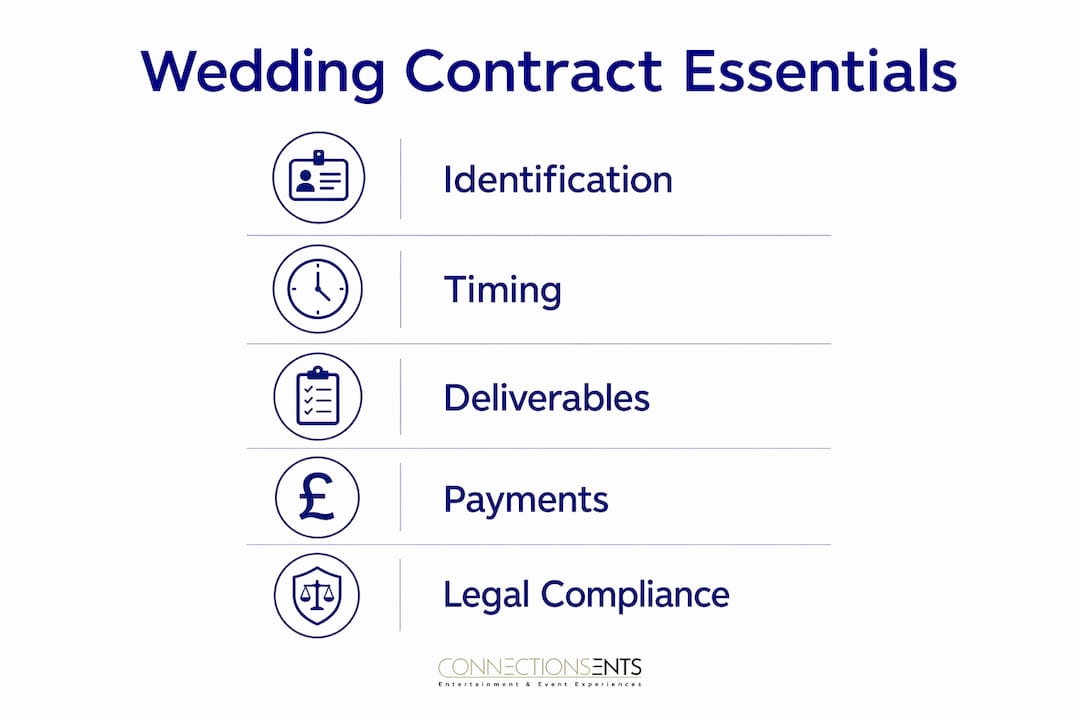
A complete wedding entertainment contract protects both parties by covering identification, timing, deliverables, payment terms, cancellation tiers, legal compliance, and personalised music and MC provisions.
| Point | Details |
|---|---|
| Start with the basics | Full legal names, wedding date, venue name, and address must appear in every contract. |
| Separate setup from performance | Load-in and breakdown windows need their own clauses to prevent timeline clashes. |
| Confirm insurance documents | Request public liability insurance and PAT testing certificates at least four weeks before the day. |
| Negotiate balanced cancellation terms | Push for symmetrical penalties so both parties face equivalent obligations if they cancel. |
| Personalise music and MC duties | Add must-play lists, do-not-play lists, and specific MC announcements with a firm submission deadline. |
Why timing and backup clauses matter more than couples realise
After years of working in wedding entertainment planning, the two clauses I see couples overlook most consistently are setup timing and backup performer provisions. Both feel like minor details when you are focused on the big picture. Both become the most stressful issues on the day if they are not written down clearly.
Setup timing is a risk category in its own right. I have seen situations where a DJ arrived at the contracted performance time, not realising the venue expected them two hours earlier for a sound check. The couple had no recourse because the contract said nothing about load-in. That is an avoidable problem, and it costs nothing to fix at the contract stage.
Backup clauses are equally undervalued. Couples often feel awkward asking about substitutes because it implies they do not trust the performer. The opposite is true. A professional entertainer will have a clear backup policy ready to discuss. If they hesitate or say it is unlikely to be needed, that is not reassurance. That is a gap in their planning.
On cancellation terms, my honest view is that most standard templates lean too far in the vendor’s favour. I am not suggesting couples should demand unreasonable refunds, but a contract that imposes strict financial penalties on you while offering the entertainer only a vague obligation to “make reasonable efforts” is not balanced. Ask for the vendor’s cancellation obligations to mirror yours. Most reputable entertainers will agree without hesitation.
The couples who have the smoothest wedding days are not the ones who trusted everything would work out. They are the ones who read the contract, asked the uncomfortable questions, and got the answers in writing. That is not pessimism. That is good planning.
— Darren
Plan your wedding entertainment with Connections Entertainment
Connections Entertainment works with couples across Norfolk and East Anglia to match them with professional entertainers who provide clear, well-structured contracts as standard. Whether you are booking a wedding DJ or exploring a full entertainment package, every act on the Connections Entertainment roster is vetted for reliability, insurance compliance, and professional conduct. Browse the full range of professional wedding entertainers to find the right fit for your style and budget, and get in touch with the team for guidance on what your contract should include before you commit to any booking.
FAQ
What must a wedding entertainment contract always include?
A wedding entertainment contract must include full legal names, the wedding date, venue details, service times, itemised deliverables, payment terms, and a cancellation policy. These are the minimum clauses needed to make the agreement clear and enforceable.
How do cancellation tiers typically work in entertainment contracts?
Most UK entertainment contracts apply 100% deposit forfeiture for cancellations fewer than 30 days before the event, and 50% forfeiture for cancellations 15–30 days prior. Always check whether the vendor faces equivalent penalties if they cancel on you.
Do entertainers need public liability insurance for UK weddings?
Public liability insurance and PAT testing certification are required by most UK venues before an entertainer is permitted to set up. Ask for copies of both documents well in advance to avoid any access issues on the day.
What is a force majeure clause in an entertainment contract?
A force majeure clause defines uncontrollable events, such as extreme weather or a venue closure, that release both parties from their obligations without financial penalty. Since 2020, these clauses have become standard in UK entertainment agreements and should clearly state what happens to deposits if triggered.
When should you submit your must-play and do-not-play lists?
Submit your music preferences at least three weeks before the wedding, even if your contract allows a shorter deadline. This gives your entertainer time to source any tracks they do not already have and avoids last-minute changes.