
Types of event equipment for venues: 2026 guide
Discover the essential types of event equipment for venues in this 2026 guide. Ensure your event shines with the right audio, lighting, and more!
TL;DR:
- Event equipment for venues includes audio systems, lighting, visual displays, furniture, staging, and rigging essential for safe and successful events. Proper selection, integration, and site assessment are crucial to prevent failures and enhance atmosphere, branding, and guest experience. A detailed checklist and on-site technical rehearsal help ensure all equipment functions harmoniously for a seamless event.
Event equipment for venues is defined as the full range of technical and physical apparatus required to stage a professional event, spanning audio systems, lighting rigs, visual displays, furniture, staging, and rigging. Understanding the types of event equipment for venues is the single most important step in planning any event, whether a corporate conference in Norwich or a wedding reception in rural Norfolk. The wrong equipment choice does not just affect aesthetics. It affects safety, guest experience, and your entire budget. This guide covers every major equipment category, with cost benchmarks, practical selection criteria, and the integration pitfalls that catch even experienced planners off guard.
1. What audio equipment types are essential for venue events?
Audio equipment is the backbone of any live event. Without clear, well-distributed sound, every other investment in the room is undermined.
The industry distinguishes between two primary audio setups: basic PA systems and professional line array systems. A basic PA system uses a single or paired speaker cabinet to distribute sound across a room. A line array suspends multiple speaker units vertically, projecting sound further and more evenly across large or complex spaces. For most small-to-medium venue events, a basic PA system is entirely sufficient.
Basic PA systems suitable for small performances typically cost £50–£100 per day, with outputs of 500–1,000 watts. That cost rises sharply for larger productions. PA system outputs scale from 500–1,000 watts for small events to 2,000–5,000 watts with engineers for bands and large conferences, with hire costs reaching £200–£500 or more per day. That range reflects not just equipment size but the labour required to operate it safely.
Key audio components to include in your event equipment checklist:
- PA speakers and subwoofers for full-range sound coverage
- Wireless microphones (handheld or lapel) for presentations and speeches
- Mixing console to balance multiple audio sources in real time
- Monitor speakers so performers or presenters can hear themselves on stage
- DI boxes and cabling to connect instruments and laptops cleanly
Pro Tip: Always request a frequency coordination plan from your audio supplier if you are running multiple wireless microphone channels. Uncoordinated wireless systems cause interference that no amount of mixing skill can fix on the day.
Venue acoustics also shape your audio choices significantly. Hard-floored rooms with high ceilings create echo and reverberation that can make speech unintelligible. Carpeted or draped rooms absorb sound and may require more power to fill the space. Walk the room before confirming your audio specification.
2. How to choose lighting equipment for different event atmospheres
Lighting does far more than illuminate a room. Lighting serves functions beyond illumination: branding, focus, and atmosphere control. That means venue basic lights rarely suffice for professional events. Additional equipment is almost always required.
The main lighting types used in venue events are:
- Wash lights for flooding large areas with colour, ideal for creating mood at weddings or gala dinners
- Spotlights for directing attention to a speaker, performer, or centrepiece
- Moving heads for dynamic effects at concerts, club nights, or award ceremonies
- Gobos for projecting logos, patterns, or monograms onto walls and floors, which makes them a direct branding tool
- Uplighters for adding colour to walls and architectural features at lower cost than full rig systems
- Followspots for tracking a moving performer across a stage
The event format dictates which combination you need. A corporate conference requires clean white wash lighting and a sharp spotlight on the lectern. A wedding reception benefits from warm uplighters, a gobo monogram, and a moving head rig for the first dance. A live concert demands a full moving head rig with haze machines to make beam effects visible.
Power and rigging are the two constraints that most planners underestimate. Moving heads draw significant power, and a venue with a single 13-amp domestic ring circuit cannot support a professional rig. Confirm the venue’s power capacity before specifying your lighting package.
Pro Tip: Book a lighting designer for any event where atmosphere is central to the brief. A skilled designer programmes cues in advance, so the room shifts from dinner to dancing without anyone touching a fader manually.
3. What visual equipment options enhance presentations and branding?
Visual display equipment covers projectors, screens, and LED video walls. Each option suits different venue conditions and budget levels.
Projectors require 3,000–5,000 lumens in dark rooms and at least 6,000 lumens in ambient light. LED video walls are preferred for daylight events despite higher costs. That distinction matters enormously for daytime conferences or outdoor-adjacent venues where blackout is impossible.
| Display type | Best use case | Typical lumen requirement | Relative cost |
|---|---|---|---|
| Standard projector and screen | Dark rooms, small conferences | 3,000–5,000 lumens | Low |
| High-brightness projector | Ambient light, large rooms | 6,000+ lumens | Medium |
| LED video wall | Daylight, large audiences, branding | Not applicable | High |
| Plasma or LCD panel array | Breakout rooms, close-range viewing | Not applicable | Medium |
Screen sizing follows a straightforward rule: the furthest viewer should be no more than eight times the screen height away from the display. A 2-metre-high screen works for a room up to 16 metres deep. Exceed that ratio and rear viewers struggle to read text.
Connection compatibility is a frequent source of failure. Laptops, media players, and broadcast equipment use HDMI, DisplayPort, SDI, and VGA connectors, and not all of these are interchangeable without adaptors. Confirm the signal chain from source to display before the event day. Connectivity and configuration gaps cause more equipment failure than missing items, and adaptors and cabling management are the most overlooked elements in any visual setup.
4. Which furniture and staging options suit different event types?
Furniture and staging are the physical framework of any event. They determine how guests move, sit, interact, and experience the space. The right choices depend on the event format, guest count, and the venue’s floor plan.
The main types of venue furniture used in event settings are:
- Round banquet tables for formal dinners and weddings, encouraging conversation across the table
- Trestle tables for buffets, registration desks, and exhibition stands
- Cocktail or poseur tables for standing receptions and networking events
- Chiavari chairs for weddings and gala dinners where aesthetics are a priority
- Stacking conference chairs for seminars and presentations where volume and speed of setup matter
- Lounge furniture (sofas, armchairs, low tables) for informal networking zones and VIP areas
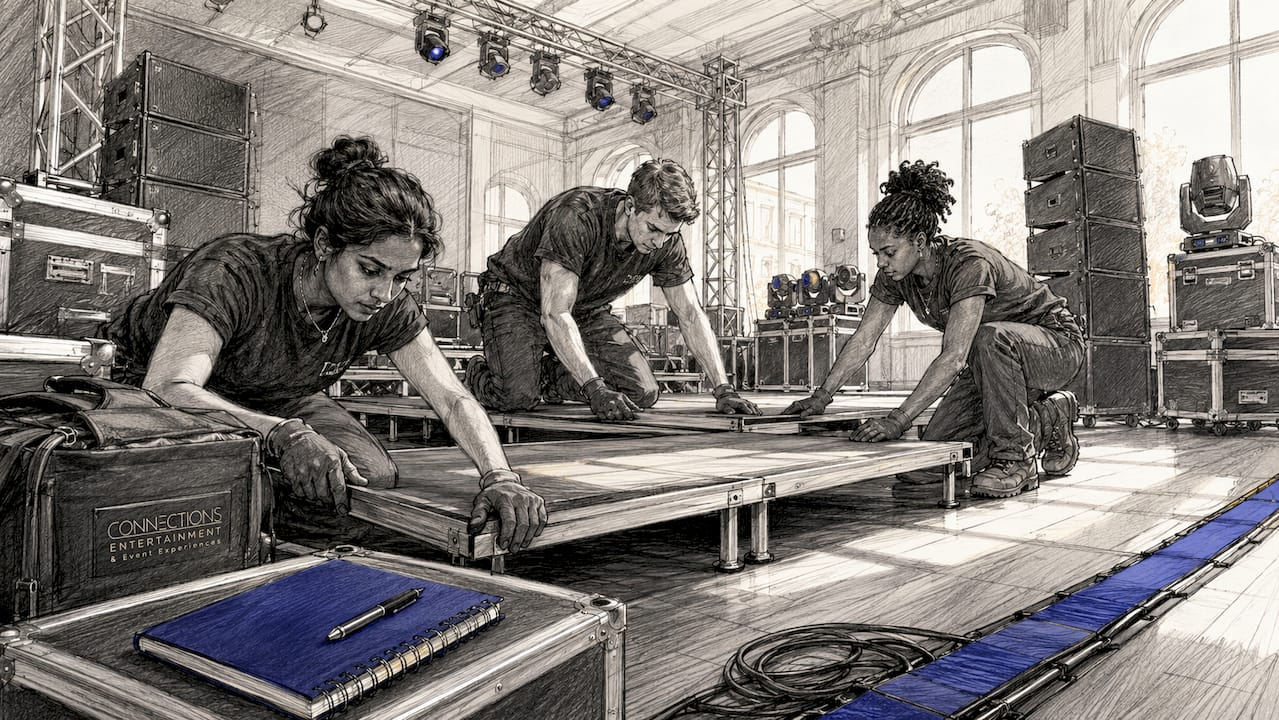
Staging options range from simple portable platforms to fully modular systems. A standard portable stage uses interlocking deck units, typically 1 metre by 2 metres per section, which can be arranged to any footprint. Modular staging adds adjustable leg heights, allowing you to create tiered platforms or adapt to uneven floors. Backdrops and pipe-and-drape systems frame the stage and define the performance area visually.
| Furniture type | Best event style | Indoor or outdoor | Key consideration |
|---|---|---|---|
| Round banquet tables | Weddings, gala dinners | Indoor | Requires more floor space per guest |
| Trestle tables | Buffets, exhibitions | Both | Versatile but less aesthetic |
| Cocktail tables | Networking, receptions | Both | No seating required |
| Lounge furniture | VIP areas, informal events | Indoor | Reduces standing capacity |
| Chiavari chairs | Weddings, formal dinners | Indoor | Higher hire cost than stacking chairs |
Outdoor events introduce additional considerations. Furniture must be weather-resistant or covered, and ground conditions affect staging stability. Always specify anti-sink feet for staging legs on grass or soft ground. Accessibility is non-negotiable: ramps, level access routes, and appropriate aisle widths must be factored into the layout before any furniture is placed.
Pro Tip: For wedding venue layouts, always draw a scaled floor plan before confirming furniture quantities. It is far easier to discover a capacity problem on paper than on the morning of the event.
5. What rigging and ancillary equipment are necessary for safe venue setups?
Rigging is the system that suspends lighting, audio, and visual equipment above the event space. It is also the area where safety regulations are most strictly enforced.
- Trussing systems form the structural framework from which equipment is hung. Box truss and triangle truss are the two most common types, with box truss offering greater load capacity for heavy rigs.
- Rigging points are the fixed anchor points in the venue ceiling or roof structure. Always confirm the safe working load of each rigging point with the venue’s structural engineer before loading any equipment.
- Chain hoists raise and lower truss sections and heavy equipment. Rigging equipment is regulated under LOLER, requiring formal safety examinations for lifting operations including hoists, winches, and fly systems. Non-compliance is a legal liability, not just a technical oversight.
- PUWER compliance applies to all work equipment used on site, including rigging tools and powered hoists. Equipment must be inspected, maintained, and operated by competent persons.
- Power distribution is the most frequently underestimated element of any venue setup. A professional event requires dedicated circuits for audio, lighting, and visual systems, with load balancing to prevent tripped breakers mid-event. Generators provide a reliable backup for outdoor events or venues with limited mains capacity.
- Cabling and adaptors connect every system in the rig. Focusing on ‘glue’ elements such as adaptors, network switches, and cabling management prevents integration failures that no amount of quality equipment can compensate for.
- Network infrastructure is increasingly critical as AV systems move to IP-based control. A dedicated network switch and structured cabling plan keeps lighting, audio, and video systems talking to each other reliably.
Most venues have hidden constraints such as narrow access routes, low power limits, or staging weight restrictions that directly affect equipment setup. A physical site visit with your technical team before confirming any equipment order is not optional. It is the single action most likely to prevent an expensive problem on the event day.
6. How to build a complete event equipment checklist
An event equipment checklist is a structured document that maps every piece of required equipment to a specific function, quantity, and responsible supplier. It prevents duplication, gaps, and last-minute hire charges.
A well-structured checklist covers six categories in sequence: audio, lighting, visual, furniture, staging, and rigging and power. Within each category, list the item, quantity, power draw in watts, supplier, and delivery time. Cross-reference the power draw column against the venue’s available circuits to confirm load balance before the event day.
Venue AV often includes a basic projector and screen, but PA systems, lighting, and labour costs often exceed initial hire quotes. Itemised AV quotes are the only reliable way to budget accurately. Request a line-by-line breakdown from every supplier, and confirm whether labour, delivery, and collection are included in the quoted price.
Equipment rental for events is most cost-effective when you hire as a package rather than sourcing individual items from multiple suppliers. A single supplier managing audio, lighting, and visual equipment reduces the number of technical interfaces and simplifies on-site coordination. It also creates a single point of accountability if something fails.
Pro Tip: Build a contingency column into your checklist for every category. Note the nearest alternative supplier for each item type. If a piece of equipment fails on delivery day, you need a solution in minutes, not hours.
Key takeaways
Selecting the right event equipment requires matching each category to the specific event format, venue constraints, and integration requirements rather than simply hiring the highest-specification items available.
| Point | Details |
|---|---|
| Audio scales with event size | PA systems range from £50–£100 per day for small events to £500 or more with engineers for large productions. |
| Lighting shapes atmosphere and branding | Venue house lights rarely suffice; uplighters, moving heads, and gobos are standard additions for professional events. |
| Visual display choice depends on light levels | Projectors need 6,000+ lumens in ambient light; LED video walls suit daylight or large-audience events. |
| Rigging requires legal compliance | LOLER and PUWER regulations apply to all lifting equipment and work apparatus used on site. |
| Integration prevents failure | Connectivity gaps, power load imbalances, and cabling errors cause more event failures than missing equipment. |
Darren’s take on equipment integration
The question I get asked most often is: “What equipment do I actually need?” The honest answer is that the question itself is the problem. Most planners approach equipment as a shopping list. They tick off speakers, lights, and a screen, then wonder why the event still feels flat or why something fails on the day.
The real discipline is integration. Corporate events often fail due to a lack of integration across equipment systems rather than missing items. I have seen events with exceptional individual components where the audio and lighting systems were on separate power circuits that tripped each other, or where the laptop signal could not reach the projector because no one had confirmed the cable run length in advance.
The habit that changed how I approach every event is the technical rehearsal. Not a sound check. Not a walk-through. A full technical rehearsal where every system runs simultaneously, every cue is tested, and every cable is traced from source to output. It adds time and cost to the pre-event schedule. It also eliminates the category of failure that is most embarrassing: the avoidable one.
My other strong view is on site visits. A physical site visit with technical teams before booking is the single highest-return activity in event production. Venues look very different on a floor plan than they do in person. Ceiling heights, rigging point locations, power socket positions, and access routes all affect your equipment specification. You cannot know any of that from a brochure.
Budget realistically for labour as well as kit. Equipment hire is the visible cost. The technicians who install, operate, and de-rig it are often the larger line item, and cutting that budget is where events go wrong.
— Darren
Planning your event equipment with Connections Entertainment
Connections Entertainment provides audio visual hire across Norfolk and East Anglia, covering PA systems, lighting packages, LED displays, staging, and full event production support. Whether you are managing a corporate function, a wedding reception, or a private party, the team works with venue managers and event planners to specify equipment that fits the space, the budget, and the brief.
Beyond equipment hire, Connections Entertainment offers full event entertainment packages that integrate DJs, live acts, photo booths, and lighting into a single, coordinated production. That means one point of contact, one technical team, and one plan. For venue managers who want to offer clients a complete event solution, that level of coordination makes a measurable difference to the final result.
FAQ
What are the main types of event equipment for venues?
The main categories are audio systems, lighting rigs, visual displays, furniture, staging, and rigging and power distribution. Each category contains multiple equipment types suited to different event formats and venue sizes.
How much does equipment rental for events typically cost?
Basic PA hire starts at around £50–£100 per day for small events. Full production setups with lighting, visual displays, and technical labour can reach several thousand pounds depending on event scale and duration.
Do venues usually provide their own AV equipment?
Most venues include a basic projector and screen in their hire package, but PA systems, professional lighting, and staging are typically not included. Always request an itemised list of what the venue provides before confirming your external hire requirements.
What regulations apply to rigging equipment at events?
Rigging equipment used for lifting, including chain hoists, winches, and fly systems, is regulated under LOLER (Lifting Operations and Lifting Equipment Regulations). All work equipment on site must also comply with PUWER (Provision and Use of Work Equipment Regulations).
Why do corporate events fail despite having good equipment?
The most common cause is poor system integration rather than equipment quality. Power load imbalances, incompatible connectors, and untested signal chains between separate systems cause failures that individual equipment quality cannot prevent.