
The role of wedding sound check: a couple’s guide
Discover the vital role of wedding sound check to ensure your vows and speeches are heard clearly. Make your ceremony unforgettable!
TL;DR:
- A wedding sound check involves testing and adjusting audio equipment to ensure clear sound during the ceremony and reception. It prevents common issues like feedback, dropouts, and venue noise limiter cut-offs, protecting emotional moments. Proper preparation and communication reduce disruptions and help deliver an enjoyable, confident event.
A wedding sound check is defined as the pre-event process of testing, adjusting, and confirming all audio equipment before guests arrive, to guarantee clear and balanced sound throughout your ceremony and reception. The role of wedding sound check goes far beyond a simple volume test. It is the difference between vows your guests hear clearly and words lost to feedback or echo. Professional audio testing, the industry term for this process, covers everything from microphone clarity to speaker placement and compliance with venue noise restrictions. Get it right, and your guests experience every speech, song, and announcement exactly as intended.
What does a wedding sound check typically involve?
A sound check covers every component of your audio setup, tested in sequence before the event begins. The process follows a clear structure that professional sound engineers and entertainers use at every wedding, regardless of venue size.
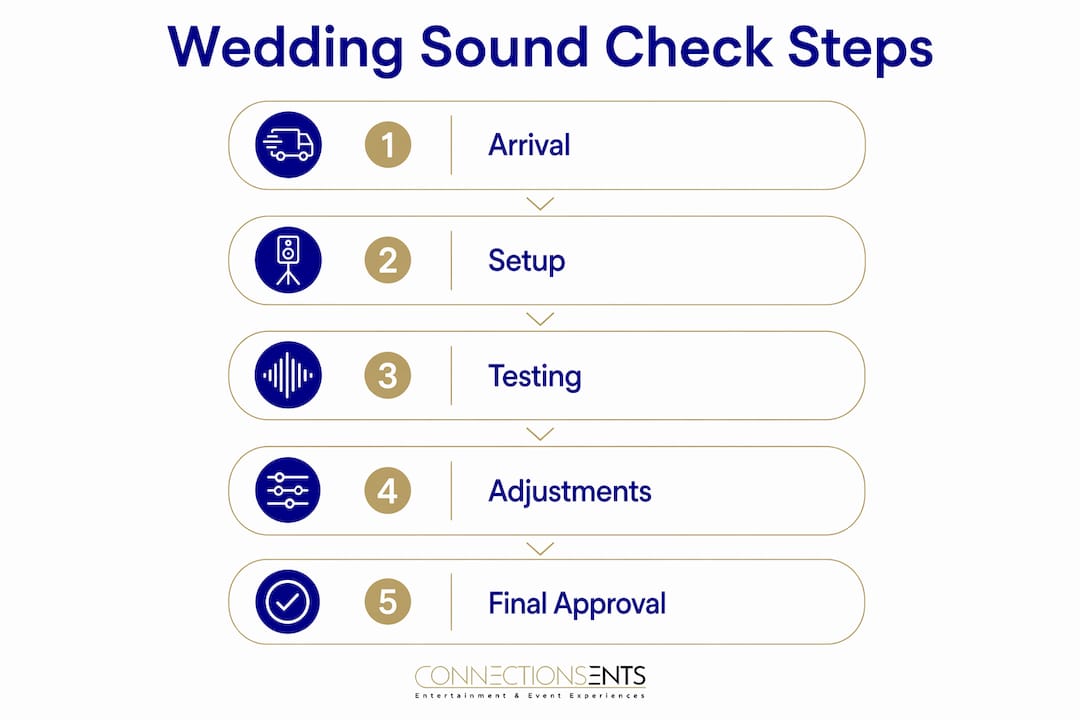
The standard steps include:
- Equipment setup and positioning: Speakers, amplifiers, mixing desks, and playback devices are placed and connected. Speaker placement affects how sound travels across the room, so this step takes careful thought.
- Microphone testing: Each microphone, whether handheld, lapel, or stand-mounted, is tested for clarity, range, and signal strength. Wireless microphones receive particular attention to rule out interference.
- Volume and gain adjustment: Sound levels are set for each channel on the mixing desk. Engineers balance vocals, instruments, and playback so no single element overpowers another.
- Line checks: Every cable and connection is confirmed live. A single loose connection can cause dropouts during a speech or first dance.
- Playback testing: Backing tracks, ceremony music, and reception playlists are played through the full system to confirm quality.
A band sound check typically lasts 60–90 minutes, covering setup and full equipment testing. That window is not negotiable if you want reliable audio on the day.
Timing matters as much as the process itself. Most bands prefer to arrive around 5PM and complete their sound check before a typical 7PM start. Some will arrive earlier for an additional fee, which is worth considering if your venue has complex acoustics or strict access windows.

The personnel involved vary by booking. A live band brings its own sound engineer. A DJ manages the desk personally. For larger weddings with multiple audio zones, a dedicated front-of-house engineer handles the mixing desk while performers focus on their performance. Understanding what wedding AV involves helps you ask the right questions when confirming who is responsible for each element.
Pro Tip: Ask your entertainer in writing who is responsible for the sound check and what equipment they are bringing. Verbal agreements get forgotten under the pressure of a wedding day.
Why is the wedding sound check important for your ceremony and reception?
The importance of a wedding sound check becomes clear the moment something goes wrong without one. Feedback squeals during the ring exchange, inaudible vows, or a microphone that cuts out mid-speech are not minor inconveniences. They are moments your guests remember for the wrong reasons.
“Clear audio is not a luxury at a wedding. It is the foundation on which every emotional moment rests. Guests who cannot hear the vows or the best man’s speech feel disconnected from the event, no matter how beautiful the venue looks.”
Audio testing prevents the most common failures before they happen. Feedback occurs when a microphone picks up its own amplified signal from a nearby speaker. A sound engineer identifies and eliminates this risk by adjusting speaker angles and microphone gain during the check. Dropouts, where sound cuts out briefly, are traced to faulty cables or wireless interference and fixed before the first guest walks in.
Testing all audio components confirms microphone clarity, music playback quality, speaker placement, and mixing balance. Each of these elements contributes directly to whether your guests feel present in the moment or distracted by poor sound.
Venue compliance is another critical reason to take the sound check seriously. Many venues enforce sound restrictions via limiters, which are devices that cut power to the PA system if volume exceeds a set threshold. If your entertainer has not tested against that limiter during the sound check, the music can cut out entirely mid-song. That is not a technical glitch. That is a planning failure.
The Health and Safety Executive recommends keeping audience sound levels below 107dB to protect hearing safety at events. A proper sound check measures levels at the audience area and front-of-house position, confirming the system operates within safe and legal limits. This protects your guests and keeps your event compliant.
How to prepare for and conduct an effective wedding sound check
Preparation on your part makes the sound check faster, more thorough, and less likely to cause disruption to your wedding schedule. You do not need technical knowledge. You need clear communication and a confirmed plan.
Follow these steps to set your sound check up for success:
- Build a wedding sound equipment checklist. Confirm with your entertainer what equipment they are supplying and what the venue provides. Common items include PA speakers, a mixing desk, microphones (ceremony and reception), monitor speakers, and playback devices. Write it down and share it with both parties.
- Schedule the sound check before guests arrive. The noisiest part of testing lasts around 15–30 minutes, but the full process takes longer. Scheduling the check at least 90 minutes before your first guests enter the venue avoids disruption and leaves time to resolve any issues.
- Discuss venue restrictions in advance. Contact your venue coordinator and ask directly about noise limiters, decibel limits, and any access restrictions for the entertainment team. Share this information with your entertainer before the day.
- Confirm who manages the sound check. Whether it is a sound engineer, your DJ, or the band’s technical lead, one person must own the process. Ambiguity leads to gaps.
- Test every microphone that will be used. This includes the ceremony officiant’s microphone, the best man’s speech microphone, and any handheld microphones for toasts. Each one needs a live test in the actual room, not a corridor or back office.
- Verify playback for key moments. Your first dance track, the processional music, and any pre-recorded announcements must all play through the full system before the event begins.
Early coordination between couple, venue, and entertainers regarding sound limits and equipment requirements consistently improves event outcomes. That coordination starts with you asking the right questions at the booking stage.
Pro Tip: Include sound check timing and responsibilities in your entertainment contract checklist. If it is not written into the agreement, it may not happen.
Common sound check challenges and how to overcome them
Even well-planned sound checks encounter obstacles. Knowing what to expect means you and your entertainer can resolve issues quickly rather than scrambling on the day.
Venue acoustics and reverberation
Hard surfaces like stone walls, wooden floors, and high ceilings create reverberation, where sound bounces around the room and muddies speech clarity. A professional engineer addresses this by adjusting equalisation settings on the mixing desk, repositioning speakers to reduce reflections, and sometimes adding acoustic dampening through soft furnishings or directional speaker arrays. Marquees present the opposite problem: fabric walls absorb too much sound, making the room feel flat. Both scenarios require adjustment during the sound check, not guesswork on the night.
Sound limiter restrictions
| Challenge | Solution |
|---|---|
| Limiter cuts power mid-song | Test at full performance volume during sound check to identify the threshold |
| Venue decibel limit unknown | Request the limit in writing from the venue coordinator before the event |
| Band volume exceeds limit | Use acoustic monitoring for performers and reduce PA output to stay compliant |
| DJ bass frequencies trigger limiter | Apply a low-frequency cut on the mixing desk to reduce limiter sensitivity |
The NADJ recommends proactive noise limiter discussions between entertainers and venues during sound checks. This is standard practice for professional DJs and should be a non-negotiable part of your entertainer’s process.
Wireless microphone interference
Wireless microphones operate on radio frequencies, and busy venues with multiple wireless systems can experience signal conflicts. The solutions include:
- Scanning for clear frequencies before the event and locking the microphone to that channel.
- Keeping wireless receivers within line of sight of the microphone transmitter.
- Avoiding frequencies used by venue Wi-Fi systems or other wireless devices.
- Testing the microphone at the furthest point from the receiver to confirm range.
A thorough sound system setup process addresses frequency scanning as a standard step. If your entertainer skips this, ask them directly why.
Cable management and safety
Loose or poorly routed cables are both a sound risk and a safety hazard. Professional cable management during the sound check includes taping down all floor cables, labelling connections at the mixing desk, and confirming that no cable creates a trip hazard in guest areas. This is not pedantic. A tripped cable during the first dance can silence the entire system.
Key takeaways
A thorough wedding sound check is the single most effective way to prevent audio failures and protect every emotional moment of your day.
| Point | Details |
|---|---|
| Sound check duration | Allow 60–90 minutes for full setup and testing before guests arrive. |
| Venue compliance | Confirm noise limiter thresholds in writing and test against them during the check. |
| Equipment checklist | Document every microphone, speaker, and playback device and share it with all parties. |
| Timing and scheduling | Complete the noisiest testing at least 90 minutes before the first guest enters. |
| Written agreements | Include sound check responsibilities in your entertainment contract to avoid gaps. |
Darren’s view: why couples underestimate this more than anything else
Having worked in event entertainment for years, the sound check is the single element couples most consistently treat as the entertainer’s problem rather than a shared responsibility. That mindset costs people dearly.
The most common mistake I see is couples who book talented performers but never ask a single question about the technical setup. They assume that because the band is professional, the audio will be perfect. Professionalism matters enormously, and the best entertainers absolutely conduct thorough checks. But the couple still needs to know what questions to ask, what the venue’s restrictions are, and whether the sound check is written into the contract.
I have been at weddings where the venue’s noise limiter was never discussed before the day. The band hit full volume during the first song of the reception, the limiter cut the power, and the room went silent. The couple had no idea the limiter existed. The band knew about it but assumed the venue had briefed the couple. Nobody had confirmed anything in writing. That silence lasted about 20 seconds. It felt like 20 minutes.
The other thing I would say is this: do not schedule your sound check too close to guest arrival. The live performers you choose need time to resolve problems, not just run through a checklist. Build in a buffer. If everything goes perfectly, you have spare time. If something needs fixing, you have the space to fix it without panic.
A sound check is not a formality. It is the rehearsal your audio deserves.
— Darren
How Connections Entertainment supports your wedding audio needs
Connections Entertainment works with couples across Norfolk and East Anglia to deliver professional wedding entertainment with audio quality built in from the start. Every entertainer on the roster understands the importance of a thorough pre-event audio check, and the team coordinates directly with venues to confirm noise restrictions, equipment requirements, and scheduling before the day arrives. Whether you are booking a DJ, a live band, or a full event entertainment package, sound quality is treated as a priority, not an afterthought. You can also browse the full entertainers roster to find performers who bring both talent and technical professionalism to your wedding.
FAQ
What is the role of a wedding sound check?
A wedding sound check is the pre-event process of testing all audio equipment, adjusting volume levels, and confirming microphone and speaker performance before guests arrive. Its role is to prevent audio failures and deliver clear sound throughout the ceremony and reception.
How long does a wedding sound check take?
A sound check typically takes 60–90 minutes, covering equipment setup, microphone testing, volume adjustment, and playback confirmation. Schedule it at least 90 minutes before guests arrive to allow time for any fixes.
What should be on a wedding sound equipment checklist?
A wedding sound equipment checklist should include PA speakers, a mixing desk, all microphones (ceremony and reception), monitor speakers, playback devices, and all cables. Confirm which items the entertainer supplies and which the venue provides.
How do venue noise limiters affect a wedding sound check?
Venue noise limiters cut power to the PA system if sound exceeds a set decibel threshold. Testing at full performance volume during the sound check identifies the limiter’s trigger point, allowing the entertainer to adjust levels and avoid cut-outs during the event.
Who is responsible for conducting the wedding sound check?
The entertainer or their sound engineer leads the sound check, but the couple is responsible for confirming it is scheduled, written into the contract, and that the venue’s restrictions have been shared with the entertainment team in advance.