
The role of wedding master of ceremonies explained
Discover the vital role of wedding master of ceremonies in ensuring your big day flows smoothly. Learn to elevate your reception experience!
TL;DR:
- The wedding MC is essential for managing the reception’s flow, guest engagement, and vendor coordination, not just jokes.
- Their role differs from the officiant, focusing on timing, atmosphere, and transitions after the legal ceremony is complete.
Your wedding day has dozens of moving parts, and the role of wedding master of ceremonies is the one that holds them all together. Yet many couples either overlook this role entirely or confuse it with the officiant’s job. The MC is not simply someone who cracks jokes between speeches. They are the person who keeps your guests informed, maintains momentum throughout the reception, and quietly coordinates with every vendor in the room. Getting this role right makes a profound difference to how your day actually feels for everyone in attendance.
Table of Contents
- Key takeaways
- The role of wedding master of ceremonies vs the officiant
- Core functions of a wedding MC
- Skills and qualities that make a great wedding MC
- Preparing your MC for the day
- Why a professional MC makes such a difference
- My take on the unsung hero of your wedding day
- How Connections Entertainment can help your wedding
- FAQ
Key takeaways
| Point | Details |
|---|---|
| MC vs officiant | The officiant legally solemnises the marriage; the MC manages the reception flow and guest experience. |
| Core MC duties | Welcoming guests, introducing speakers, cueing formalities, and liaising with vendors are all central wedding MC responsibilities. |
| Skill over humour | Calmness, organisation, and communication matter far more in a wedding MC than being the funniest person in the room. |
| Preparation is everything | Providing your MC with a detailed run sheet and name list well in advance prevents costly mistakes on the day. |
| Professional value | A professional MC relieves you and your loved ones of logistical pressure and integrates smoothly with entertainment teams. |
The role of wedding master of ceremonies vs the officiant
One of the most common points of confusion for couples planning their wedding is the distinction between these two roles. They are not interchangeable, and they serve entirely different purposes across your day.
The officiant holds a legal function. Their responsibility centres on conducting the marriage ceremony, pronouncing you married, and handling the marriage licence paperwork. In England and Wales, this must be carried out by an authorised person, whether that is a registrar, a religious minister, or a licensed celebrant. The ceremony itself is their domain, and their primary focus is ensuring everything within it is legally sound and personally meaningful.
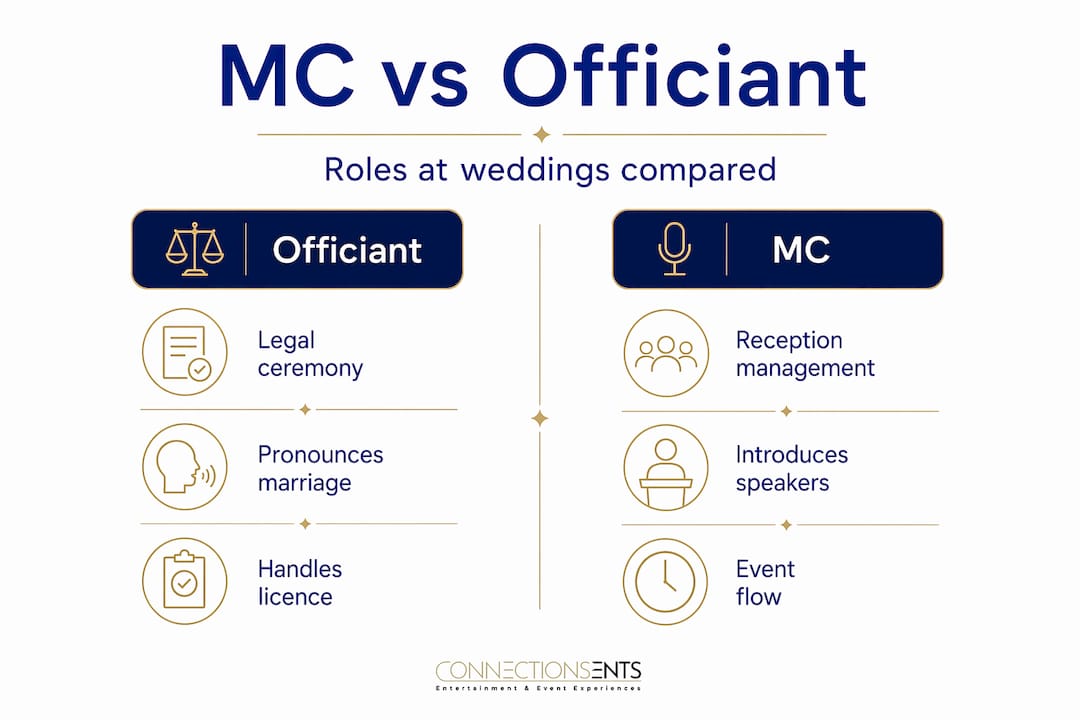
The MC, by contrast, manages the reception, where the legal formalities are already complete. Their job begins the moment guests arrive at the venue and continues right through until the final farewell. Where the officiant deals with vows and paperwork, the MC deals with timing, atmosphere, and communication.
| Aspect | Wedding officiant duties | Wedding MC responsibilities |
|---|---|---|
| Legal function | Solemnises the marriage and files paperwork | None |
| Timing | Oversees the wedding ceremony | Manages the full reception programme |
| Guest interaction | Guides guests through the ceremony | Welcomes, informs, and entertains guests throughout the evening |
| Vendor liaison | Minimal | Coordinates with DJ, caterers, and venue staff |
| Key moments | Vows, ring exchange, pronouncement | First dance, speeches, cake cutting, send-off |
Both roles genuinely complement each other. When your ceremony flows beautifully under a skilled officiant and your reception moves confidently under a prepared MC, the whole day feels cohesive and calm.
Pro Tip: Never assume your officiant will also act as MC for the reception. Always clarify this in advance and confirm who is responsible for each part of the day.
Core functions of a wedding MC
Understanding the full scope of wedding MC responsibilities helps you see just how central this person is to your guest experience. This is not a role that can be improvised on the day.
The functions of master of ceremonies at a wedding break down into a clear sequence of responsibilities:
Welcoming guests on arrival. The MC sets the tone from the first moment. A warm, confident welcome makes guests feel at ease and signals that the day is in safe hands. This includes directing people to their seats and giving any housekeeping announcements such as phone etiquette or seating arrangements.
Introducing the couple and wedding party. When the newlyweds enter the reception, the MC announces them with the appropriate level of energy and formality that reflects the couple’s wishes. This moment should feel celebratory and personal, not like a generic announcement at a corporate event.
Cueing and introducing speeches. The MC introduces each speaker by name, briefly contextualises their relationship to the couple, and keeps things moving briskly once each speech concludes. Introductions should be concise, focused on guiding guests rather than becoming performances in their own right.
Signalling key formalities. First dance, cake cutting, bouquet toss, and the evening send-off all require a clear prompt from the MC. Without this, guests are left uncertain and momentum stalls. The MC watches the clock, stays in touch with the venue coordinator, and moves each moment forward at the right time.
Liaising with vendors throughout the evening. MCs check in with the venue and catering team, cue the DJ or band, and keep the timeline on track without rushing guests. This behind-the-scenes communication is invisible to your guests but absolutely vital to a smooth reception.
Handling the unexpected. A caterer is running late. A key guest has not arrived. A speech runs over. The MC absorbs these hiccups calmly and adjusts the run sheet without making the issue visible to the room. This adaptability is, in many ways, the most valuable thing an MC brings.
Pro Tip: Ask your MC to do a walk-through of the venue before the reception begins. Knowing where the exits, microphone stations, and catering areas are will help them communicate more confidently with both guests and vendors.
Skills and qualities that make a great wedding MC
There is a persistent myth that the best wedding MC is whoever in your social circle makes people laugh the most. In practice, humour is a secondary quality. The traits that truly distinguish a strong MC are far more grounded.
Calmness under pressure. When things do not go to plan, the MC must maintain calm leadership and re-script on the fly without flustering. A panicked MC makes the couple and guests anxious. A steady one keeps everyone relaxed.
Strong public speaking ability. The MC speaks to a room full of people of different ages, backgrounds, and relationships to the couple. They need clear diction, good projection, and enough confidence on a microphone that they do not trail off or rush.
The ability to read the room. According to strategist Prithee Kathpal, an effective MC reads the audience and decides dynamically when to extend a moment and when to move on. This emotional awareness keeps the energy at the right level throughout the night.
Organisation and attention to detail. The MC holds the run sheet, knows every speaker’s name, and tracks the timeline. Missing a cue because they were not paying attention is not easily recovered from.
Cultural sensitivity and adaptability. Modern weddings often bring together guests from varied cultural backgrounds. A great MC adapts between different audiences and settings with confidence and respect.
When deciding how to choose a wedding MC, weigh these qualities honestly against your candidates. A close friend with genuine warmth and strong organisational instincts can be excellent. But someone chosen purely because they are the life and soul of the party may struggle when a microphone, a schedule, and a room of 120 guests are involved. Consider also whether you want a friend managing logistics on your behalf all evening, rather than simply enjoying the celebration with you.
Preparing your MC for the day
Even the most capable MC will underperform without proper preparation. Your job as a couple is to give your MC every tool they need well before the wedding day.
Here is what that preparation should cover:
Create a detailed run sheet. This document should list every moment of the reception in chronological order, with approximate timings, participant names, and any specific instructions. A well-prepared run sheet is the MC’s most important reference. Bear in mind that run sheets evolve throughout the day and your MC needs the flexibility to adapt in real time.
Provide a phonetic name guide. Nothing undermines confidence in an MC faster than mispronounced names. Write out a list of every speaker, wedding party member, and key guest with phonetic spellings alongside. This is especially important for names that are unfamiliar or have cultural nuances.
Brief them on your tone and priorities. Is this a formal, black-tie reception or a relaxed garden party? Do you want humour kept to a minimum or is banter welcome? Your MC should understand your vision so their delivery matches it. Openings and introductions work best when they are warm and brief, guided by the couple’s preferences rather than the MC’s personal style.
Connect them with your other suppliers. Introduce your MC to your DJ or band, your venue coordinator, and your caterers before the day. A quick group message or shared email thread can prevent a great deal of confusion on the night.
Schedule a final briefing. Even a 30-minute call the week before the wedding can catch last-minute changes, confirm speech order, and give your MC the confidence they need to walk in prepared.
Pro Tip: If your venue has a wedding coordinator, ask them to be the MC’s key point of contact on the day. This pairing means your MC always has someone to consult without needing to pull you or your partner away from enjoying your wedding.
Why a professional MC makes such a difference
There is a meaningful gap between asking a family member to step up and hiring a professional, and understanding that gap helps you make the right decision for your day.
Professional MCs are experienced at handling hiccups that would leave an unprepared guest-turned-MC visibly stressed. They have managed delayed caterers, overrunning speeches, technical sound issues, and unexpected schedule changes. They know how to fill time gracefully and how to move things forward without anyone in the room sensing urgency.

| Consideration | Friend or family member MC | Professional wedding MC |
|---|---|---|
| Familiarity with the couple | High | Medium (can be briefed) |
| Experience managing events | Usually low | High |
| Handling unexpected issues | Can struggle under pressure | Trained to adapt calmly |
| Guest relationships | Personal and warm | Neutral and professional |
| Enjoyment of the wedding | Reduced by duty | Full focus on the role |
| Integration with entertainment | Requires significant briefing | Typically experienced with DJ or band coordination |
One frequently overlooked benefit is the experience professionals bring to working alongside entertainment teams. When your MC and DJ or live band are working in close coordination, music cues hit precisely when they should, announcements land cleanly, and transitions between moments feel polished rather than clunky. That coordination is difficult to replicate with someone who has never worked in a live event setting before.
Choosing a professional MC also frees your friends and family to simply be guests. When your best man or sibling is on MC duty, they spend the evening watching the clock rather than celebrating alongside you.
My take on the unsung hero of your wedding day
I have seen hundreds of weddings, and the single most underestimated role in the planning process is consistently the MC. Couples spend months choosing flowers, menus, and photographers, and then nominate their MC two weeks before the day because someone seemed confident at a birthday party.
In my experience, the difference a truly prepared MC makes is not subtle. It shows in whether speeches run on time, whether guests feel guided or confused, and whether the couple can actually relax and be present during their own reception. When the MC is calm and organised, that calm spreads through the room.
The biggest mistake I see is choosing for humour alone. Being funny is a nice bonus, but the MC’s real job is managing flow and facilitating transitions. A comedian who cannot manage a run sheet, stay in contact with the venue team, or keep the evening moving is a liability dressed up as entertainment.
My advice? Give your MC real authority and real information. Share the run sheet. Introduce them to your suppliers. Tell them your priorities. The couples who treat this role seriously and invest time in preparation consistently tell me their reception felt effortless. That effortlessness is entirely manufactured by a person behind a microphone who knows exactly what they are doing.
— Darren
How Connections Entertainment can help your wedding
At Connections Entertainment, we understand that a smooth, memorable reception comes down to having the right people in the right roles. If you are weighing up your options for professional MC and entertainment services, our experienced team is here to take that pressure off you completely.
We work across Norfolk and East Anglia, providing professional entertainers who understand how to manage a live wedding reception, coordinate with your venue, and keep the energy exactly where you want it throughout the evening. Whether you are looking for a dedicated MC, a DJ who doubles as a confident reception host, or a fully coordinated entertainment package for your wedding, we can help you build the right combination for your day. Get in touch with our team to discuss your requirements, check availability, and find out how we can make your reception the celebration you have been planning for.
FAQ
What is the main role of a wedding master of ceremonies?
The main role of a wedding master of ceremonies is to manage the flow of the reception, welcoming guests, introducing speakers, cueing formalities such as the first dance and cake cutting, and liaising with vendors to keep the event on schedule.
How is a wedding MC different from the officiant?
The officiant legally solemnises the marriage and handles the marriage licence, while the MC manages the reception logistics and guest experience. They are two separate roles covering different parts of the day.
Does a wedding MC need to be funny?
No. Calmness and organisation are far more valuable in a wedding MC than humour. A steady, well-prepared MC who manages the timeline and communicates clearly will contribute far more to your day than someone chosen purely for comedy.
When should we brief our wedding MC?
You should share your run sheet and name list at least two to three weeks before the wedding, with a final briefing call in the week leading up to the day to confirm any last-minute changes to the schedule or speaker order.
Is it worth hiring a professional wedding MC?
For many couples, yes. A professional MC brings experience managing unexpected challenges, works confidently alongside entertainment teams, and allows your friends and family to enjoy the day rather than managing it.