
The role of resident DJs at venues: a 2026 guide
Discover the role of resident DJs at venues in 2026. Learn their responsibilities and business impact to enhance guest experiences and revenue.
TL;DR:
- A resident DJ performs regularly at a single venue, shaping its musical atmosphere and guest experience over time. They influence revenue, build brand identity, and reinforce a consistent sonic signature that attracts repeat visitors.
A resident DJ is defined as a professional disc jockey who performs regularly at a single venue, shaping its musical atmosphere, energy, and guest experience over time. Unlike a one-off booking, a residency creates a consistent sonic identity that guests return for. The role of resident DJ at venues goes well beyond playing tracks. It encompasses crowd reading, brand building, legal compliance, and direct influence on revenue. This guide covers the responsibilities, business impact, and practical strategies that venue managers and event organisers need to make informed decisions about resident DJ appointments in 2026.
What are the key responsibilities of a resident DJ at venues?
A resident DJ’s core responsibility is delivering a consistent, high-quality performance on a regular schedule. Consistency matters because guests build expectations around it. A DJ who performs every Friday at the same venue trains the audience to associate that night with a particular energy and sound. Miss that standard once, and trust erodes quickly.
The responsibilities of a resident DJ extend into several practical areas:
- Music curation: Selecting tracks that suit the venue’s concept, trading hours, and audience demographic. A cocktail bar requires a different approach to a late-night club.
- Crowd reading: Adjusting the set in real time based on the room’s energy, age range, and mood. This is a skill that automated playlists cannot replicate.
- Scheduling reliability: Arriving on time, setting up correctly, and finishing within agreed hours. Punctuality is non-negotiable in a professional residency.
- Event promotion: Sharing upcoming dates on social media, engaging with regulars, and helping the venue build its audience. A DJ who promotes their own nights adds measurable value.
- Collaboration with venue staff: Communicating with bar managers, security, and event coordinators to keep the night running smoothly.
- Legal compliance: Understanding noise limiters, music licensing obligations, and public liability insurance requirements.
Pro Tip: Ask any prospective resident DJ to show you their public liability insurance certificate and confirm they understand your venue’s noise limiter settings before the first booking. Addressing these details early prevents costly problems later.
Effective resident DJs also dynamically adjust volume and tempo throughout the night. The recommended approach is to maintain 70–75 decibels with slower tempos in the early evening, then increase both past 10 PM to build energy. This structured approach to sound management directly supports dwell time and sales.

How do resident DJs impact venue business outcomes?
The financial case for a resident DJ is clear. Venue owners report a 15–25% increase in bar revenue on nights with live DJ sets compared to automated playlists. That uplift reflects the DJ’s ability to control atmosphere in ways that a static playlist simply cannot.
A resident DJ typically costs between £200 and £400 per night in UK venues as of 2026. Weekend slots command higher fees, but the return on that investment is measurable in increased spend per head. Midweek slots, where footfall is naturally lower, benefit most from a resident DJ’s ability to sustain energy and keep guests at the bar longer.
“DJs attract more casual, venue-agnostic customers, whereas live music fosters loyal, experience-focused crowds. Resident DJs contribute to increased footfall and faster table turnover, which can equate to comparable per-hour revenue to live music nights.”
The table below summarises the key business differences between resident DJs and live bands for UK venues:
| Factor | Resident DJ | Live band |
|---|---|---|
| Typical cost per night | £200–£400 | Significantly higher |
| Flexibility to adapt in real time | High | Low |
| Customer loyalty generated | Moderate | High |
| Footfall on quieter nights | Strong | Variable |
| Revenue per hour potential | Comparable | Comparable |
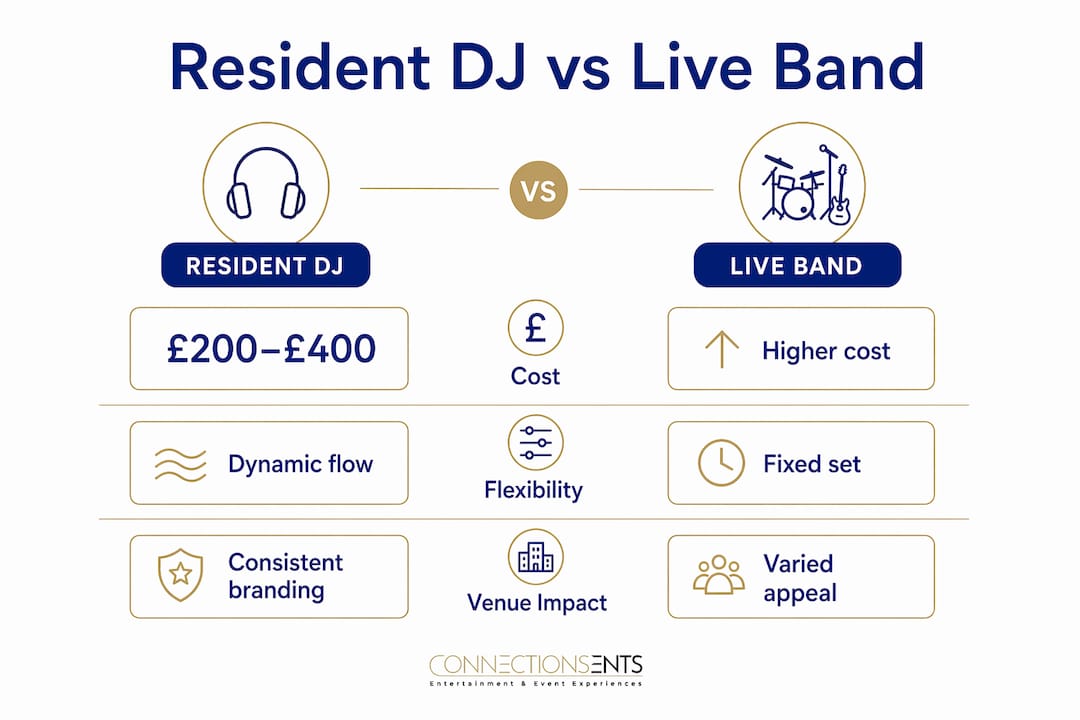
DJs generally cost less than live bands and offer greater flexibility to adapt the music flow in real time. Live bands generate stronger customer loyalty, but resident DJs maximise volume on quieter nights and work particularly well for midweek trade. For venue managers balancing budget against atmosphere, a resident DJ is often the more practical and profitable choice across the weekly programme.
How do resident DJs shape venue branding and guest experience?
Resident DJs are sonic branding assets that define the emotional tone and identity of a venue. Sonic branding is the deliberate use of music to create a recognisable atmosphere that guests associate with a specific place. In 2026, it is a growing priority for UK venues competing in saturated markets.
A resident DJ delivers sonic branding through consistency. When the same DJ plays a curated style every week, guests begin to identify the venue by its sound. That recognition builds loyalty. Guests do not just return for the drinks or the décor. They return because they know what the music will feel like.
The importance of resident DJs in this context goes beyond entertainment. They act as ambassadors for the venue’s concept. A jazz-influenced bar in Norwich needs a DJ who understands that genre’s nuances and can hold that identity across a full evening. A high-energy club night needs someone who can build a set arc that peaks at the right moment.
Key ways a resident DJ reinforces venue branding include:
- Signature sound: A consistent musical style that guests recognise and seek out, distinguishing the venue from competitors.
- Emotional tone: Setting the mood from the moment guests arrive, whether that is relaxed and sophisticated or high-energy and social.
- Audience identity: Attracting a specific demographic repeatedly, which helps the venue build a loyal and predictable customer base.
- Venue concept alignment: Reinforcing the visual and conceptual identity of the space through music that matches the décor, menu, and overall positioning.
You can read more about strategic entertainment approaches and how they support venue identity in competitive markets. Sonic branding via resident DJs is not a trend to ignore. It is a practical tool for differentiation that venues in London and beyond are already using to stand out.
What steps do venues take to recruit and retain effective resident DJs?
Finding the right resident DJ requires more than browsing a booking platform. The most effective residencies are built on relationships, and that process takes time on both sides.
Attend the venue regularly before pitching. Residencies are usually secured through relationship-building and demonstrating an understanding of the venue’s energy and audience. Cold approaches rarely succeed. A DJ who has spent months attending a venue, speaking with staff, and understanding the crowd is far more persuasive than one who sends a generic email.
Assess professionalism alongside technical skill. A DJ’s mixing ability matters, but so does their punctuality, communication style, and willingness to promote the night. Many DJs lose residencies by neglecting professionalism and failing to adapt or promote the event. Evaluate both dimensions before committing.
Clarify legal and operational requirements upfront. Securing a residency requires the DJ to understand noise control, licensing, and liability. Venues should confirm these requirements are met before the first night, not after a complaint.
Build mutual promotion into the agreement. The most successful residencies involve the DJ actively promoting their nights through social media and personal networks. Make this expectation explicit in any agreement. A DJ who brings their own audience adds direct commercial value.
Review and adapt regularly. Audience tastes shift. A resident DJ who worked brilliantly two years ago may no longer fit the venue’s evolving concept. Schedule regular reviews and maintain open communication about what is and is not working.
Common pitfalls that end residencies include: failing to read the crowd, ignoring the venue’s noise policies, neglecting social media promotion, and treating the role as a guaranteed booking rather than an ongoing performance. Securing a residency typically requires months of regular attendance and rapport-building. Being reliable and promoting the night is as important as DJ skill.
Pro Tip: When evaluating a resident DJ candidate, ask them to describe how they would handle a quiet Tuesday night versus a busy Saturday. Their answer reveals whether they understand the operational realities of a residency, not just the glamour of it.
For guidance on selecting the right DJ for different venue contexts, including midweek versus weekend considerations, it helps to think through your specific audience and trading patterns before making any booking.
Key takeaways
A resident DJ is the single most cost-effective way for a UK venue to build a consistent atmosphere, increase bar revenue, and establish a recognisable sonic identity across the weekly programme.
| Point | Details |
|---|---|
| Revenue impact | DJ nights can increase bar revenue by 15–25% compared to automated playlists. |
| Cost vs. live bands | Resident DJs cost £200–£400 per night and offer greater flexibility than live bands. |
| Sonic branding | Consistent DJ style builds a recognisable venue identity that drives repeat visits. |
| Residency retention | Professionalism, promotion, and adaptability matter as much as technical DJ skill. |
| Legal compliance | DJs must understand noise limits, licensing, and insurance before any residency begins. |
Darren’s view: resident DJs are a venue strategy, not a line item
The most common mistake I see venue managers make is treating a resident DJ as a cost to minimise rather than an asset to invest in. They book the cheapest available option, give no thought to musical fit, and then wonder why the atmosphere feels flat on a Friday night.
A resident DJ who genuinely understands your venue is worth considerably more than their fee. They shape how guests feel from the moment they walk in. They keep people at the bar longer. They bring their own audience. And they give your venue a sound that guests cannot find anywhere else. That is not a performance. That is a business function.
The venues I have seen get this right share one habit: they treat the residency as a partnership. They brief the DJ on the week’s promotions, they share feedback after each night, and they give the DJ room to develop the sound over time. The venues that get it wrong tend to micromanage the set list and change DJs every few months, which destroys the consistency that makes a residency valuable in the first place.
Sonic branding is not a concept reserved for large London clubs. A pub in Norfolk with a well-chosen resident DJ and a consistent musical identity will outperform a competitor that relies on a Spotify playlist every single time. The data supports it, and so does every venue manager I have spoken to who has made the investment properly.
If you are planning your entertainment calendar for 2026, put the resident DJ conversation at the top of the agenda. It is one of the highest-return decisions a venue can make.
— Darren
How Connections Entertainment supports venues with resident DJ solutions
Connections Entertainment works with venues across Norfolk and East Anglia to source, schedule, and manage professional entertainment that fits the venue’s concept and audience. Whether you need a resident DJ for weekly club nights, private functions, or corporate events, the team brings experience across a wide range of venue types and event formats.
The event entertainment options available through Connections Entertainment include DJ packages tailored to venue size, trading hours, and budget. You can also browse the full entertainers catalogue to find acts that complement your resident DJ programme, from live music to tribute acts and beyond. For venue managers who want a more structured approach to entertainment planning, Connections Entertainment offers full event coordination support alongside individual bookings.
FAQ
What does a resident DJ do at a venue?
A resident DJ performs regularly at a single venue, curating music to suit the atmosphere, reading the crowd in real time, and helping build the venue’s sonic identity. The role includes promotion, legal compliance, and collaboration with venue staff.
How does a resident DJ differ from a guest DJ?
A resident DJ performs consistently at one venue over an extended period, building familiarity with the audience and the venue’s sound. A guest DJ is a one-off or occasional booking, typically brought in for a special event or to attract a new audience.
How much does a resident DJ cost in the UK?
A specialist resident DJ typically costs between £200 and £400 per night in UK venues as of 2026, with weekend slots commanding higher fees than midweek bookings.
How do venues find and keep a good resident DJ?
Venues find effective resident DJs through relationship-building rather than cold approaches. Retaining them requires clear expectations around professionalism, promotion, legal compliance, and regular communication about performance and audience feedback.
Do resident DJs increase bar revenue?
Venue owners report a 15–25% increase in bar revenue on nights with live DJ sets compared to automated playlists. The DJ’s ability to control tempo, volume, and energy directly influences how long guests stay and how much they spend.