
The role of a wedding entertainment brief
Discover the vital role of a wedding entertainment brief in crafting a memorable celebration. Align vendors, define goals, and ensure success!
TL;DR:
- A wedding entertainment brief is a detailed planning document that aligns vendors with your desired atmosphere, format, and timeline. It helps prevent gaps, overlaps, and misunderstandings, ensuring a cohesive, memorable experience. Tailoring the brief to your guests, venue, and style maximizes engagement and simplifies logistical coordination.
A wedding entertainment brief is a formal planning document that defines your entertainment objectives, preferred formats, timeline, and budget expectations for every vendor involved in your celebration. Without one, even the most talented DJ or live band is working blind. The role of a wedding entertainment brief extends far beyond a simple playlist request. It acts as the single source of truth that aligns your DJ, live performers, venue coordinator, and any experiential acts you have booked. In 2026, with couples increasingly choosing guest-led, interactive formats such as live illustrators, roaming musicians, and sensory stations, a well-structured brief is no longer optional. It is the document that turns your entertainment vision into a coordinated, memorable experience.
What are the essential components of a wedding entertainment brief?
A strong entertainment brief covers six core areas: your desired atmosphere, your budget, your timeline, your preferred entertainment formats, your venue logistics, and the defined roles of each performer. Miss any one of these and you create gaps that entertainers will fill with their own assumptions, which may not match your vision at all.
Atmosphere and objectives
Start by describing the emotional tone you want at each stage of the day. A relaxed, conversational cocktail hour feels very different from a high-energy evening reception. Write this down explicitly. Phrases like “warm and intimate” or “celebratory and loud” give entertainers a clear creative direction that a track listing alone cannot provide.

Budget guidelines and tiered options
Wedding entertainment costs in 2026 range from under £500 for interactive lawn games and photo booths to over £8,000 for full live bands with production. Professional DJ services typically fall between £800 and £2,500 in the UK, while live bands can reach £10,000 or more depending on size. Stating your budget range in the brief prevents wasted conversations and helps vendors propose options that genuinely fit your plans.
Timeline mapping across wedding phases
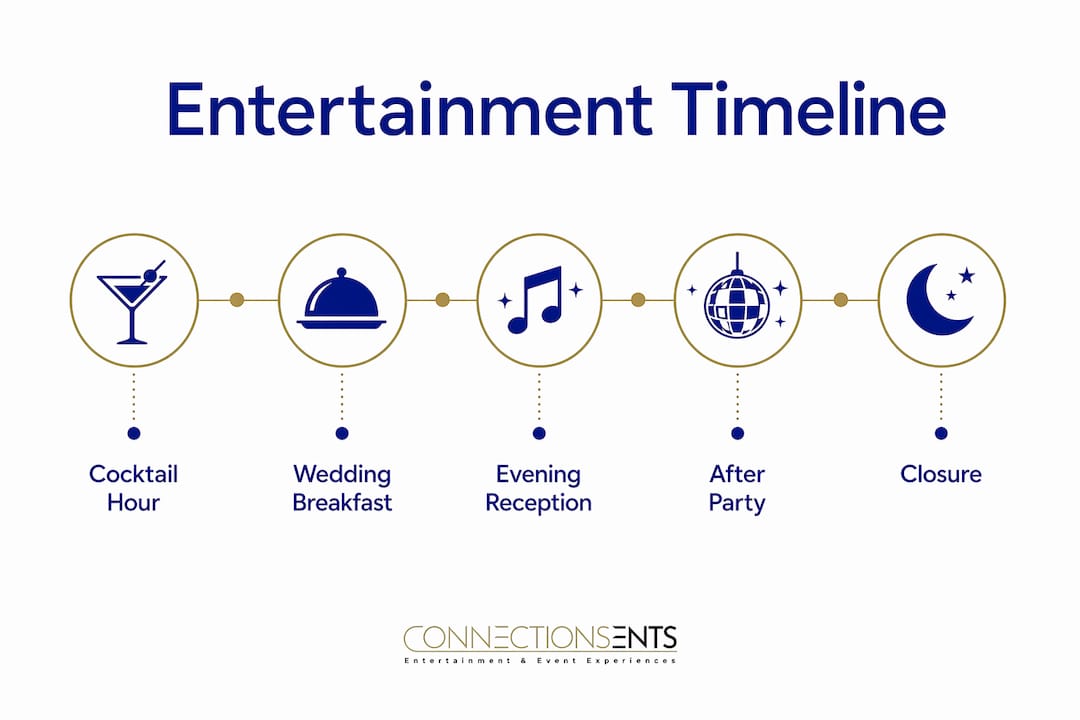
Your brief should map entertainment to at least three distinct phases: the cocktail hour, the wedding breakfast, and the post-dinner reception. Segmenting entertainment into phases prevents the dead air that dulls reception energy and keeps guests engaged throughout the full day. Include estimated start and end times for each phase, and note any fixed moments such as the first dance, speeches, or cake cutting that entertainment must work around.
Entertainment format preferences
Be specific about the formats you want. Do you prefer a DJ for the evening and a string quartet for the ceremony? Are you considering a photo booth, a caricature artist, or a live painter for the cocktail hour? List your preferences clearly, including any acts you have already provisioned or are considering. This allows your entertainment provider to spot conflicts, suggest complementary additions, and plan equipment accordingly.
Venue logistics and technical requirements
Include your venue’s capacity, layout, any noise restrictions, and available power supply. Outdoor weddings have different AV and power requirements compared to a traditional ballroom. Roaming musicians work well in garden settings; a full band with a PA system needs a stage and adequate power. Your brief should flag these constraints early so no one arrives on the day to discover the venue cannot accommodate their setup.
Defining roles clearly
Specify who is responsible for MC duties, guest transitions, and pacing. A DJ, for example, can serve as both performer and master of ceremonies. A live band typically focuses on performance. If you want a single point of contact managing the flow of the day, state that in the brief.
Pro Tip: Include a one-page summary at the front of your brief that lists your top three entertainment priorities. Vendors read dozens of briefs and a clear summary ensures your non-negotiables are never missed.
How do different wedding entertainment options compare?
Understanding the distinctions between entertainment types helps you allocate budget wisely and schedule each act where it will have the most impact.
| Entertainment type | Typical UK cost (2026) | Best suited to | Key role in the day |
|---|---|---|---|
| Professional DJ | £800 to £2,500 | Evening reception | Music, MC duties, pacing |
| Live band (4 to 6 piece) | £2,500 to £10,000+ | Evening reception or dinner | Atmosphere, energy, interaction |
| String quartet or acoustic duo | £400 to £1,200 | Ceremony or drinks reception | Ambience, background mood |
| Photo booth | £400 to £800 | Cocktail hour or evening | Guest interaction, keepsakes |
| Experiential acts (illustrators, caricaturists) | £300 to £1,500 | Cocktail hour or dinner | Engagement, conversation starter |
| Interactive games (lawn games, shoe game) | Under £500 | Outdoor or afternoon | Low-key guest participation |
The DJ as flow manager
A professional DJ does far more than play music. Experienced DJs coordinate with planners and adapt in real time to keep the reception moving naturally. They manage the pacing between speeches, the first dance, and the open floor. They read the room and adjust energy levels accordingly. For this reason, many couples find their DJ is the most operationally critical vendor at the reception, not just the most audible one. If you want to explore DJ services in detail, it is worth understanding exactly what coordination responsibilities you can delegate to them.
Live bands and atmosphere
Live bands create an energy that recorded music cannot replicate. The visual spectacle of performers on stage, the natural dynamics of live sound, and the ability to interact directly with guests all contribute to a heightened atmosphere. The trade-off is cost and logistics. A six-piece band needs a stage, sound check time, and break periods, all of which must be accounted for in your brief and timeline. The benefits of live entertainment are well documented, but they require more detailed logistical planning than a DJ setup.
Experiential and interactive acts
Interactive entertainment options such as caricature artists, photo booths, live painters, and the shoe game balance investment with genuine guest engagement. These acts work particularly well during the cocktail hour and wedding breakfast, when guests need something to do while the couple is occupied with photographs. They also generate shareable content and lasting keepsakes, which adds value beyond the day itself.
Pro Tip: Book experiential acts for the cocktail hour rather than the evening. Guests are more receptive to interaction before dinner, and it prevents the evening DJ set from being interrupted by competing activities.
Why does timeline management matter in your entertainment brief?
Poor timeline management is the single most common reason wedding entertainment fails to deliver. Without a detailed schedule in the brief, entertainers make independent decisions about pacing, and those decisions rarely align with each other or with the couple’s expectations.
Entertainment shapes the emotional arc of the entire wedding day. The transition from ceremony to drinks reception, from dinner to dancing, from the first dance to the open floor: each of these moments needs a deliberate entertainment cue. Without one, guests drift, energy drops, and the day loses momentum. A brief that maps these transitions explicitly gives every vendor a shared reference point.
Consider these common pitfalls that a detailed brief prevents:
- Dead air during room turnarounds. If the brief does not specify background music for the gap between dinner and the evening reception, guests stand in silence while staff reset the room.
- Overlapping acts. Without coordination notes, a roaming magician and a photo booth attendant may both compete for guest attention at the same moment, diluting the impact of both.
- Missed cues for key moments. The first dance, cake cutting, and bouquet toss all require the DJ or band to be ready on cue. A brief with precise timings removes any ambiguity.
- Overrunning speeches. When speeches run long, entertainment schedules compress. Your brief should include contingency notes so entertainers know which elements to shorten if time is lost.
All-in-one entertainment teams that combine hosting, performing, and coordinating roles reduce this complexity significantly, particularly for larger weddings. When a single team manages the full day, the brief becomes their internal operating document rather than a communication tool between separate vendors.
Your brief should also specify who has authority to make real-time adjustments. If the DJ can extend the first dance set by 15 minutes without checking with you, say so. If every change requires approval from your wedding planner, state that too. Clear decision-making authority prevents hesitation at critical moments.
How can you tailor your brief to reflect your style and guests?
The most effective entertainment briefs move beyond logistics and reflect the couple’s personality, cultural background, and the specific demographic of their guest list. Generic briefs produce generic results.
Incorporating personal and cultural elements
If your wedding has a cultural theme, your brief should specify this explicitly. A South Asian wedding may require Bhangra performers or a specific playlist of Bollywood classics. A Celtic wedding might call for a ceilidh band. Naming these requirements in the brief allows entertainers to prepare appropriately and prevents last-minute requests that cannot be fulfilled.
Accounting for guest age ranges
Venue logistics and guest demographics should directly influence your entertainment choices. A wedding with a significant proportion of older guests benefits from entertainment that does not rely on high volume or fast-paced interaction. Acoustic duos, caricaturists, and seated interactive games work well across age groups. A younger crowd may respond better to a high-energy DJ set, a photo booth with props, or a live band playing recognisable contemporary tracks.
Balancing traditional and experiential elements
2026 wedding entertainment trends strongly favour guest-led, experiential formats that encourage interaction and connection. Live illustrators who sketch guests during the drinks reception, roaming performers who weave through dinner tables, and fragrance stations where guests create personalised scents are all gaining traction. These formats work best when balanced with at least one traditional anchor, such as a DJ for the evening, that guests can rely on as a familiar touchstone.
Your brief should specify the balance you want. For example: “We want two experiential acts during the cocktail hour and a traditional DJ-led evening reception with MC duties.” That single sentence tells your entertainment provider everything they need to structure their proposal.
Adapting to venue type and season
An outdoor summer wedding in Norfolk opens up options like lawn games, roaming acoustic musicians, and open-air dance floors. A winter wedding in a historic hall calls for a different approach. Winter wedding entertainment planning requires attention to indoor acoustics, heating considerations for performers, and the natural intimacy that enclosed spaces create. Your brief should note the season, the venue type, and any environmental factors that will shape what is practical and what will feel right on the day.
Key takeaways
A well-crafted wedding entertainment brief is the single most effective tool for aligning your entertainment vision with the practical realities of your wedding day.
| Point | Details |
|---|---|
| Define atmosphere explicitly | Describe the emotional tone for each phase so entertainers have clear creative direction. |
| Map entertainment to phases | Assign specific acts to the cocktail hour, dinner, and evening to prevent dead air. |
| Clarify entertainer roles | State who manages MC duties, pacing, and guest transitions to avoid confusion on the day. |
| Match entertainment to your guests | Account for age range, cultural background, and venue type when selecting and briefing acts. |
| Budget by tier | List your budget range per act category so vendors can propose options that genuinely fit. |
Why I think most couples underestimate the brief
Most couples spend weeks choosing a DJ or live band and then send a two-paragraph email as their brief. That gap between the quality of the decision and the quality of the communication is where most wedding entertainment problems originate.
I have seen beautifully chosen acts deliver flat performances, not because they lacked talent, but because they had no clear picture of the day’s emotional arc, the guest demographic, or the venue’s constraints. A talented performer working from a vague brief will default to what has worked at previous weddings, which may be entirely wrong for yours.
The couples whose weddings I remember most fondly are the ones who treated their entertainment brief as a creative document, not an administrative chore. They wrote about the feeling they wanted guests to have when they walked into the drinks reception. They specified that their grandparents would be seated near the dance floor and that the volume needed to allow conversation. They noted that speeches were likely to overrun and asked the DJ to have a contingency plan ready.
The 2026 shift towards interactive, guest-led entertainment makes this even more pressing. When you are booking a live illustrator, a roaming band, and a DJ alongside each other, the brief is the only document that tells each of them where they fit in the day’s story. Without it, you have three separate performances. With it, you have one cohesive experience.
My honest advice: write your brief before you finalise your bookings. Use it as a filter. If a vendor cannot engage meaningfully with a detailed brief, that tells you something important about how they will perform on the day.
— Darren
How Connections Entertainment can help you plan
Connections Entertainment works with couples across Norfolk and East Anglia to build entertainment plans that are as detailed or as flexible as you need. Whether you are looking for a professional DJ to anchor your evening reception, a live performer to set the tone during the drinks hour, or a photo booth to keep guests entertained between courses, the team can help you structure a brief that covers every phase of your day. Connections Entertainment also works directly with venues to align technical requirements, timing, and logistics before the day arrives. If you are ready to explore the full range of options available, browse the entertainment services on the website or get in touch to discuss your plans with the team directly.
FAQ
What is a wedding entertainment brief?
A wedding entertainment brief is a planning document that outlines your entertainment objectives, preferred formats, timeline, and budget for all vendors involved in your wedding. It serves as the shared reference point that aligns your DJ, live performers, and any experiential acts with your vision for the day.
How early should you send your entertainment brief to vendors?
Send your brief at the point of booking, ideally three to six months before the wedding. This gives entertainers time to prepare, source specific equipment, and flag any logistical conflicts before they become problems on the day.
What entertainment options work best for the cocktail hour?
Experiential acts such as caricature artists, live illustrators, acoustic duos, and photo booths work particularly well during the cocktail hour. Guests are receptive to interaction at this stage, and these acts keep energy positive while the couple is occupied with photographs.
How do you choose wedding entertainment for a mixed-age guest list?
Select at least one entertainment format that works across age groups, such as an acoustic performer or a caricaturist, and pair it with higher-energy options for younger guests in the evening. Your brief should specify the age range of your guests so entertainers can adapt their set and approach accordingly.
Does a DJ or a live band work better for a wedding reception?
A DJ offers greater flexibility, MC capabilities, and lower cost, typically between £800 and £2,500 in the UK. A live band creates a stronger visual atmosphere and higher energy but requires more logistical planning and a larger budget. Many couples use both, with a live band for the wedding breakfast and a DJ for the evening reception.