
Private party venue selection tips: your full guide
Discover essential private party venue selection tips to choose the perfect space for your event. Avoid costly mistakes and plan with confidence!
TL;DR:
- Choosing the right venue is the most crucial step in private party planning, as it impacts attendance, atmosphere, and overall success.
- It is essential to evaluate capacity, location, facilities, and hidden costs carefully before making a decision to avoid costly mistakes.
Choosing the right venue is the single most important decision in planning a private party. Get it wrong and no amount of great food or entertainment will save the evening. Get it right and everything else falls into place. These private party venue selection tips cover the full picture: capacity planning, location, facilities, hidden costs, and a practical method for comparing your shortlist. Whether you are planning an intimate dinner or a large celebration, the guidance here applies directly to your event.
1. How to use private party venue selection tips from the start
The venue selection process in event planning is formally known as site selection. It is the structured evaluation of spaces against a defined set of criteria before any booking is made. Most people skip the structure and rely on gut feeling. That approach leads to expensive mistakes. The most effective way to choose a venue is to define your non-negotiables first, then measure every space against them.
Your non-negotiables should cover four areas: guest capacity, location, facilities, and total cost. Atmosphere matters too. Matching the venue’s feeling to your event’s goals is critical before you even look at price. A sleek, minimalist space suits a milestone birthday for adults. A garden venue with outdoor space suits a summer family gathering. Getting that match right early saves you from falling in love with a venue that simply does not fit your event type.
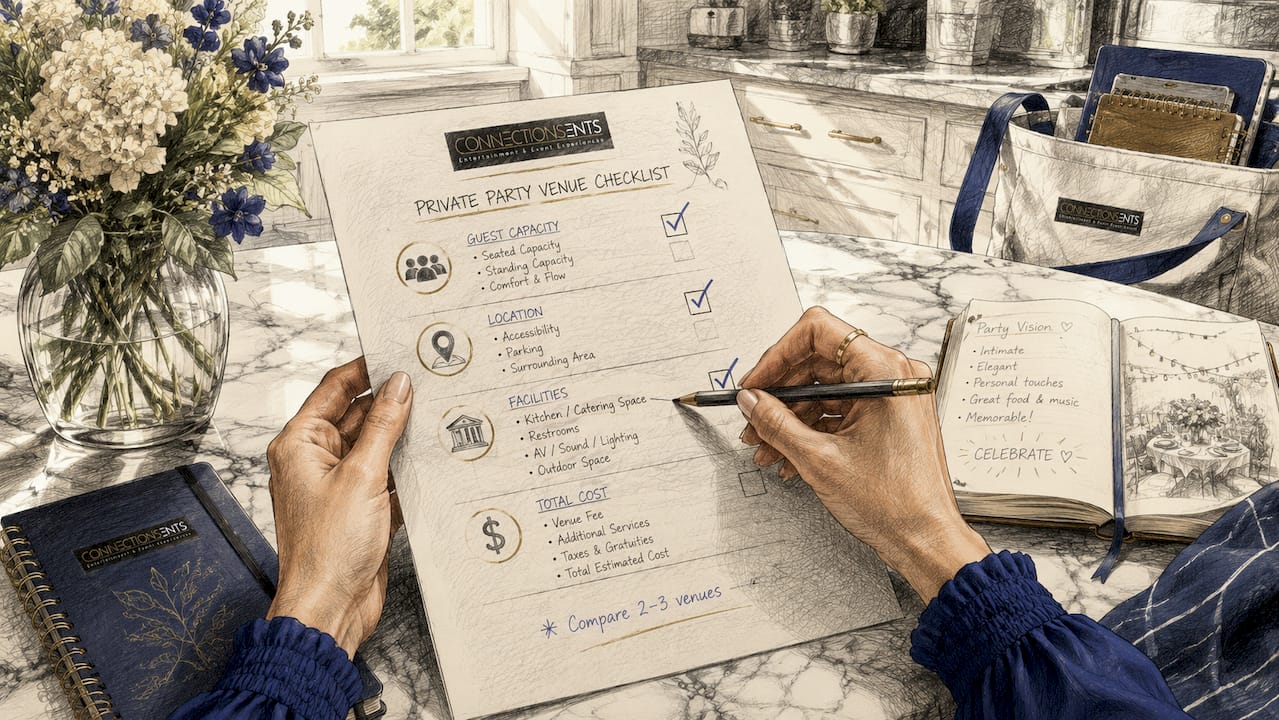
Preparing a private party venue brief before you contact any venue is one of the most practical steps you can take. It forces you to commit your requirements to paper, which makes every subsequent conversation with venue managers far more productive.
2. Aligning venue size and capacity with your guest list
Venue capacity is the most misunderstood number in private event planning. The rule used by professional planners is straightforward: plan for 100% of invitees in your venue size, but budget catering for approximately 75% attendance. That balance keeps the room from feeling cramped while preventing food waste and unnecessary spend.
The layout of your event changes the effective capacity of any room. A buffet setup, a dance floor, a kids’ activity area, and a photo booth all consume floor space. A venue that holds 120 people for a seated dinner may comfortably hold only 80 once you account for a dance floor and a DJ setup. Always ask the venue for a scaled floor plan and map your specific layout onto it before committing.
- Seated dinner: Allow approximately 1.5–2 square metres per guest.
- Buffet with standing areas: Reduce seated allowance and add service table space.
- Dance floor: Reserve a dedicated zone away from dining tables.
- Children’s area: Separate from the main flow to reduce noise and safety risks.
- Entertainment setup: Factor in DJ booth, stage, or photo booth footprint.
Pro Tip: Walk the venue in your mind as a guest. Trace the route from the entrance to the bar, to the dance floor, and to the toilets. Any bottleneck you spot during that mental walkthrough will become a real problem on the night.
One logistical detail that planners consistently overlook is restroom provision. Events over 75 guests need a minimum of 4–6 toilet stalls to avoid disruptive queuing. Count the stalls yourself during your venue visit. Do not rely on the venue’s stated capacity figure to imply adequate facilities.
3. Why location and accessibility beat aesthetics every time
A beautiful venue that is inconvenient to reach will have poor attendance. Venues within 15 minutes of the majority of guests produce significantly better turnout than venues 45 minutes away, regardless of how impressive the space looks. Convenience is the deciding factor for most guests when choosing whether to attend.
When evaluating location, go beyond the postcode. Think through every mode of transport your guests are likely to use.
- Parking: Is there free on-site parking? How many spaces? Is there overflow parking nearby?
- Public transport: Is the venue within walking distance of a train station or bus stop?
- Ridesharing: Is the address easy to find for drivers using apps like Uber or a local taxi firm?
- Accessibility: Does the venue have step-free access, accessible toilets, and adequate lighting for guests with mobility challenges?
The accessibility point deserves particular attention. If any of your guests use a wheelchair, a walking aid, or have a visual impairment, a venue with steps, narrow doorways, or poor lighting is not a viable option. Confirm accessibility features in writing with the venue before you visit.
The trade-off between a premium venue far from your guests and a more modest venue close by almost always favours proximity. Your guests’ comfort and willingness to travel directly affects the atmosphere of the event. A closer venue with a full room creates far more energy than a stunning space with half the expected attendance.
4. Essential facilities to inspect before you book
Facilities are where many private party venues fall short of their marketing photographs. The checklist below covers the areas that most directly affect your guests’ experience.
- Kitchen and catering prep space: Is there a full kitchen for external caterers, or only a basic prep area? Confirm what equipment is available.
- Sound system: Does the venue have an installed PA system, or do you need to hire one? Check speaker placement and whether the system covers the whole room evenly.
- Lighting: Is there adjustable lighting for different moments in the evening? Harsh overhead lighting kills atmosphere. Dimmable or coloured lighting makes a significant difference.
- Staff availability: How many venue staff are on duty during your event? Who is the point of contact if something goes wrong?
- Catering policy: Does the venue require you to use their in-house catering, or can you bring an external caterer? In-house catering often comes with a minimum spend requirement.
The role of a venue coordinator is one of the most misunderstood aspects of venue hire. The title sounds reassuring, but the coordinator’s duties vary enormously. Some coordinators manage the full event from setup to close. Others simply hand over the keys and leave. Get a written description of exactly what the coordinator will do on the day before you factor their support into your planning.
Pro Tip: Ask the venue to show you the toilets, the kitchen, and the car park during your visit. These three areas reveal more about the practical quality of a venue than the main event space does.
Check the venue’s noise restrictions and curfew. Many venues in residential areas have strict rules on amplified music after a certain hour. If you are planning a DJ or live band, confirm the permitted decibel level and finish time in writing. A curfew of 10:30 pm can fundamentally change the shape of your evening.
5. How to compare and shortlist venues without decision fatigue
Comparing venues without a structure leads to confusion. After two or three visits, the details blur together and you end up choosing based on whichever venue you saw most recently. A four-layer comparison approach cuts through that problem. The four layers are: fit (does it meet your basic requirements?), package value (what is included in the hire fee?), rules and logistics (what are the restrictions?), and total cost (what is the all-in figure?).
Build a simple spreadsheet with those four categories as columns and each venue as a row. Score each venue against your non-negotiables. Limit your shortlist to three venues. Research consistently shows that reducing options to three is the point at which decision-making becomes manageable without sacrificing choice.
When you request quotes, ask for written estimates that include every possible fee. Venues frequently quote a headline hire rate that excludes service charges, setup fees, security deposits, and corkage. Tour venues with a prepared list of questions covering rental costs, noise rules, catering policies, and cancellation terms before you walk through the door. That preparation stops you wasting time on venues that fail on a basic criterion.
Once you have your written quotes, visualise the guest journey through each venue. Start from the car park or nearest transport stop. Walk through the entrance, past the bar, to the main event space, and then to the toilets. That mental walkthrough consistently reveals practical problems that photographs and floor plans do not show.
Ask each shortlisted venue for references from events of a similar size and type to yours. A venue that has successfully hosted a 90-person birthday party is a very different proposition from one that primarily hosts corporate conferences. Speaking to a previous client takes ten minutes and can save you from a costly mistake.
6. Understanding hidden costs in venue hire
Hidden costs are the most common reason private party budgets collapse. Food and beverage minimums can triple the effective cost of a venue beyond the stated hire fee. A venue that charges £500 to hire may require a minimum spend of £3,000 on food and drink. That figure only appears in the contract, not in the initial quote.
Always ask these questions before you sign anything:
- Is there a food and beverage minimum spend? What happens if you do not reach it?
- Are there additional charges for setup, breakdown, or cleaning?
- What is the security deposit, and under what conditions is it withheld?
- What is the cancellation policy, and at what point do you lose your deposit?
- Are there corkage fees if you bring your own wine or spirits?
Understanding the full venue hire agreement before you sign protects you from surprises. Read every clause, particularly those covering cancellation, damage liability, and noise restrictions. If the venue cannot provide a clear written answer to any of the questions above, treat that as a warning sign.
Some venues operate as dry hire spaces, meaning you rent the room with no services included. Dry hire gives you maximum flexibility over catering, entertainment, and décor, but it also means you are responsible for sourcing and coordinating every supplier yourself. That model suits experienced planners but can overwhelm first-time hosts.
7. Matching venue atmosphere to your event type
Atmosphere is not decoration. It is the combined effect of lighting, acoustics, ceiling height, natural light, and the physical character of the space. A venue that feels right for a cocktail party will feel wrong for a children’s birthday. Getting this match right before you focus on price saves significant time and prevents disappointment.
Visit each venue at the time of day your event will run. Venues look entirely different at night. A daytime tour in bright natural light hides lighting flaws, awkward shadows, and acoustic problems that only appear in the evening. If an evening visit is not possible, ask the venue for photographs taken during an evening event of a similar size to yours.
Consider the acoustic character of the space. High ceilings and hard floors create echo, which makes conversation difficult and amplified music sound muddy. Carpeted rooms or spaces with soft furnishings absorb sound and make the environment more comfortable for guests. If live music or a DJ is part of your plans, the acoustic profile of the venue matters as much as the PA system.
The entertainment options you choose should complement the venue’s character, not fight against it. A tribute act needs a stage or a clear performance area. A photo booth needs a dedicated corner with good lighting and enough space for a group of six to stand comfortably. Plan your entertainment layout alongside your venue assessment, not after you have already booked.
Key takeaways
The most effective approach to choosing a private party venue is to match capacity, location, facilities, and total cost against a written list of non-negotiables before visiting any space.
| Point | Details |
|---|---|
| Capacity planning | Book venue size for 100% of invitees but budget catering for 75% expected attendance. |
| Location over aesthetics | Venues within 15 minutes of most guests produce better turnout than distant premium spaces. |
| Facilities checklist | Confirm sound, lighting, toilets, catering policy, and coordinator duties in writing before booking. |
| Hidden costs | Always clarify food and beverage minimums and all additional fees before signing any contract. |
| Structured comparison | Use a four-layer spreadsheet and limit your shortlist to three venues to reduce decision fatigue. |
Darren’s take: what most people get wrong when choosing a venue
The single biggest mistake I see is people booking a venue because it looks beautiful in photographs. They fall for the aesthetic and skip the practical questions. Then the night arrives and there are not enough toilets, the sound system is inadequate, and the coordinator turns out to be a part-time member of staff who leaves at 9 pm.
The second mistake is ignoring the contract until it is too late. Food and beverage minimums are the real budget conversation, not the hire fee. I have seen clients budget carefully for a £600 room hire and then discover a £2,500 minimum spend buried in the contract. That is not a minor detail. That is the difference between a party that works financially and one that does not.
My strongest advice is to visit every shortlisted venue in the evening, ideally during an event. You will see the lighting, hear the acoustics, and understand the flow of the space in a way that no daytime tour can replicate. If the venue will not accommodate an evening visit, ask for evening event photographs as a minimum. A venue that resists that request is telling you something.
Finally, ask the coordinator to describe their role in writing. The responsibilities of venue coordinators vary so widely that the title is almost meaningless without clarification. Some are genuinely invaluable. Others are facility managers who will not lift a finger beyond unlocking the door. Know which one you are getting before you rely on them.
— Darren
Planning your private party entertainment alongside your venue
Once your venue is confirmed, entertainment is the next decision that shapes the entire event. Connections Entertainment works with private party hosts across Norfolk and East Anglia to match the right entertainment to the right space. From DJs and live music to photo booths and tribute acts, the team at Connections Entertainment understands how venue acoustics, layout, and atmosphere affect entertainment choices. Browsing the full range of private party entertainment options gives you a clear picture of what is possible within your venue’s specific setup. Whether you need a DJ who can read a room or a photo booth that fits a compact corner, Connections Entertainment can advise on the best fit for your event.
FAQ
How far in advance should I book a private party venue?
Book popular venues at least six months in advance for weekend dates, and twelve months ahead for peak periods such as december and the summer school holidays. Last-minute availability exists but limits your choice significantly.
What is a food and beverage minimum in venue hire?
A food and beverage minimum is a contractual requirement to spend a set amount on catering and drinks through the venue. Hidden costs like this can triple the effective cost of a venue beyond the headline hire fee.
How many toilets does a private party venue need?
A minimum of 4–6 toilet stalls is recommended for events with more than 75 guests. Fewer stalls create queuing that disrupts the flow of the evening.
What does a venue coordinator actually do?
The role varies significantly between venues. Some coordinators manage the full event; others only provide access to the space. Always request a written description of their duties before relying on their support.
Should I choose a dry hire venue for a private party?
A dry hire venue gives you full flexibility over catering, entertainment, and décor, but requires you to source and manage every supplier independently. It suits planners with experience and a clear supplier network, but adds significant coordination work for first-time hosts.