
How to choose a DJ for house parties: your guide
Learn how to choose a DJ for house parties. Discover key qualities that ensure an unforgettable experience for your guests!
TL;DR:
- Choosing the right DJ impacts the energy and success of your house party significantly.
- A professional DJ with private event experience, clear communication, and equipment readiness ensures a memorable night.
Choosing the right DJ is the single most important decision you will make for your house party. The DJ shapes the energy in the room, keeps guests on the dance floor, and manages the flow of the evening from start to finish. This is not simply about picking someone with a good music taste. Professional DJ selection, the recognised industry term for this process, involves assessing crowd reading ability, timeline management, equipment knowledge, and communication skills. Get it right and your party becomes the one guests talk about for months.
How to choose a DJ for house parties: key qualities to look for
The most common mistake hosts make is treating all DJs as interchangeable. Private event DJs specialise in timeline management, balancing energy transitions smoothly across conversation, dancing, and formalities. That is a fundamentally different skill set from a nightclub DJ who plays to a fixed crowd in a fixed venue all night.
When selecting a DJ for a house party, you need someone who can read the room and respond to it. A DJ who asks you detailed questions about your guests, your venue layout, and your preferred music style is demonstrating exactly the kind of preparation that separates professionals from hobbyists. Hosts frequently mistake nightclub DJ skillsets for private event expertise, which leads to mismatches in pacing and crowd engagement. That mismatch kills the atmosphere.
The qualities that matter most when hiring a DJ for a house party are:
- Experience with private events. Ask specifically whether they have worked house parties, birthday celebrations, or similar informal gatherings. Nightclub experience alone is not sufficient.
- Timeline management. A good DJ knows when to build energy, when to dial it back, and when to let guests chat. This skill keeps the evening feeling natural rather than forced.
- Prompt, clear communication. A DJ’s communication style during vetting is a strong predictor of their reliability on the night. Slow replies and vague answers before booking are red flags.
- Adaptability. The best DJs adjust music style and volume in real time based on guest energy, venue acoustics, and the timing of food and drink service.
- Professionalism. This shows up in how they present themselves, how they handle your questions, and whether they arrive prepared.
Pro Tip: Ask any DJ you are considering: “How do you handle a moment when the dance floor empties?” Their answer tells you immediately whether they understand crowd dynamics or simply press play.
A DJ who can articulate a clear strategy for managing energy shifts is worth far more than one who simply lists their music genres. The ability to read the room and adjust dynamically is what separates a memorable party from a forgettable one.
How do you evaluate a DJ’s music style for your party?
Matching a DJ’s musical repertoire to your party’s atmosphere is not about finding someone who likes the same songs as you. It is about finding someone who can build and sustain the right mood for your specific group of guests.
Start by defining your party’s vibe. A relaxed gathering of friends in their thirties calls for a very different approach than a high-energy birthday celebration for a mixed-age group. Once you know what you want, you can assess whether a DJ’s background fits.
Here is a practical process for evaluating musical fit:
- Ask for sample mixes or recordings. DJs should provide sample mix recordings or videos demonstrating their style. Listen for smooth transitions, genre variety, and whether the energy arc feels natural rather than jarring.
- Discuss genre flexibility. Ask whether they can blend genres across an evening. A DJ who only plays one style will struggle when your guests have varied tastes.
- Clarify their approach to requests. Professional DJs filter song requests to maintain flow and vibe rather than playing every request uncritically. This is a sign of skill, not stubbornness. Ask how they handle requests that do not fit the mood.
- Ask about do-not-play lists. A DJ who welcomes a do-not-play list is one who respects your preferences. This is standard practice among experienced professionals.
- Discuss the playlist structure. Find out whether they plan a rough arc for the evening or respond entirely in the moment. The best approach combines both: a loose structure with room to adapt.
The DJ’s willingness to have a detailed conversation about music before the event is itself a quality indicator. A professional who asks about your guests’ age range, the party’s purpose, and your musical preferences is already doing their job well. You can find further guidance on what to expect from a professional booking through Connections Entertainment’s DJ selection guide.
Understanding how DJs manage energy transitions across a private event also helps you ask better questions during the vetting process.
What equipment and logistics matter when hiring a house party DJ?
Equipment is where many house party bookings go wrong. Hosts assume the DJ will handle everything, then discover on the night that the sound system is too small for the room, or that there is no backup plan for a technical failure.
Minimum equipment for a private party includes speakers appropriate to the venue size, a mixer or controller, microphones, and backup gear. A DJ who cannot confirm they carry backup equipment is not prepared for professional work.
| Equipment item | What to confirm with your DJ |
|---|---|
| Speakers | Sized correctly for your room’s square footage |
| Mixer or controller | Owned by the DJ, not borrowed |
| Microphone | Available if you need announcements or toasts |
| Backup gear | Spare cables, a backup controller, or a second speaker |
| Lighting | Whether it is included or an additional cost |
Space and power requirements also need clarifying before the event. Ask your DJ how much floor space they need for setup and how many power sockets they require. A DJ familiar with your specific venue can optimise sound quality and setup, knowing space and power constraints in advance. If they have not visited your venue, share photos and measurements.
Pro Tip: Confirm in writing exactly what the DJ will bring and what you are expected to provide. A simple checklist exchanged by email prevents misunderstandings on the day.
Also clarify the setup and breakdown schedule. A professional DJ needs time to set up before guests arrive and should not be packing down while people are still on the dance floor. Agree on arrival time, setup duration, and finish time before you sign anything.
Steps to vet and book your ideal house party DJ
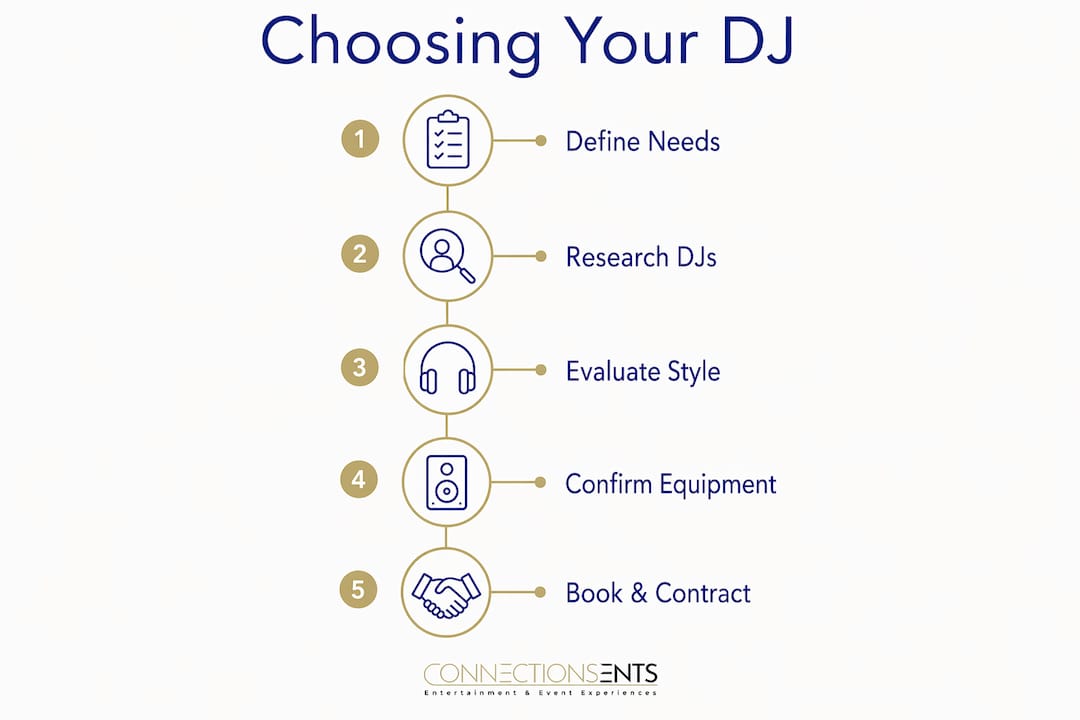
A structured approach to booking saves you time and protects you from poor choices. Follow these steps from initial research through to signing a contract.
- Gather recommendations. Ask friends who have hosted similar events, or check reputable entertainment agencies such as Connections Entertainment. Personal recommendations carry more weight than online reviews alone.
- Shortlist DJs with relevant experience. Focus on those who have worked private parties or informal gatherings, not just clubs or large-scale events. Review their sample mixes and any testimonials from similar events.
- Prepare your questions. Before any conversation, write down your key questions covering music style, logistics, equipment, backup plans, and pricing. This keeps the conversation focused and helps you compare DJs fairly.
- Assess communication responsiveness. Picking a DJ who communicates clearly and promptly during the booking phase reduces the likelihood of last-minute issues. If they take days to reply to a simple enquiry, that pattern will continue.
- Discuss the event in detail. Share your guest profile, venue layout, preferred music style, and any specific requirements such as a do-not-play list or a particular song for a key moment.
- Request a written contract. Written contracts protect hosts by clearly defining the event date, times, cost, services, and cancellation policies. Never book a DJ without one. A contract is not a sign of distrust. It is a sign that both parties are professional.
You can also explore what a party DJ package typically includes before you start comparing quotes, so you know what represents fair value.
Common pitfalls in DJ selection and how to avoid them
Even well-prepared hosts fall into predictable traps when booking a DJ. Knowing what to watch for saves you from a disappointing evening.
- Choosing based on price alone. The cheapest DJ is rarely the right DJ. Low pricing often reflects limited equipment, minimal experience with private events, or a lack of professional insurance.
- Ignoring event type fit. A DJ who specialises in club nights or large festivals will not naturally adapt to a relaxed house party setting. Always ask for evidence of experience with similar events.
- Skipping the contract. Verbal agreements leave you with no recourse if the DJ cancels, arrives late, or delivers less than promised. A written contract is non-negotiable.
- Overlooking personality fit. A DJ’s personality affects the atmosphere as much as their music. Someone who is cold, dismissive, or difficult to communicate with before the event will bring that energy into your home.
- Failing to discuss contingency plans. Ask every DJ what happens if their equipment fails or they are taken ill. A professional has a clear answer. An unprepared one does not.
- Leaving booking too late. Good DJs book up quickly, particularly for weekend dates in spring and summer. Aim to confirm your booking at least six to eight weeks in advance for a typical house party.
The party entertainment options available through reputable agencies give you a vetted starting point, which removes much of the guesswork from the shortlisting process.
Key takeaways
Choosing the right DJ for a house party requires assessing private event experience, communication quality, equipment readiness, and musical versatility before signing any contract.
| Point | Details |
|---|---|
| Private event experience matters | Choose a DJ with proven experience at informal gatherings, not just clubs or large venues. |
| Communication predicts reliability | A DJ who responds promptly and clearly before booking is far more likely to deliver on the night. |
| Equipment must fit the venue | Confirm speaker sizing, backup gear, and power requirements in writing before the event. |
| Music versatility over genre loyalty | The best DJs blend genres, manage requests, and adapt to guest energy throughout the evening. |
| Always use a written contract | A contract covering date, time, cost, services, and cancellation terms protects both you and the DJ. |
What I have learned about booking house party DJs
Darren’s perspective
After years of working in event entertainment, the thing that surprises hosts most is how much a DJ’s personality shapes the room. People focus on music genres and equipment specs, which matter, but the DJ’s ability to read a group of people and respond to them in real time is what actually determines whether the night feels alive or flat.
The clearest lesson I have taken from experience is this: the vetting conversation tells you almost everything. A DJ who asks thoughtful questions about your guests, your space, and the kind of evening you want is already demonstrating the skills they will use on the night. A DJ who gives you a price and a playlist without asking a single question is showing you exactly how they will approach your event.
I have also seen hosts underestimate how much early communication matters. Agreeing on the timeline, the setup schedule, and the do-not-play list weeks before the event removes stress for everyone. Last-minute arrangements create last-minute problems. The hosts who have the best experiences are almost always the ones who treated the booking process as a collaboration rather than a transaction.
Trust professionals who invest in preparation. They are not just selling you music. They are taking responsibility for the atmosphere in your home for an entire evening. That deserves proper vetting, a proper contract, and proper respect for the process.
— Darren
Professional DJ entertainment for your house party
Connections Entertainment offers a range of professional DJs suited to house parties and private gatherings across Norfolk, East Anglia, and beyond. Whether you want a DJ who specialises in a particular era, a broad crowd-pleasing set, or a fully coordinated entertainment package with lighting and AV support, the team can match you with the right professional for your event. Every DJ on the roster brings verified private event experience, their own professional equipment, and a commitment to clear communication from first enquiry through to the final song. Browse the full range of available entertainers or get in touch to discuss your specific requirements.
FAQ
What is the difference between a private party DJ and a club DJ?
Private party DJs specialise in timeline management and crowd reading across a varied evening, while club DJs typically play to a fixed audience in a controlled venue. The two skill sets differ significantly, and choosing the wrong type leads to poor pacing and low engagement at house parties.
What questions should I ask a DJ before booking?
Ask about their experience with private events, how they handle song requests, what equipment they bring, whether they carry backup gear, and what their cancellation policy is. A professional DJ will answer all of these confidently and in detail.
Do I need a written contract for a house party DJ?
A written contract is non-negotiable. Contracts protect hosts by confirming the event date, times, cost, services provided, and cancellation terms, removing any ambiguity on both sides.
How far in advance should I book a DJ for a house party?
Booking at least six to eight weeks in advance is advisable for weekend dates, particularly during spring and summer when demand is highest. Popular DJs with strong reputations fill their calendars quickly.
How do I know if a DJ’s music style suits my party?
Ask for sample mix recordings or videos from previous private events. Sample work helps evaluate a DJ’s ability to blend genres, manage transitions, and sustain the right energy for your specific crowd.